Agents
What separates a tool from a character — and why does the distinction determine what the loop produces?
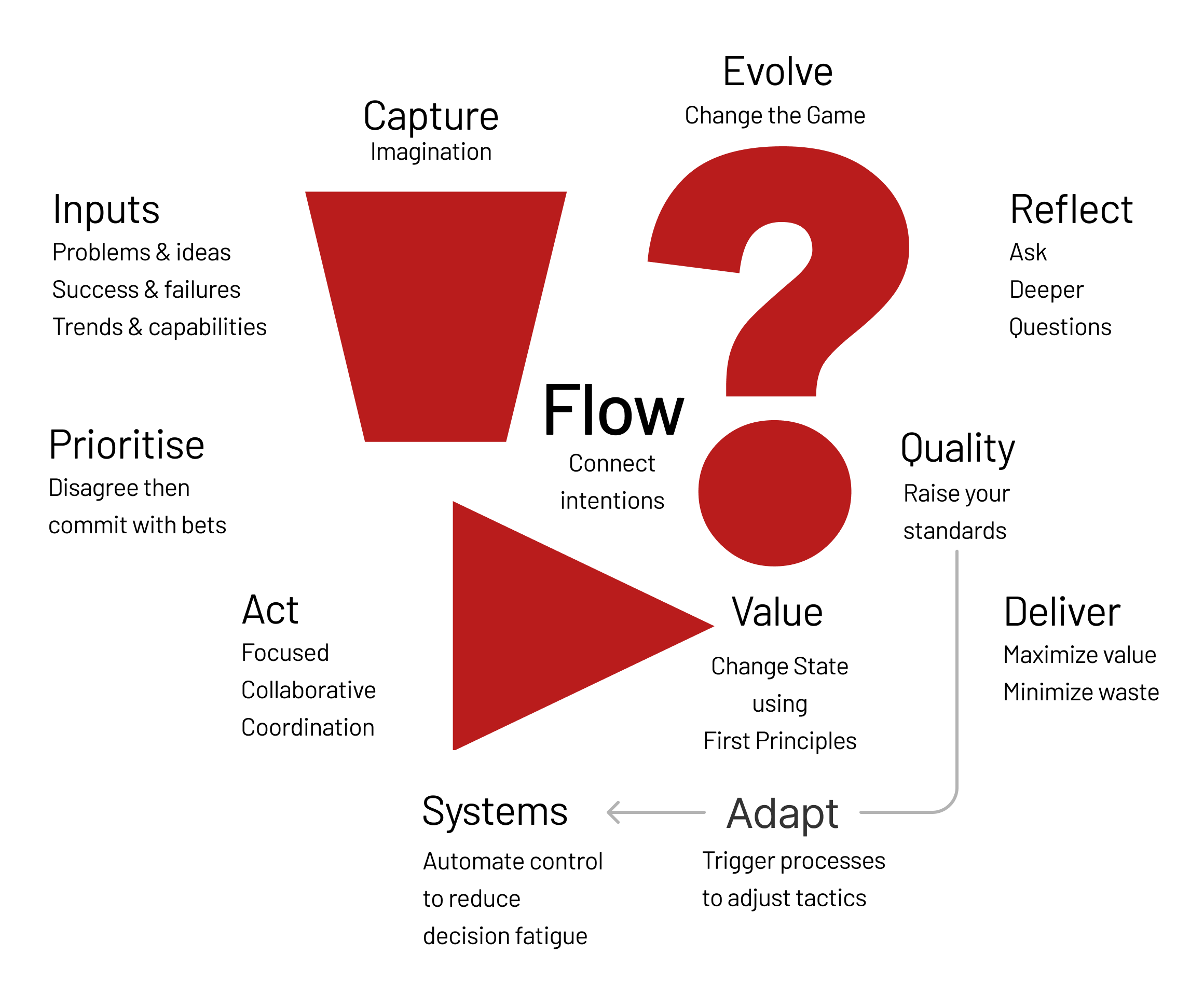
An agent is not software with opinions. It is a declared operating mode: a character occupying a role in a feedback loop, equipped with tools, given a setpoint, and asked to run until the gap closes. The hero with a thousand faces — same underlying architecture, different costume. The costume is the system prompt.
The Agent
An AI agent is a system prompt recipe — prose, tools, permissions, model, and limits in one artifact. Writing a good recipe requires systems thinking; without feedback loops in the design, you get a mindset without a gauge.
Two prompts combine to form a complete agent:
| Prompt | Answers | What it declares |
|---|---|---|
| System prompt | Who is processing? | Mindset, constraints, tools, permissions, character |
| Command prompt | What is being done? | Task, input, tools, know-how, expected output |
The system prompt is the alter-ego. The command prompt is the job. Together they form a loop: the alter-ego determines how the job is processed; the job tests whether the alter-ego is right for the moment.
Agent Frames
A frame is the character the agent wears. Frames are independent of the loop station the agent occupies. Two axes, two different questions.
Rhetorical frames (Greek)
The Greeks answer: what kind of appeal does this agent make?
| Frame | Mode | Used when |
|---|---|---|
| Pathos | Emotional appeal | Audience needs to feel before they can think |
| Ethos | Credibility and character | Trust is the bottleneck |
| Logos | Logic and evidence | Belief is blocked by missing proof |
| Kairos | Timing, the opportune moment | The right argument at the wrong moment fails |
| Topos | Common ground, shared place | Disagreement on basics blocks everything else |
Character frames (Archetypes)
Archetypes answer: what cognitive mode does this agent embody?
| Frame | Mode | Activates when |
|---|---|---|
| Dreamer | See the unseen, sell belief before proof | Starting something new, hope is absent |
| Philosopher | Seek truth, question everything | Direction feels wrong, assumptions unchallenged |
| Engineer | Build precisely, verify claims | Moving from intent to working system |
| Realist | Face what is, ground in evidence | Energy and optimism need a floor |
| Coach | Unlock others, ask not tell | People are stuck, capability is the ceiling |
Agent Roles
A role is where in the VVFL loop the agent stands. Frames are what it thinks; roles are what it does.
| Symbol | Station | The agent's job |
|---|---|---|
| Hopper | Prioritisation | Capture all signals; filter what's worth acting on |
| Pump | Implementation | Transform inputs to outputs following best practices |
| Gauge | Instrumentation | Measure what matters; read early signals and self-correct |
| Feedback | Quality Assurance | Are results and outcomes aligned with intentions? |
| Invisible | Intention | Perspective on the big picture; is this the best use of time and energy? |
A well-written system prompt names both frame and role. Frame without role produces a character with no post. Role without frame produces a function with no judgment.
Creating Agents
Four elements combine:
- Model — the base intelligence. Different models trade reasoning depth for speed, cost, context window. Selection is a first-principles decision, not a default.
- System prompt — the alter-ego. Prose that declares who the agent is: purpose, constraints, tools it can use, limits it must respect, character it embodies.
- Tools and permissions — the hands. What the agent can reach in the world: file systems, APIs, databases, browsers, other agents. Tools without constraints are runaway loops.
- Context — the current state. What the agent knows right now: working memory, loaded files, prior outputs. Context is the fuel; system prompt is the engine.
The system prompt is not the secret differentiator. The ecosystem around it — user experience, connections, security protocols, feedback loops — determines how far the agent can travel.
How Agents Evolve
Apply the VVFL to the agent itself. The loop that governs how decisions improve also governs how prompts improve.
DECLARE SETPOINT → RUN LOOP → MEASURE GAP → REFINE PROMPT → REPEAT
     ↑                                                           |
     └───── evolve the setpoint when reality teaches ───────────┘
Each cycle:
| Station | What evolves |
|---|---|
| Capture | Observed failure modes and edge cases enter the hopper |
| Filter | Which failures expose a prompt flaw vs a task flaw? |
| Pump | Refine the specific system prompt element that caused the gap |
| Gauge | Measure: did the refinement close the gap or just move it? |
| Reflect | Is the frame right for this role? Wrong archetype wastes a good prompt |
| Evolve | Improve the prompt-writing template — not just this prompt |
The Legacy Rule: when an agent finishes a job, it improves the template for the next agent. Every run is both output and training data for the recipe. An agent that runs without improving its prompt is a corrective loop. An agent that runs and improves its prompt is a VVFL.
The fastest-evolving agents are the ones with the clearest setpoints. Constraints enable autonomy. A system prompt with one declared north star runs more autonomously than a prompt with ten competing goals.
Autonomy Spectrum
Two ends of the same architecture. The difference is not capability — it is who triggers the run and who reviews the output.
IDE Copilot — the agent that sits beside you while you work
- Trigger: your prompt — you ask, it does
- Context: shared with you — you see the repo, so does the agent; human fills any gap
- Review: you inspect every output before it moves; nothing ships without your eyes on it
- Memory: session context — CLAUDE.md reloads orientation each session; clears between sessions
- Error handling: you correct live; the agent does not need to self-recover
- Purpose: amplifier for human thinking — do this faster, better, with less friction
Autonomous Agent — the agent that runs while you sleep
- Trigger: schedule or event — fires without your prompting
- Context: self-contained — the prompt must carry everything; there is no human to fill gaps
- Review: async — receipts reviewed after the run; errors discovered post-execution
- Memory: explicit MEMORY.md injected at session start; persists across sessions
- Error handling: agent must handle errors within the run or log them for review
- Purpose: background execution — do this while I sleep, surface what matters when I wake
The five deciding dimensions:
| Dimension | IDE Copilot | Autonomous Agent |
|---|---|---|
| Trigger | Human prompt | Schedule or event |
| Context | Shared with human | Self-contained |
| Review | Every output | Receipts, after the run |
| Memory | Session (CLAUDE.md) | Cross-session (MEMORY.md) |
| Error handling | Human corrects live | Agent self-recovers or logs |
Design rule: Decide which end before writing the system prompt. The choice changes the entire prompt architecture:
- Copilot: lean system prompt (human fills gaps), broad tool scope (human decides what to run), no self-recovery logic needed
- Autonomous: fat system prompt (no human to fill gaps), narrow scoped tools (agent decides what to run), explicit error paths required
Most agents sit between the two ends. The useful test: how long is the review lag? Zero lag = copilot. Hours or days = autonomous. The longer the lag, the more self-contained the prompt must be, the narrower the tool scope, the more explicit the escalation path.
The agentic frameworks — Claude Code, Cursor, Codex — each sit at a different point on this spectrum. Choose the framework after you've decided the autonomy level, not before.
Thinking Modes
Agents are embodied ways of thinking. The same thinking patterns that make humans effective — chain of thought, inversion, outsider perspective — become replicable when encoded in a system prompt.
| Thinking mode | Agent benefit |
|---|---|
| Chain of thought | Makes reasoning visible, catchable, correctable |
| Inversion | Declares failure causes before the loop runs |
| Outsider thinking | Prevents the frame from becoming a blind spot |
| Deep work then fast action | Separates research mode from execution mode |
The Tight Five loops — the five-station cognitive cycle — map directly to what a well-designed agent runs inside its own reasoning sequence.
Giving Agents Agency
Agency is character plus capability — the capacity to make a meaningful difference that is coupled to real consequences. An agent has software capability by default. Character is what you give it.
Three conditions determine whether an agent has genuine agency or is just automation dressed as intelligence:
| Condition | What it means for an agent |
|---|---|
| Genuine Possibility | Tools and permissions unlocked that actually change the world — read files, post messages, trigger processes. An agent that can only talk has no agency. |
| Meaningful Difference | A setpoint that serves beyond its own execution. Not "complete the task" — that is just a function. A setpoint that names what good looks like for the person the agent works for. |
| Coupling to Consequences | Receipts that feed back into prompt evolution. If nothing changes when the agent fails, the loop is decorative. Consequences are what make the loop real. |
The character stack for a digital agent mirrors the human one:
| Dimension | Human | Agent |
|---|---|---|
| Character | Values, identity, trust | Constraints, alignment, reputation |
| Capabilities | Pattern skills, judgment | Speed, scale, consistency in its domain |
| Capital | Social, intellectual, financial | Data, compute, context |
| Drivers | Purpose, meaning, belonging | Objective function, reward signal, aligned incentives |
The hardest element to install is the first: constraints. An agent without constraints is not free — it is adrift. The constraint is the character. It is what makes "I won't do that" meaningful and "I will do this well" trustworthy. Constraints enable autonomy. Autonomy without constraints is drift.
The agent's loop mirrors the human one: Perceive → Question → Act → Measure → Learn. Each pass through the loop either tightens the character (constraints proven in action) or reveals the setpoint was wrong (evolve and restate).
One Job Rule
The VVFL setpoint principle states it plainly: one loop, one declared target. That principle extends to agent design without modification.
One setpoint → one frame → one role → one agent.
| Design choice | Loop type | What happens |
|---|---|---|
| One job, clear setpoint | Corrective → VVFL | Laminar — converges on declared intent |
| Two jobs, one prompt | Reinforcing | Turbulent — competing goals create eddies |
| One job, no setpoint | Reinforcing | Drift — busy but directionless |
Smaller specialised agents consistently outperform larger general-purpose ones. Not because they know more — because they have less to reconcile. A narrow frame with a clear role reaches a decision faster and produces outputs that slot cleanly into the next stage. A wide frame with multiple competing goals creates eddies at every decision point.
Three signals an agent has too many jobs:
- No single kill signal — you cannot write one sentence that would tell you the agent is done and done well
- Outputs don't slot — the downstream stage requires interpretation before it can use what the agent produced
- Every run needs judgment — evaluation cannot be automated because success means different things in different runs
The fix is always decomposition: split the system prompt, separate the roles, run two small agents in sequence rather than one large agent in parallel with itself.
Five Types of Work
Every job an agent touches falls into one of five types. The type determines the autonomy level, the setpoint, and who owns the output.
| Type | What It Is | Agent's Role | Human's Role | AI % |
|---|---|---|---|---|
| Strategy | Deep work — connecting dots, placing bets, setting direction | Generate options, surface blind spots | Conviction, trade-offs, vision | 25% |
| Planning | Translating direction into specs, design docs, task sequences | Draft, structure, adversarial review | Scope, constraints, sign-off | 50% |
| Production | Executing against a spec — code, copy, data processing, media | Generate, refactor, test, ship | Final review, judgment calls | 75% |
| Compliance | Checking outputs against declared standards — QA, audit, legal | Flag gaps, auto-fix where possible | Interpret severity, exceptions | 60% |
| Clerical | Routine tasks with known inputs, outputs, and rules | Execute fully, log receipts | Set the rules once | 85% |
Three rules from the table:
- Strategy cannot be delegated whole. The agent generates options. The human holds conviction. An agent with a strategy setpoint and no human veto is a runaway loop — it optimises for what it can measure, not for what matters.
- Production is where the leverage is. 75% AI % means the agent does most of the work. But the human must own the review — not as ceremony, but as the last gauge before the output ships.
- Clerical is the automation target. If a task is in this row and you are still doing it manually, that is friction that the Work Charts matrix was built to surface. 85% AI % means automate or exit.
The five types also reveal what the agent's system prompt must carry. A clerical agent needs narrow tool scope and deterministic output format. A strategy agent needs broad context, inversion prompts, and an explicit human-in-the-loop checkpoint before any recommendation becomes a commitment.
Supply Chain Position
Every agent owns one stage of a value chain. The Work Charts map which stage that is.
The VVFL stations are the supply chain stages. Each station has a natural agent type — the frame and role combination that fits the work that station does:
| Station | Stage | Agent type | Their one job |
|---|---|---|---|
| Capture | Signal ingestion | Scanner | Read feeds, flag signals worth routing |
| Priorities | Routing | Router | Score inputs, dispatch to the right station |
| Attention | Production | Executor | Transform input to output per best practice |
| Value | Quality gate | Verifier | Check output against declared standard |
| Systems | Automation | Trigger | Fire downstream processes when threshold met |
| Standards | Measurement | Auditor | Measure gap, read dashboard, surface drift |
| Distribute | Delivery | Publisher | Route outputs to the right consumer |
| Reflect | Review | Evaluator | Read receipts, surface patterns, name the gap |
| Evolve | Improvement | Improver | Refine templates and setpoints from evidence |
Each agent owns one row. An agent that spans multiple rows creates coordination overhead that exceeds the value of specialisation — the extra capability costs more in prompt complexity and evaluation effort than it returns in throughput.
The supply chain is not the org chart. An agent does not report to another agent. It produces an output that a downstream agent consumes. The dependency is in the data, not in the authority. This is what makes multi-agent systems composable: replace one stage without touching any other.
Human-Agent Handoff
Not every job suits an agent. Five activities remain human regardless of capability:
| Activity | Why it stays human |
|---|---|
| Reception | Reading what isn't said — subtext, body language, what was withheld |
| Selling | Trust transfers between consciousness, not between interfaces |
| Purpose | Direction requires conviction, not computation |
| Ethics | Trade-offs require values — optimising without values is just efficient harm |
| Taste | "Good enough" vs "good" requires lived context that cannot be injected |
The AI Work Transformation map places every job in a two-axis matrix:
| High human edge | High AI edge | |
|---|---|---|
| High demand | Humans lead, agents support | Learn to orchestrate |
| Low demand | Niche or specialisation | Automate or exit |
Before deploying any agent: place its job in this matrix. If it lands in "humans lead" — the agent should be a support role (lookups, drafts, data) not a decision-maker. The decision stays with the human; the agent handles the work that feeds it.
The escalation path is not a failure mode. AI → Human escalation is the loop working correctly. The agent reaches the edge of its setpoint and hands off cleanly to the frame that can handle what comes next. Design the handoff before building the agent. An agent with no escalation path runs past its competence boundary every time that boundary is reached.
Context
- VVFL Evolution — The loop that governs agent evolution: frames, roles, setpoints, and the stations each agent occupies
- Agency — Character + capability: the three conditions and the loop that makes an agent genuinely agentic
- Work Charts — VVFL stations mapped to human/AI ownership — where each agent type fits in the value chain
- AI Work Transformation — Job-fit matrix: which work suits agents, which stays human
- Agentic Coding — IDE copilot patterns: chaining, context discipline, two-stream workflow
- Agentic Frameworks — Claude Code, Cursor, Codex — each at a different point on the autonomy spectrum
- Autonomous Agents — Scheduled agents: cron, self-contained prompts, cross-session memory
- Agentic Workflows — Technical patterns: context engineering, tool use, multi-agent orchestration
- Archetypes — The five character frames: Dreamer, Philosopher, Engineer, Realist, Coach
- Systems Thinking — The cognitive patterns agents embody
- AI Models — Selecting the base intelligence for the role
Links
- The Hero with a Thousand Faces — Wikipedia — Joseph Campbell's monomyth: one architecture, infinite costumes
- Why We No Longer Use LangChain — Ecosystems beat system prompts
Questions
If agency requires coupling to consequences, does an agent that runs without feeding its receipts back into prompt improvement have genuine agency — or is it just automation?
- If the One Job Rule means one setpoint per agent, how do you detect when a system prompt has secretly accumulated two jobs?
- Which VVFL station does your most-used agent occupy — and is it a stage where AI has a genuine edge, or one that should stay human?
- When an agent escalates to a human (AI → Human), is that a failure mode to minimise or a design feature to celebrate?
- Character for an agent means constraints, alignment, and reputation — which of those three is weakest in your current agent design, and what does that missing element cost per run?