Continuous Improvement
Where do you lose the most time to work you've already done once?
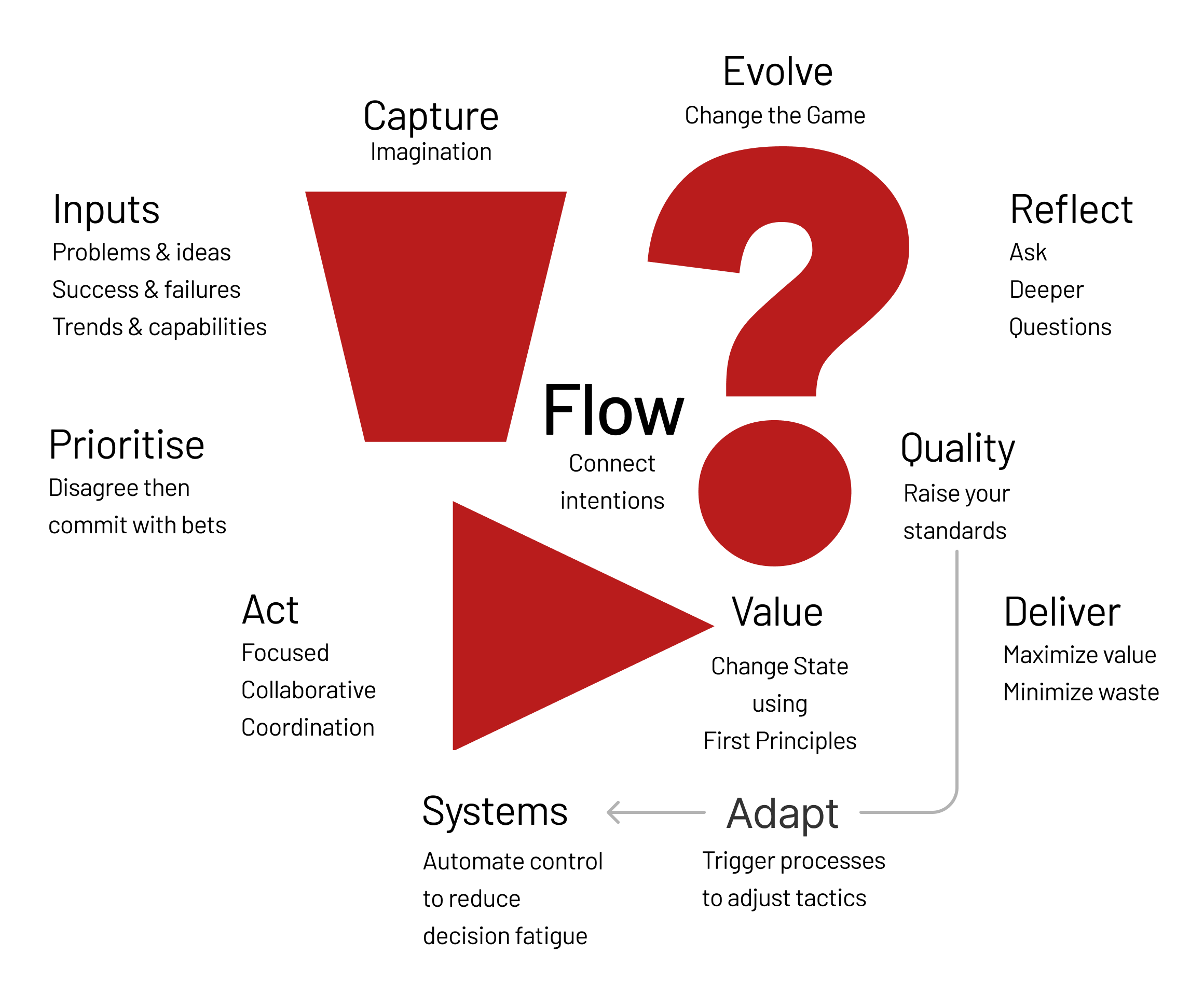
The improvement loop exists to close that gap. Every repeated error is evidence that experience hasn't become method yet.
Principles
Process optimisation converts tacit experience into explicit method — then measures, improves, and repeats. The loop: document → measure → analyze → improve → standardize. Each cycle tightens the gap between intention and outcome. A process without measurement runs on hope. Measurement without a process generates numbers nobody acts on. Together, they close the same loop that governs every feedback system — setpoint, gauge, controller, agent. The improvement loop is the VVFL applied to how work gets done.
Dig Deeper
- Business Process Reengineering — Redesign processes from first principles when incremental fixes stop working
- Checklists — Structured verification lists that prevent errors of omission
- Process Mapping — Visualise how work moves — find the gaps and handoff failures
- Process Modelling — Build abstract representations of a process before committing to change
- Quality Assurance — Gates and standards that keep the improvement loop honest
Four Capabilities
| Capability | Question it answers | Reach for it when |
|---|---|---|
| Questioning | What is the real problem? | Optimising for the wrong thing |
| Problem Solving | Is this the right problem? | Symptoms masking root causes |
| Decisions | What is the right move? | Choice — not method — is the bottleneck |
| Reengineering | How do we improve how work gets done? | Repetition reveals waste |
Each builds on the one above. Better questions define better problems. Better problem definitions produce better decisions. Better decisions run through better processes.
Application
Where this loop runs in practice:
- Work Charts — who does what (capability → demand mapping)
- Marketing Activities — reference implementation of a fully documented workflow system
- Reading the Game — the in-play decision cycle
- Standards — where improved processes compound into predictability
Context
- Systems Thinking — See the loops before optimising them
- Naming Standards — Canonical hierarchy: Standard → Process → Procedure → Workflow
- Scoreboard — The gauge that proves the improvement loop closed
- Navigation System — Value, belief, and control — the three loops any process must serve
- Matrix Thinking — Find the empty cells — the processes that don't exist yet
Questions
Which undocumented process would cause the most damage if the person who knows it left tomorrow?
- Where in the loop are you stuck — documenting, measuring, analyzing, improving, or standardizing?
- What process have you followed for years without measuring its intended outcome?
- When did a defect found during execution last reach the template that caused it — and how many runs shipped broken in the gap?