Process Optimisation
Map Reality, Model Improvement, Close the Gap.
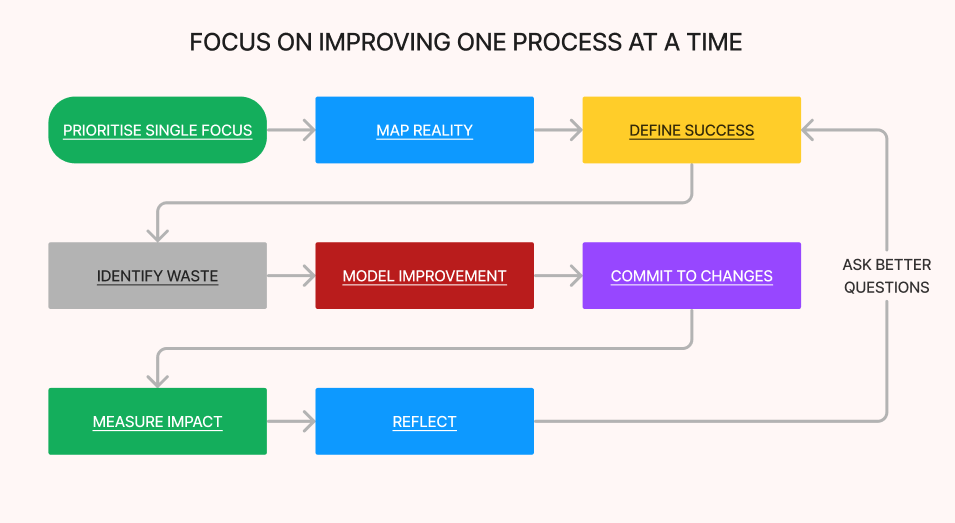
Make it easy to do the right thing and annoying to do the wrong thing. Build trust in systems that operate more effectively to transform and distribute value through embedded situational wisdom.
Levels
Four levels, from strategic to tactical:
STANDARD (Glue) → PROCESS (Tacit) → PROCEDURE (Explicit) → WORKFLOW (Trace)
| Level | Term | Concept | Definition |
|---|---|---|---|
| 1 | Standards | Atoms and Bits of interoperability and composability | The Ontology (Why things relate) |
| 2 | Process | Process Knowledge | The Goal (What needs to happen — Tacit) |
| 3 | Procedure | Procedural Knowledge | The Rules (Formalized logic — Explicit) |
| 4 | Workflow | Decision Trace | The Execution (How it actually happened) |
Full definitions: Naming Standards → Operations Hierarchy
Methods
| Method | Question | What it does |
|---|---|---|
| Process Mapping | What is current reality? | Visualize flows to expose bottlenecks, redundancies, and gaps |
| Process Modelling | What would improve it? | Simulate changes before implementing — quantify impact, reduce risk |
| Checklists | How do we hold the standard? | Reduce errors, enable delegation without quality loss |
| Quality Assurance | Is the output good enough? | Define acceptance criteria, build verification into workflows |
| BPR | Is it worth fixing — or scrapping? | Radical redesign when incremental improvement won't close the gap |
Work Charts vs. Workflows — different tools, different questions:
| Tool | Question | Maps |
|---|---|---|
| Work Chart | Who does what? | Capability → Demand |
| Workflow | How is it done? | Steps → Outcome |
Work Charts identify WHAT activities exist and WHO does them. Workflows document HOW each activity is performed.
Maturity
Track where each workflow sits:
| Status | Symbol | Definition | Next Step |
|---|---|---|---|
| Gap | GAP | No documentation exists | Document the workflow |
| Draft | D | Documented but not validated | Test with real work |
| Failing | F | Documented but not working | Diagnose and fix |
| Approved | A | Validated and approved | Monitor performance |
| Needs Work | NW | Approved but degrading | Schedule review |
| Active Review | AR | Currently being improved | Complete review cycle |
For each process, ask: What triggers it? Who owns it? How do we know it's working?
Workflow Template
Every workflow document needs:
| Section | Content |
|---|---|
| Purpose | What outcome does this produce? |
| Trigger | What initiates this workflow? Schedule · Event · Threshold · Request |
| Frequency | How often does it run? |
| Owner | Who is responsible? |
| Output | What gets produced, in what format, delivered where? |
| Success Criteria | Quality metrics and performance metrics |
| Failure Modes | Common problems and their solutions |
Dependency rule: Every blockedBy reference must resolve to a real step. Phantom dependencies look active but cannot advance — catch them at plan creation, not mid-execution.
Reference implementation: Article Copywriting Workflow
Improvement Loop
DOCUMENT → MEASURE → ANALYZE → IMPROVE → STANDARDIZE
    ↑                                         |
    └─────────────────────────────────────────┘
Process without context = Bureaucracy. Context without process = Chaos. Each cycle adds to the context graph — decision traces become patterns, patterns improve process.
The feedback cycle must be shorter than the defect's blast radius.
| Defect found during... | Log it in... | Fix cycle |
|---|---|---|
| Plan execution | Source template's issues file | Same session if possible, next plan at latest |
| Retrospective | Improvement loop backlog | Next standardization cycle |
| Production incident | Incident record + template fix | Immediate |
Pit of Success
Design systems where the right thing is the path of least resistance.
| Pattern | Without It | With It |
|---|---|---|
| Name it | Concepts exist across 6 pages but unnamed — can't be taught or tested | One named concept in one hub page, cross-linked everywhere |
| Hub pages route | Index is a 3-row table — nobody knows where to start | Curated links with commentary, 10-second test passes |
| Validate links | 46 broken references compound for months, nobody notices | Validation runs every push. Broken link = broken chain |
| Templates reference sources | Template disconnected from docs it implements — drift guaranteed | source_files in every template phase |
| Specify return signal | Feedback loop closer is 2 lines + a link | Trigger, format, receiver, action — all specified inline |
Each pattern prevents a class of error, not an instance. The question after every fix: did we prevent the class, or just fix the instance? See Enforcement Hierarchy.
Anti-Patterns
| Anti-Pattern | Problem | Solution |
|---|---|---|
| Undocumented | Knowledge locked in heads | Document as workflows |
| Over-documented | Nobody reads 50-page SOPs | Keep workflows scannable |
| Never updated | Documentation drifts from reality | Review triggers, scheduled audits |
| No metrics | Can't tell if it's working | Define success criteria upfront |
| No owner | Nobody responsible for improvement | Assign ownership |
| Too rigid | Can't adapt to context | Build in decision points |
| Too loose | Inconsistent outcomes | Add checklists at critical points |
Context
- Process Optimisation — The parent hub: questioning, problem solving, decisions, method
- First Principles — Question requirements before optimising them
- Standards — Where improved processes compound into predictability
- Work Charts — Who does what (capability → demand)
- Scoreboard — The gauge that proves the improvement loop closed
- Reading the Game — The in-play decision cycle: runs during, not after, the loop
Questions
Which of your undocumented processes would cause the most damage if the person who knows it left tomorrow?
- Where in the improvement loop are you stuck — documenting, measuring, analyzing, improving, or standardizing?
- What process do you follow religiously that has never been measured against its intended outcome?
- When context and process conflict, which wins in your organization — and what does that cost?
- How long does it take for a defect found during execution to reach the template that caused it — and how many plans ship broken in the gap?