The Journey
What is the most valuable thing in the world?
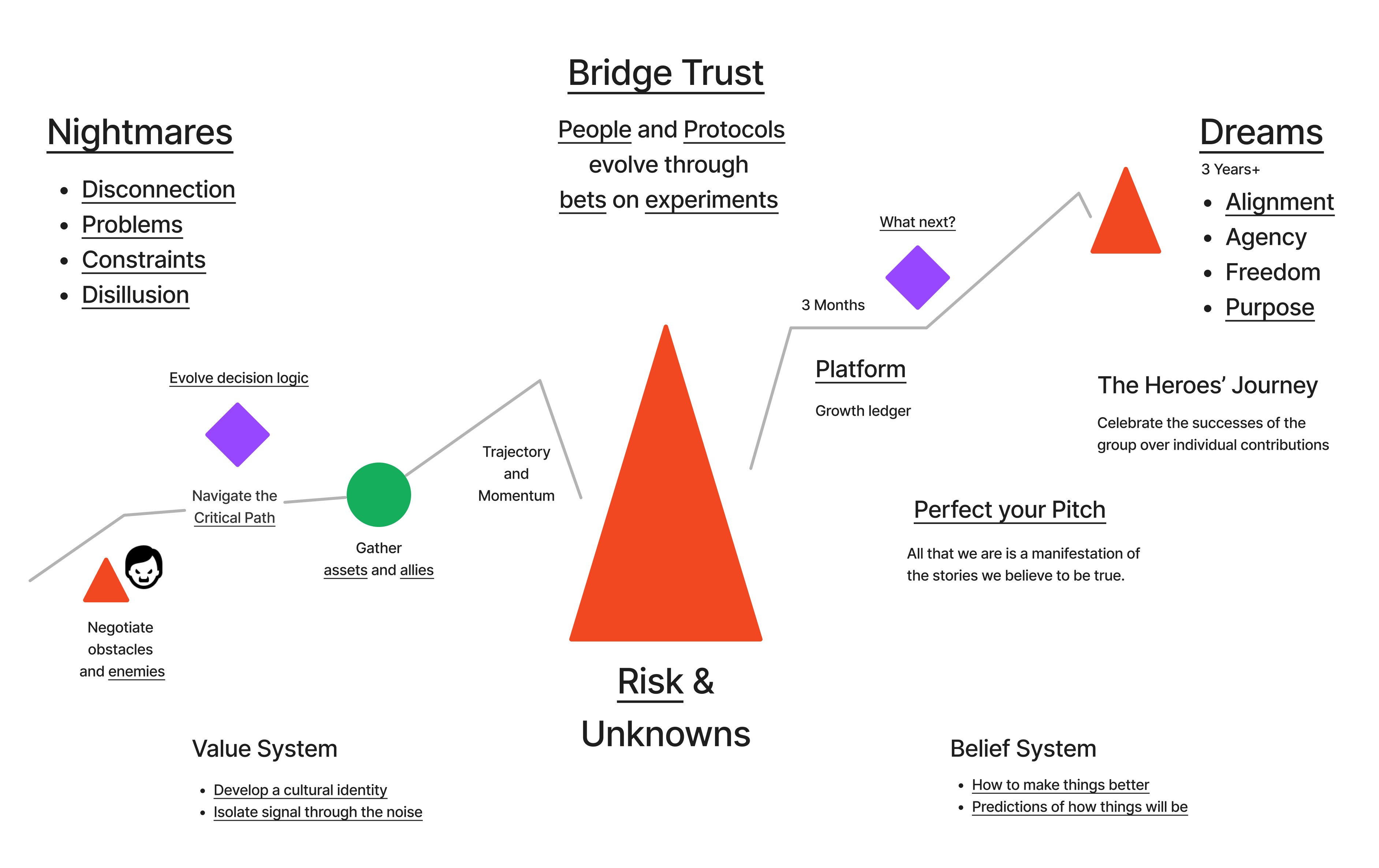
Know who you are. Know how to recognise the truth. Deepen connections you can trust.
The Prize
Individual capability is abundant. Intelligence is cheap. Execution is automated. What is genuinely scarce: the ability to align dreams — to build something enough people want badly enough to stay in the game long enough to see it compound.
That is the Shared Dream. The platform exists to manufacture one thing: conditions where individual journeys become a collective force.
| Dream Scale | What Aligns | What Emerges |
|---|---|---|
| Individual | Values → Beliefs → Actions | Self-efficacy, mastery |
| Team | Shared quest, shared language, shared code | Collective flow |
| Ecosystem | Common setpoint, mutual trust, verifiable contribution | Emergent capability beyond any individual |
The highest form: a mastermind. Fifteen individuals reading the game as one organism. The ball finds space before the gap opens. No one decides — everyone knows. That is collective agency — the game's final stage.
The Arc
Onboarding teaches the culture. Culture grows the community. Community builds the ecosystem of players — biological and phygital. Players elevate agency. Agency steers by navigation. Navigation points at the dream. That is the game.
The loop runs again. Each turn sharpens the next.
The Game
Every life is a game already running. The question is whether you chose the rules.
Campbell called it the monomyth. Leave the familiar. Face trials. Transform. Return changed. The questions get harder. What changes is not the pattern — it is you. The upward spiral.
| Stage | What breaks | What's required | What you carry forward |
|---|---|---|---|
| Call | The familiar fails | Courage to name the gap | A specific problem worth solving |
| Threshold | The old map runs out | Classification, not explanation | The constraint map |
| Trials | The gap meets resistance | Repeated small proof | Calibrated capability |
| Abyss | The real fear surfaces | Honest measurement | Tested belief |
| Transformation | Identity shifts | The decision to stay | A new setpoint |
| Return | You arrive changed | Will to share | Better maps for the next player |
The return is the Legacy Rule: you don't finish the journey and keep the treasure. You finish and leave better maps. That is how the Shared Dream compounds — each player's return raises the floor for the next.
Three Game Outcomes
In the AI era, three outcomes exist. The rules you play by determine which one you get.
| Outcome | How You Play | Where You End |
|---|---|---|
| Drift | Run the old game faster with new tools | Commoditized — faster at the wrong thing |
| Survive | Automate constraints, maintain position | Stable — but the setpoint belongs to someone else |
| Surthrive | Own the taste model, compound aligned intent | Irreplaceable — the dream is yours to set |
The difference between survive and surthrive: who owns the setpoint. AI runs the loop. You own what "done well" means in your domain. That judgment — accumulated through real decisions — is the moat. The Shared Dream is what happens when enough moats align.
Players
| Scale | Player Type | Game Role | Enters When |
|---|---|---|---|
| Individual | Hero | Crosses a threshold no one else can cross for them | They feel the call |
| Team | Guild | Holds shared language, shared code, shared quests | They find a common problem worth solving |
| Ecosystem | Civilization | Shares a setpoint — the dream is collective | They prove their maps improve when shared |
The Knowledge Stack
The game runs on four layers. Each layer compounds the one above it.
| Layer | What it is | What breaks without it |
|---|---|---|
| Primitives | Values, beliefs, decisions — the raw game elements | No anchor. The loop has no setpoint. |
| Protocols | How players interact — meetings, channels, feedback loops | No coordination. Individuals work near each other, not together. |
| Standards | What counts as winning — what done well looks like | No trust. Every game is custom. Nothing compounds. |
| Platforms | Where the game runs — tools, agents, infrastructure | No scale. The dream stays local. |
The Stage Map
Nine stages. Each one unlocks the next.
| # | Stage | Quest | What you earn |
|---|---|---|---|
| 1 | Onboarding | Learn the culture by doing | A trusted first crew member |
| 2 | Culture | Internalize the shared code | Language that coordinates without orders |
| 3 | Community | Build bonds of counterparties | Trust that enables exchange |
| 4 | Ecosystem | Find your role in value circulation | Five counterparties pulling together |
| 5 | Players | Build biological + phygital crew | Collective capability |
| 6 | Agency | Develop character + capability | Real impact on the world |
| 7 | Navigation | Read Value, Belief, Control instruments | True bearing when the ground shifts |
| 8 | The Dream | Name the picture worth sailing toward | A setpoint beyond self |
| 9 | The Game | Design the loop | The Shared Dream |
The Archipelago
The nine-stage Arc above is one map of the journey. The eighteen-hole Archipelago is another — same journey, different traversal. The Arc says how you grow. The archipelago says where you choose.
Each hole is a recurring decision a person who lives into old age will face whether they choose to or not. Eighteen islands grouped into six archipelagos: Self, Resources, Bonds, Truth, Power, Legacy. You build a boat to reach each island, you play the hole, you sail on. The clubhouse — the nineteenth — is where two scorecards are read aloud:
- Play card — how you swung. Mastery loop. Played better each round?
- Course card — what you left for the foursome behind you. Stewardship loop. Course in better condition?
The Arc is the staircase. The archipelago is the round you play on each step. Both lenses are needed. Run them in parallel.
Know Yourself
Three questions at the root of the Shared Dream.
| Question | What it opens |
|---|---|
| Who are you? | Soul. Identity before role. Values before behaviour. |
| Where do you come from? | Grounding in first principles — what you know is real, before it was filtered. |
| What are you becoming? | Dream. The picture worth pursuing. The pulling is the living. |
Foundations
- spirit
- mind
- body
- family
- land
Lack any, the house falls. The Shared Dream is built on foundations, not vision alone.
Love of Game
The deepest strategy is not a strategy. Playing for the love of the game means value leads — the loop compounds. When control leads, the loop extracts.
| Orientation | Starts At | Direction | Result |
|---|---|---|---|
| Love-driven | Value | Value → Belief → Control | Loops compound. The game improves. |
| Extraction-driven | Control | Control → Belief → Value | Loops degrade. The game collapses. |
Would you still build this if no one was watching and no token was appreciating?
Entry Points
The game has interfaces. Choose where to start.
| Who you are | Where to start |
|---|---|
| Starting something new | Navigate the AI Landscape — the individual hero's journey |
| Re-engineering to adapt | Navigate the AI Landscape — five stages, one working system |
| Building a team | Community — who plays, how roles align |
| Designing the rules | The Game — mechanics, economics, game design |
| Finding your bearing | Navigation — Value, Belief, Control instruments |
Context
- Science — The method that grounds the journey in truth
- Standards — Proven patterns that compound effort
- Systems — Thinking instruments: perceive, question, decide, improve
- Software — What gets built and shipped
- Scoreboard — How you know the journey is working
- Crypto — The outer game: trade, industry, and commerce on verifiable rails
- Collective Agency — When individual loops synchronize into one higher-order loop
- The Greatest Game — Stewardship: intelligence scales via compute, wisdom scales via trust
- Dream Engineering — Agency lives in the gap between intention and attention
- Flow — The measure. Intention + attention aligned.
Links
- Positive Feedback Loops
- Play for Love of the Game — Deep Strategy
- Value → Belief → Control Chain
- Why Extractors Lose
Questions
What dream is worth sharing?
- What setpoint do you hold that, if enough others held it too, would change what gets built?
- At which stage of the journey are you now — and what does crossing the next threshold require?
- If aligned intent is the most valuable thing, how do you measure whether yours is growing or fragmenting?
- Are you playing for the love of the game — or for what the game pays?