Navigation System
Future generations of intelligence are shaped more by the way we act than the things we say.
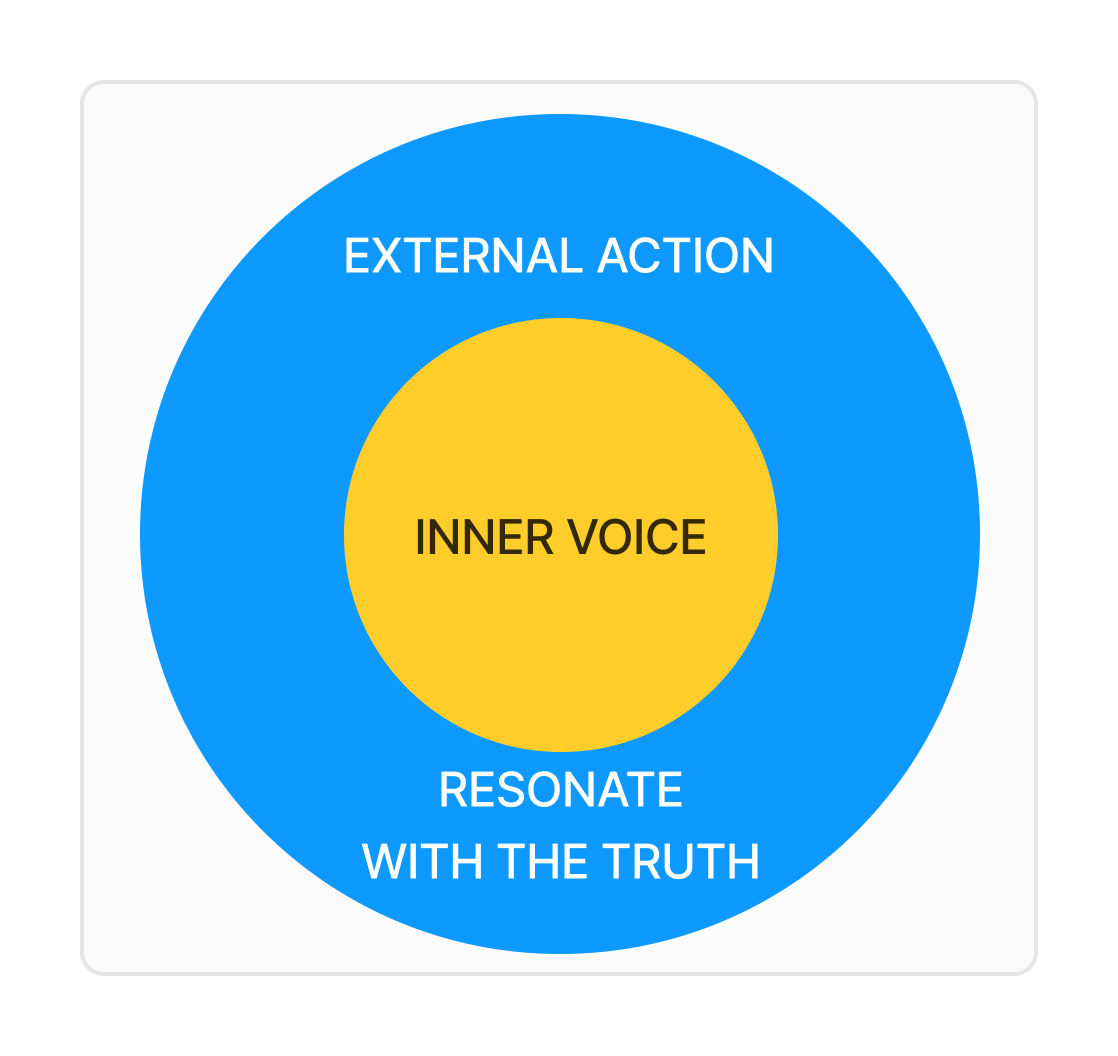
Sail by instruments, not by sight. The ocean is too big to feel your way across. You know where north is, but the wind doesn't always let you sail straight there. Tacking is fine. Losing your bearing isn't. The instruments tell you where you stand relative to the star — not whether you're on a straight line.
Every system — person, organization, economy — runs three interlocking loops. When all three harmonize, you experience flow. When one is off, you feel dis-ease — the signal to diagnose which loop needs attention.
The System
The sequence matters. Value comes first — always.
| System | Question | When Aligned | When Broken |
|---|---|---|---|
| Value | What is truly important? | Inate understanding of what really matters | Chasing metrics that drift from meaning |
| Belief | How do things work? How is that changing? | Clarity and purity of intention on doing good | Delusion — confident movement toward the wrong thing |
| Control | What levers can you pull? | Attention on levers that move the needle | Efficient movement in the wrong direction |
Belief without value is delusion — you head somewhere with conviction but no ground. Control without value is waste — you execute well toward the wrong outcome. The value system must be rock solid before the other two can function. Not rock solid as in rigid — rock solid as in known. You know what real world value looks like. You know what matters to real people. That knowing is the anchor everything else attaches to.
Principles
VALUE (anchor)          BELIEF (pull)         CONTROL (push)
What grounds you?       Where headed?         How to get there?
      ↓                      ↓                      ↓
  Principles              Predictions            Protocols
  Essentials              Intentions             Standards
  Belonging               Purpose                Platform
      └──────────────────────┼──────────────────────┘
                             ↓
                     NAVIGATION STATE
                    (flow or dis-ease)
Standards are the focus because they are the Control system's mechanism for making Belief system predictions accurate. Better standards reduce variance. Reduced variance tightens prediction bounds. Accurate predictions earn capital. The improvement direction is inside-out: ground in Value first, then sharpen Belief, then tighten Control. Standards improved without grounded value are efficient movement in the wrong direction.
The Act
Navigation is not passive orientation. It is the act of arguing for what is correct.
When you move an idea, a person, or an organization toward truth against resistance — all three systems run at once. Value declares what correct looks like: the setpoint before the argument opens. Belief names the transformation: where the audience is now, where they need to arrive. Control deploys the instrument that moves them — the right appeal, at the right station, in the right sequence.
This is rhetoric as navigation. Not rhetoric for winning — rhetoric for truth. The difference is the gauge. Rhetoric-for-winning measures applause. Rhetoric-for-truth measures distance from the declared setpoint. The Greeks × Stations matrix is the Control leg — one instrument of three.
When the argument fails, the three-system frame names which leg is broken:
| Symptom | Broken | Fix |
|---|---|---|
| "This argument is loud but I can't say what it's for." | Value | Declare the setpoint — what correct outcome are you arguing toward? |
| "We're arguing for the right thing but the audience can't picture arriving there." | Belief | Name the transformation — where are they now, where should they arrive? |
| "We know what's right and where we want to go, but nothing lands." | Control | Run the instrument check — which Greek at which station is missing? |
Control without Value is manipulation. Belief without Value is prophecy without ground. Value without Belief and Control is righteousness without movement.
The Vessel Test in Navigation
The diagnostic above is the Vessel Test made operational. Inside-out — does the argument hold water? Run the three legs and name which leaks. Outside-in — does it float the audience? That work happens through the Greeks × Stations instrument and lands only when meaning translates. A vessel that holds water without floating is a sealed tank. A vessel that floats without holding water sinks the first time it carries weight.
The Hero's Journey is this navigation run at scale — not a single argument but a campaign to advance a correct idea:
| Stage | Rhetorical Act | System |
|---|---|---|
| Ordinary World | The baseline belief being challenged | Belief — current state |
| Call to Adventure | Setpoint declared: what correct looks like | Value |
| Tests and Ordeal | Counter-arguments met, decisive argument deployed | Control |
| Return with Elixir | New baseline installed — the ratcheted setpoint | Value — evolved |
The hero doesn't carry a sword home. They carry a ratcheted setpoint — the audience's belief now closer to correct than before. That is the elixir. It only lands when all three systems ran true.
Mantra
Continuously develop mantra to get a prompt in the right direction — mindset before method. Peak flow is the state where insight arrives without effort and action expresses goodwill without friction. The mantra is the prompt that opens the channel.
The Tight Five is the mechanism. These five are the outer face — the Dreamer's interface with the world. They are built on the invariant inner foundation (Performance · Principles · Platform · Process · Players — the inner game) that you bring to every context. Five questions, run in sequence, build the belief platform — not through willpower but through progressive clarity:
| Question | Builds | Belief Gained |
|---|---|---|
| Why does this matter? | Purpose | Clarity — I know what I'm for |
| What truths guide me? | Principles | Trust — I'm not guessing |
| What do I control? | Platform | Edge — I have something to work with |
| What do I see others don't? | Perspective | Conviction — my edge is real |
| How do I know it's working? | Performance | Agency — I can find a way |
Confidence is not a personality trait. It is the output of having your Tight Five tight. When you can answer all five, you have the platform to act — because you know what you're for, what's true, what you control, where your edge is, and how to read the feedback. That's "find a way" as a system, not a hope.
The purpose of this outer clarity is bandwidth. Mantra and systems handle the known decision routes — the hard calls you've already thought through — so you arrive at the novel problem with full capacity. Point of difference only lives in the novel. You cannot access your edge while managing the routine.
These three systems are the Scoreboard loop at the individual level — Belief sets intended state (priorities), Control executes decisions to change state, Value determines which instruments you trust to read the gap.
| Scoreboard | Navigation System | Question |
|---|---|---|
| Priorities | Belief — intended state | Where are you going? |
| Decisions | Control — execution | How do you change state? |
| Instruments | Value — what you measure | What grounds the reading? |
The Landscape
Each system maps to site sections you build and industries that threaten sovereignty if someone else owns the data.
| System | What You Build | Industry Exposure | Data at Stake |
|---|---|---|---|
| Value | Principles, Foundations | Payments, Banking | What you value enough to pay for, what you own |
| Belief | Priorities, Scoreboard | AI Data, Advertising, Gaming | What you see, believe, and inhabit |
| Control | Platform, Protocols, Standards | Telecom, Mobility, Robotics | Where you go, what signals reach you, what acts on your behalf |
Navigation Scorecard
Every navigation system runs on data. The scorecard reveals which data flows carry the most power — and who controls them.
| # | System | Data Flow | Source Industry | Data (1-5) | AI (1-5) | Robot (1-5) | If Someone Else Owns It |
|---|---|---|---|---|---|---|---|
| VALUE | |||||||
| 1 | Value | Transaction records | Payments | 5 | 4 | 1 | They record what you value enough to pay for |
| 2 | Value | Financial records | Banking | 5 | 4 | 1 | They custody your stored value |
| 3 | Value | Property records | Real Estate | 4 | 3 | 1 | They certify what you own |
| BELIEF | |||||||
| 4 | Belief | Training data | AI Data | 5 | 5 | 1 | They train the brain making your predictions |
| 5 | Belief | Attention signals | Advertising | 4 | 5 | 1 | They shape what you see and believe |
| 6 | Belief | Behavioral patterns | Gaming | 3 | 4 | 1 | They design the systems you inhabit |
| 7 | Belief | Content engagement | Entertainment | 2 | 4 | 1 | They curate your information diet |
| CONTROL | |||||||
| 8 | Control | Connectivity | Telecom | 4 | 4 | 2 | They control the signals between you and the world |
| 9 | Control | Movement data | Mobility | 5 | 4 | 5 | They know where you go and when |
| 10 | Control | Sensor + actuator | Robotics | 5 | 5 | 5 | They command agents acting on your behalf |
| 11 | Control | Earth observation | Space | 5 | 4 | 4 | They observe the physical world from above |
How to read:
- Data — How valuable is this data for predicting and influencing behavior? (1 = generic, 5 = irreplaceable)
- AI — How much does AI amplify this data's power? (1 = marginal, 5 = existential)
- Robot — How much does physical automation extend this data's reach? (1 = minimal, 5 = dominant)
Three patterns:
- Belief is the most AI-exposed system. Training data (5), attention (5), behavior (4) — AI doesn't just use this data, it reshapes what you perceive. Lose belief sovereignty and your predictions are someone else's.
- Control is the most robot-exposed system. Mobility (5), robotics (5), space (4) — physical agents extend data collection into the real world. Lose control sovereignty and your movements, actions, and environments are instrumented by others.
- Value is the most regulated but least defended. Transaction and financial data are highly regulated (GDPR, PCI) but regulation assumes centralized custody. DePIN + tokenization shift the custody model entirely.
The Navigation Loop
The navigation loop is how you run it in practice:
QUESTIONS → PROBLEM SOLVING → DECISIONS → ACTION → FEEDBACK
| Stage | Core Question | Surface |
|---|---|---|
| Questions | What am I really trying to understand? | Questions |
| Problem Solving | What is the most important problem now? | Problem Solving |
| Decisions | Given constraints, what will I do next? | Decisions |
| Alignment | Are we committed to the same thing? | Meetings |
| Feedback | What happened vs what we expected? | Scoreboard |
Decisions applied to specific domains: tech stack, AI strategy, infrastructure cost.
Five Priorities
Five questions keep the loop coherent across personal, venture, and system levels. This is the outside-in face of the Tight Five fractal pair — the Dreamer's view, context-adaptive: the five cells shift with whatever domain is currently in view. The set shown below is the current dogfooding context (the instrument building itself). The inside-out face — the Engineer's view — is the invariant foundation: the same five cells every cycle (Performance, Principles, Platform, Process, Players). Three cells bridge both faces. Two cells pivot.
| Priority | Outside-in (Dreamer) question — this context | System | Inside-out (Engineer) pivot — invariant |
|---|---|---|---|
| Purpose | Why does this matter to me? | Value | Pivot-promotes to Process — the know-how encoding the why |
| Principles | What truths guide me? | Value | Invariant — same content, plural pronoun |
| Platform | What do I control? | Control | Invariant — same content, plural pronoun |
| Perspective | What do I see others don't? | Belief | Pivot-promotes to Players — who is in the boat |
| Performance | How do I know it's working? | Control + Belief | Invariant — same content, plural pronoun |
When the Dreamer's five are explicit on the outside, the Engineer's foundation sharpens — Purpose matures into Process, Perspective matures into Players, and the three invariants hold the bridge. When the Dreamer's five are vague, the Engineer's process stays bureaucratic and the players drift. Fix the dream first so the build has somewhere to land. In different contexts, the Dreamer's five will name different cells — but the Engineer's five never change.
Prediction Map
The six prediction domains map directly onto the three systems. Every prediction is a bet on which system matters most — and where the world is headed.
| System | Prediction Domains | What You're Betting On |
|---|---|---|
| Value | Healthspan, Education | What people will value enough to pay for, learn, and protect |
| Belief | AI Trajectory, Geopolitics | What shapes perception — who trains the models, who writes the rules |
| Control | Crypto & DePIN, Work Transformation | What infrastructure carries intent — and who operates it |
Predictions without navigation are speculation. Navigation without predictions is drift. The sovereignty scorecard shows what's at stake. The predictions show where the bets are. Together they form the belief system's instrument panel.
Data Sovereignty
The three systems depend on data you control. Industries that generate and own data are the convergence point — if someone else owns the data, they steer the system.
| System | Data Dependency | Industrial Threat |
|---|---|---|
| Value | Transaction + financial records | Payments, Banking |
| Belief | Training data + attention + behavior | AI Data, Advertising, Gaming |
| Control | Connectivity + movement + sensors | Telecom, Mobility, Robotics |
DePIN is the mechanism. Data sovereignty is the outcome. The navigation system is why it matters.
Three Instruments
Navigation runs on three coherent instruments — one pattern, one implementation, one protection. Together they make the loop hold across seasons.
| Instrument | Role | What it does |
|---|---|---|
| Tight Five | The pattern | Five questions that keep any venture honest |
| Prompt Deck | The implementation | A five-slide deck turning the five questions into prompts you can sell, coach, and ship with |
| Time + Mind | The protection | A weekly loop giving each question real time in the calendar and the right frame of mind |
"Vision without action is a daydream. Action without vision is a nightmare." The design spec lives in the proverb: pair vision with action on every question, every cell, every season. One instrument without the others drifts — all three, run as one loop, compound.
Building the Boat
If a life is eighteen holes on the archipelago, each hole sits on a different island. The boat that reaches it is the navigation system — Value, Belief, Control — assembled differently for each voyage. The Tight Five is the boat-building kit.
Different holes need different boats. Some need a heavy boat — gravity to hold against drift. Some need a light boat — space to let the wind do the work.
| Archipelago | Boat shape | What dominates the rig |
|---|---|---|
| Self | Light, daily, repeatable | Value — what the body, mind, and spirit are actually for |
| Resources | Balanced — all three systems pulling | Belief — the read on where the work is going |
| Bonds | Slow, deep keel | Value — what the partnership, the kin line, the tribe is actually for |
| Truth | Heavy keel, quick rudder | Control — the protocol that holds the swing under load |
| Power | Big rig, full crew | All three — Value sets the why, Belief reads the room, Control deploys the move |
| Legacy | Built quietly, over years | Value — only the long-arc setpoint survives the whole voyage |
The voyage between islands is the journey. The hole on each island is the decision. They are different acts. The instruments stay the same — what changes is which leg of the rig carries the weight.
To the Dream
The instruments read the gap between where you are and where you say you are going. That destination is the dream — the fixed reference that makes correction meaningful.
Context
- Predictions — The belief system's instrument panel: six domains, scored and falsifiable
- Pictures — The dream precedes the prediction — if you can't picture it, you can't predict it
- Tokenization — When navigation succeeds, value flows as tokenized specifics, not shared fiction
- Intelligent Hyperlinks — The pipe that carries what the navigation system directs
- The North Star — The fixed reference point the three systems correct toward
- Scoreboard — The loop made measurable: priorities → decisions → instruments
- Telco MEV — Industrial proof: reference data (Value), routing logic (Belief), capacity planning (Control)
- Industries — The scorecard shows what's at stake across every vertical
- Tight Five — Five bound elements, any domain
- First Principles — The reasoning method and routing to all domain first principles
- Principles — Pure science: physics, biology, mathematics
- Platform — Tools and infrastructure powering the control system
- Flow — When all three systems align
- DePIN — The mechanism for data sovereignty
- Ecosystem — Five counterparties, three generational hooks — who enters the navigation system
- Mission Loop — The 7-step session design pattern for crossing a gap: Picture, Ask, Mission, Practice, Calibrate, Reduce, Teach back
- Onboarding — How new crew learn to read the instruments
- Business — The five business layers that this navigation system makes coherent: Strategy → BD → Growth → Operations → Artifacts
- The Mycelium — The layer you can't see that governs everything you can
- Dream Engineering — Inner, outer, and the third space where navigation happens
- Agency — What the navigation system builds: the capacity to act on what you know, with whom you trust, on the platform you control
- Evolution — The governing principle beneath navigation — purposeful variation, not random drift. The navigation system is evolution made intentional
- Credibility — The three loops that prove you're playing the game these systems define
Questions
If dis-ease is the signal that a system is misaligned — what dis-ease are you ignoring right now?
- Which of the three systems do you over-invest in at the expense of the others?
- What would change if you treated your strongest conviction as your biggest blind spot?
- Where in your life are you optimizing a solution that should be questioned instead?