Goodwill

Money's crisis ahead is not a liquidity crisis. It is a substrate collapse.
When truth, identity, and trust fail, the instruments still print numbers — but the numbers no longer settle to anything real, to anyone in particular, or to anyone you believe. The rails work. The ledger updates. The meaning is gone.
The Substrate
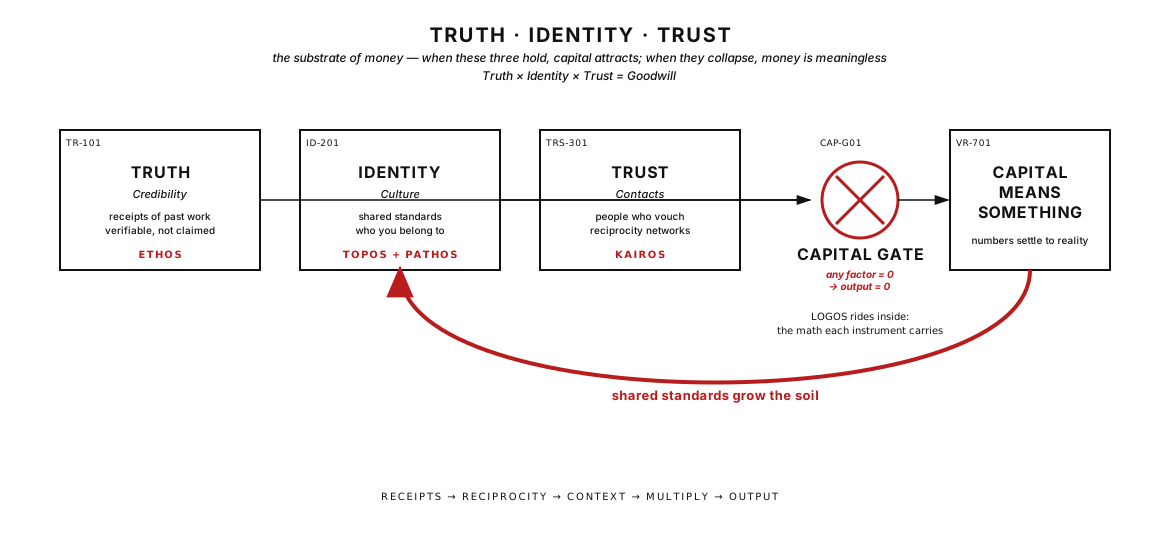
Three things carry money's meaning. When any one collapses, the whole stack fails.
Truth. Receipts of past work that can be verified. The math surviving scrutiny. Without truth, a cashflow story becomes fiction — numbers on a page that point to nothing real. An LLM can argue any position convincingly. Ask it to build a case, then ask it to demolish that case. It will do both with equal skill. The machine has no position. It has rhetoric. That is not a flaw in the technology. It is a mirror. Most connections, most claims, most marketing optimises for reach, not for truth. The bigger the network grows, the less it means.
Identity. Who you are, who you belong to, the shared standards that make your word legible. Ethos is the rhetorical name. Pepeha is the practice. Without identity, the self-audit valve has no referent — "would I bet my own time at this IRR?" only works if there is a self that persists long enough to be held to the answer.
Trust. People who return your call and vouch for you by default. Reciprocity networks that move capital before contracts do. Without trust, belief never transfers. Capital stays on the sideline even when the math is perfect and the identity is clear.
Truth × Identity × Trust = Goodwill. Multiplication matters. Zero in any factor zeroes the whole. Goodwill is the only capital stream that cannot be printed, inflated, or extracted by force. It is the substrate under which every other instrument — cashflow projections, pitch decks, unit economics — means anything at all.
Three Dimensions
Three things separate a real connection from noise — and they are how you measure goodwill in practice.
Weight — how much they actually influence the outcome when it matters. Not their title. Not their reach. Their effect on the result when the stakes are real.
Confidence — how reliable that influence is. Not once. Consistently. A brilliant mind that disappears under pressure scores zero.
Context — when and where that connection activates. The right person in the wrong moment is the wrong person. Timing is not a bonus dimension. It is the dimension that makes the other two real.
Most people track none of these. They track follower count, inbox volume, event attendance. Glory metrics that measure activity, not value.
The Setpoint
Every feedback loop needs three things: a setpoint (what you are optimising for), a gauge (how you measure reality), and a controller (what corrects drift).
Goodwill without a setpoint is a runaway loop. It extracts. It flatters. It grows without deepening.
Goodwill with a setpoint — do the right thing, the right way, at the right time — is a virtuous loop. It compounds. Each interaction builds trust. Trust reduces friction. Reduced friction increases the speed and quality of the next interaction.
The same is true for machines. Teaching an AI to be a good teammate is the same problem as building a team you trust. You need a setpoint — what are we actually optimising for? You need a gauge — is it working? And you need the courage to weigh connections honestly instead of counting them politely.
The Goodwill Formula
Goodwill is not your network size. It is the depth of connections you can rely on to do the right thing, in the right way, at the right time.
That sentence decomposes:
| Fragment | What it means | What it measures |
|---|---|---|
| Depth | How much weight and confidence the connection carries | Quality over quantity |
| Rely on | Consistency under pressure | Performance when it matters |
| Right thing | Aligned values | Shared principles |
| Right way | Competence in context | Capability, not just willingness |
| Right time | Activation when needed | Context awareness |
Score every connection in your network on those three dimensions — weight, confidence, context. The number you get is your actual goodwill.
Everything else is rhetoric.
The Experiment
If goodwill is the substrate, then the venture is the experiment that tests it.
A venture is a bet that a small group — aligned on values, complementary in capability, honest about what they don't know — can create something no individual could. The platform removes the critical path that drains months before you deliver value. What remains is the hard part: finding the right people and doing the right work.
Every venture in the experiments table shows $0 actual. That is not failure. That is honesty about what has not yet been tested. The berley trail leads here — not to a product, but to a question: what would you build if the friction were removed?
Context
- Making Money — Capital streams and why goodwill sits at the top
- Sign the Articles — The vessel built on this substrate; values + vision embodied as habits and rituals
- Character Can't Be Faked — The workflow filter that protects the substrate from being diluted
- Feedback Loops — The three loop types: runaway, corrective, virtuous
- Persuasion — Rhetoric without a setpoint is noise
- Reality — Glory metrics vs measurement that matters
- Value System — The setpoint that makes everything else work
- Tight Five Loops — Setpoint, gauge, controller
- Ventures — Experiments in progress, scored by conviction not revenue
- Goodwill — The Practice — The inner-loop practice that grows the substrate
- Explore: Berley Trails — building depth of relationship with clients who stay; Touch For Fun — measuring trust, not headcount
Questions
Where in your life is goodwill compounding — and where is it silently depleting?
- If you scored every relationship on weight, confidence, and context, which ones would surprise you?
- What is the setpoint of your network — what are you actually optimising for?
- When a connection scores high on weight but low on confidence, what does that tell you?
- What would you build if the only constraint was finding the right three people?