Inside-Out Storyselling: The Hero's Journey for Business
Problem: AI transformation is often sold with the software as the hero, before the business has named what it values, what is happening in the field, or what proof would earn the next move.
Question: How can a business owner map a transformation story that starts inside, survives contact with reality, and returns proven value to customers or community?
Decision: Choose the smallest credible transformation experiment and whether to pursue it as a Journey or a Venture.
This method produces a Journey Brief: a value-grounded map from present reality to first proof, correction, reusable capability, and value returned.
The enduring pattern
The Hero's Journey is an enduring cross-cultural mythic pattern expressed through a thousand faces. Joseph Campbell's The Hero with a Thousand Faces is an influential articulation of the monomyth, not proof that every culture tells one universal story.
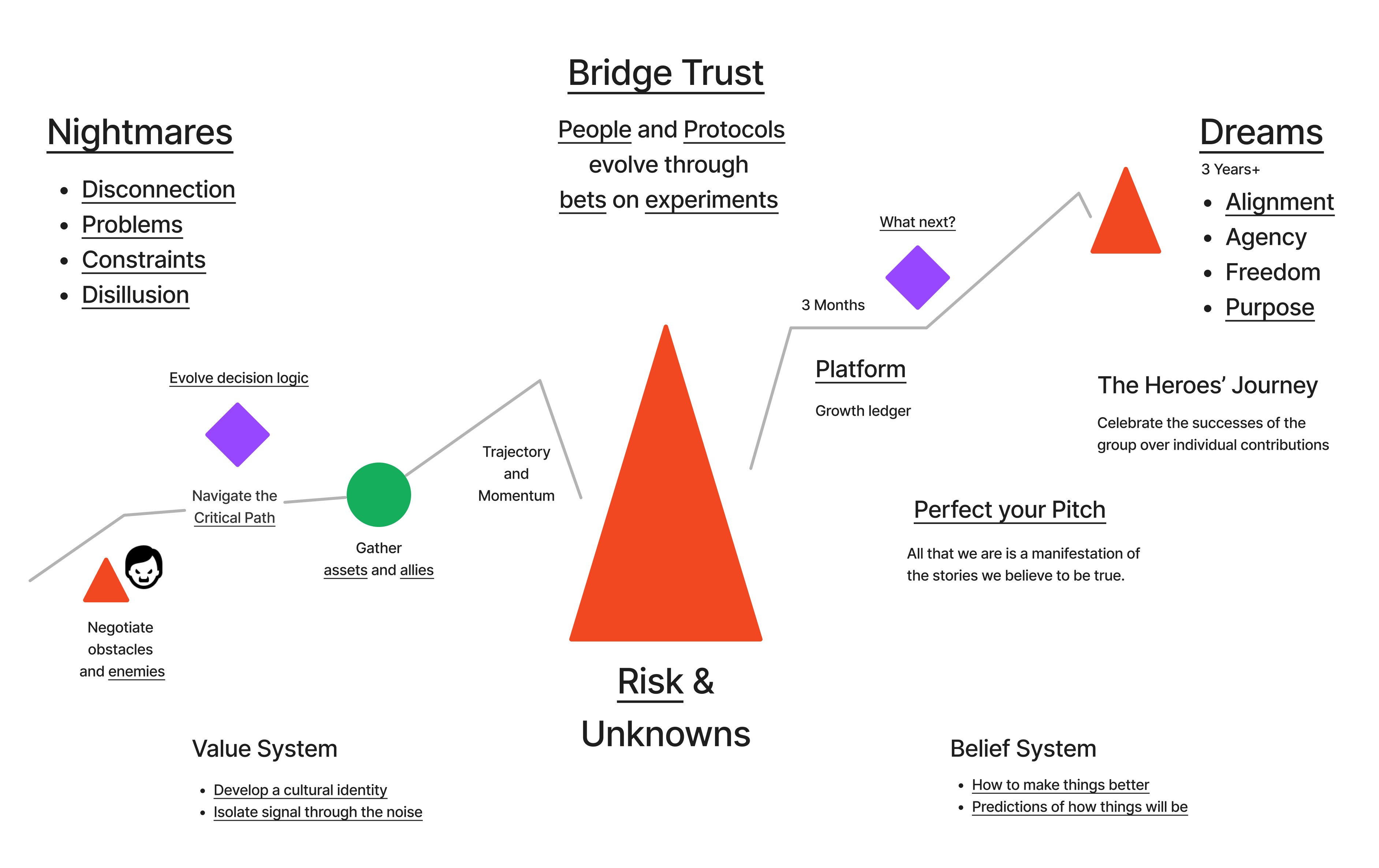
For business, compress the mythic arc to five stations:
CALL → THRESHOLD → TRIALS → TRANSFORMATION → RETURN
Join it to the evidence spine used by Storytelling:
FIELD → VALUE → FRAME → STORY → ACTION
The combined inside-out journey is:
VALUE SYSTEM → FIELD REALITY → CALL → INTENTION → PLAY
→ TRIALS → APPRECIATION → PROOF → TRANSFORMATION → RETURN
The mythic arc supplies movement. The evidence spine supplies integrity. Neither works alone.
Keep the roles true
| Role | Place in the journey |
|---|---|
| Business owner and team | The hero who chooses, crosses the threshold, learns, and changes. |
| Customer or community | The receiving player who decides whether value arrived. |
| Dreamineering | The guide who helps the hero see reality, picture the dream, and engineer a bridge. |
| Stackmates | Allies, instruments, protocols, and mycelium that help capability and evidence flow. |
| Software factory | A capability system. It equips the play; it is never the hero. |
| Proven shared value | The boon returned to the business, customer, or community. |
If the guide, platform, or software takes the centre of the story, stop. The business cannot own a transformation in which it has been reduced to an audience.
Inputs
- One business owner and the team who can act.
- A Value System setpoint: what good means and what must not be traded away.
- Field evidence from a recent workflow, decision, customer interaction, or failed attempt.
- One receiving player and the change they would appreciate.
- Constraints, available allies, capability gaps, and a bounded time or cost budget.
- A baseline and a signal that could disprove the proposed value.
Map the journey
1. Reaffirm the value system
Name the value worth serving, the people it should serve, and the line the transformation must not cross. Separate the setpoint from revenue, adoption, or activity measures.
Output: a one-sentence value-system setpoint and one non-negotiable guardrail.
Check: would the setpoint still guide a hard choice if the attractive option made more money?
2. Enter the field
Follow one real unit of work through the current operating model. Record observed steps, waits, workarounds, decisions, evidence, and the words used by the people doing and receiving the work. Use Value Stream Mapping when the flow crosses several owners.
Output: a field-reality statement with a baseline, evidence links, and labelled assumptions.
Check: can another person distinguish what was observed, inferred, and still unknown?
3. Hear the call and set the intention
Name what in the field now demands a response, who feels it, and the cost of doing nothing. Then describe the desired transformation as changed reality, not purchased software.
Output: a call-to-adventure statement, cost of inaction, and desired transformation.
Check: does the call matter without mentioning AI, Dreamineering, Stackmates, or a feature?
4. Cross the threshold with one play
Choose the smallest Reality–Dream–Bridge experiment that can test the desired change. Make the rules voluntary and clear: owner, constraint, timebox, input, action, receiver, proof signal, correction rule, and stopping condition.
Output: a one-round experiment card.
Check: can the team run the experiment now without committing to the full transformation?
5. Run the trials and read appreciation
Treat obstacles, failed attempts, and corrections as trials that build capability. Ask the receiving player what changed and why it mattered. Do not substitute internal activity, generated output, or seller enthusiasm for appreciation.
Output: a trial log containing actions, surprises, corrections, receiver feedback, and capability gaps.
Check: did a named receiver experience a change they recognise as valuable?
6. Turn appreciation into proof
Compare the result with the baseline. Record evidence, limits, harms, counter-signals, and the cheapest next falsifier. Decide to keep, correct, expand, or stop.
Output: a proof record and an explicit next decision.
Check: could a sceptical operator reproduce the comparison and reach their own conclusion?
7. Transform capability and return the boon
Only after proof, decide what should become reusable: a skill, protocol, instrument, data flow, or software capability. Return the lesson and value to the business or community so the next player starts with a better map.
Output: a capability change, its owner, its reuse condition, and the value returned.
Check: is the business more able to repeat or improve the outcome without depending on the guide?
Choose one door
| Door | Choose it when | First commitment |
|---|---|---|
| Journey | An established business has customers, operating evidence, and a model worth transforming. | Map reality, the desired two-year future, and the smallest bridge that can prove movement. |
| Venture | An AI-native business idea still needs demand, identity, and a viable operating model tested. | Test the desired future as a bounded venture before treating it as a business. |
The route is a recommendation, not a verdict. New field evidence can change it.
Teach, then reveal
Give the reader the map before presenting an offer. First help them name values, inspect reality, choose a play, and define proof. Then reveal where a guide or enabling system could reduce risk or accelerate learning.
This sequence is both useful and commercial: useful because the owner keeps the map even if they buy nothing; commercial because a capable guide becomes legible through the quality of the guidance. The offer should answer an already-understood capability gap, not manufacture one.
Map My Journey
Put this to work
Map My Journey
AI-native business journey coachCopy this prompt. Paste into Claude, ChatGPT, or any AI assistant. The page context is already loaded — send it and get analysis tailored to your role.
Checks
- The business owner and team remain the hero throughout.
- The customer or community is a named receiver, not a market abstraction.
- Every story claim traces to field evidence or is labelled as an assumption.
- The experiment can fail, stop, or change direction without requiring the full offer.
- Appreciation comes from the receiver; proof compares evidence with a baseline.
- AI and software appear only where a proven capability gap calls for them.
- The returned value improves the business or community, not only the seller's case study.
- The Journey Brief is useful under the no-purchase test.
Failure Modes
- Hero capture — the seller, guide, founder mythology, or software becomes the protagonist.
- Story before field — a polished arc is built on guessed operations or borrowed customer language.
- Value theatre — purpose and appreciation language hides a weak, extractive, or unreceived outcome.
- Software-first framing — the transformation is described as deployment rather than changed capability and reality.
- Proof stretch — projections, demos, or internal activity are presented as measured receiver value.
- Actionless inspiration — the story creates emotion but leaves no bounded play, owner, or stopping rule.
Proof Of Done
The method is done when the owner has a Journey Brief with all ten sections, a named receiving player, a baseline, one runnable Reality–Dream–Bridge experiment, a falsifiable proof signal, a correction rule, a stopping condition, and a reasoned Journey-or-Venture route. The first loop is proven only when the receiver's evidence supports or corrects the anticipated value and the business records what capability should be retained, changed, or stopped.
Changes my mind: If owner-led, evidence-first journey framing repeatedly produces less understanding, agency, or testable movement than a plain field-and-experiment brief, the mythic layer is adding drag and should be removed.
Retrieval
Load this method before shaping a transformation narrative, sales conversation, Journey, Venture, or AI capability proposal when the hero, receiver, first proof, or route is unclear.
Version delta: This method joins the Hero's Journey to the Field-to-Value evidence spine and adds a no-purchase Journey Brief as the first commercial action.
Context
- depends-on Value System — set what good means before choosing the journey.
- depends-on Value Stream Mapping — observe how value currently reaches, or fails to reach, a receiver.
- applies Storytelling — carry evidence through a credible commercial arc.
- operationalises Selling — transfer earned belief from inner conviction to an outer decision.
- pairs-with Games — turn the hero's trials into voluntary, bounded plays with feedback.
- pictured-by The Journey — see the mythic pattern and its business application together.
Questions
Next question: Which real operating flow contains the cheapest honest trial of the transformation you want?
- What does the business value before it values AI?
- Who must appreciate the returned boon for the journey to count?
- What evidence would make you stop telling this story?