You are here: PlaybookOn this page
Your First Business Quest
You do not need to know how to build a company. You need a Northstar, one person, one problem, and one test small enough to survive being wrong.
This page uses the Hero's Journey as a memory aid. It is not a law of life, a demand to take risks, or proof that your idea is good. You remain free to change course or stop at every stage.
See the whole journey
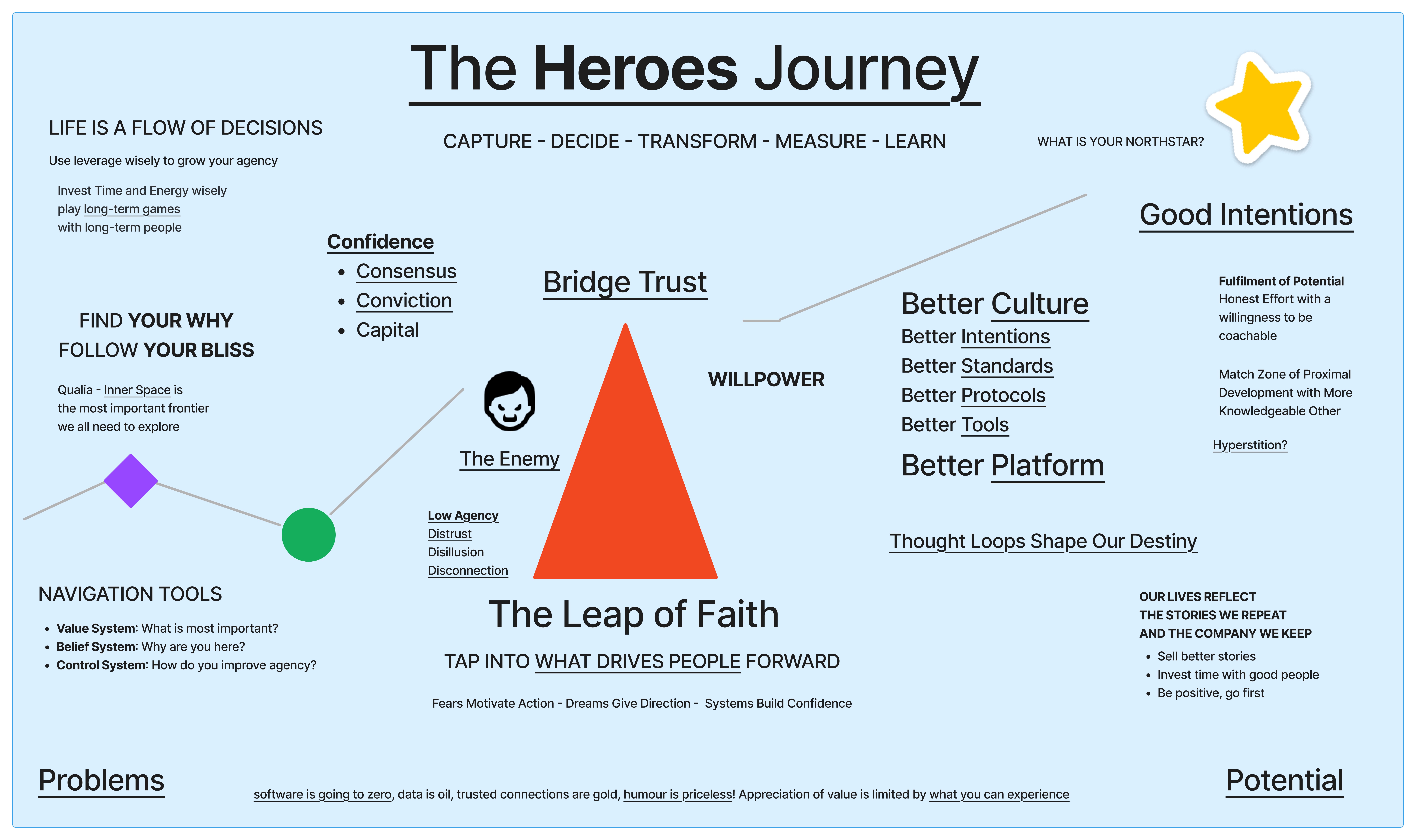
The map is an overview. The method below carries its critical relationships in text.
The quest in one line
Set the Northstar → hear the call → prepare → face the enemy within → gather allies → bridge trust → take a bounded leap → transform, measure, learn → return with greater agency.
The hero is the learner. The Northstar is the good the journey should serve. The treasure is evidence and increased agency. A good return may be ADVANCE, TEST, PARK, or KILL.
Before you leave home
Set your boundaries before the story creates momentum:
- Time: how many hours can you spend before review?
- Money: what can you lose without harm or pressure to continue?
- Trust: whose consent, privacy, or reputation must you protect?
- Safety: what would make you stop immediately?
- Authority: who must approve money, meetings, accounts, data, or public claims?
If you are under 18, involve a trusted adult before spending money, collecting personal information, meeting strangers, entering contracts, or using a platform with age restrictions.
1. Set the Northstar
Before asking whether the idea can work, ask whether it should.
I want to help person move from present state to better state while protecting value, consent, or boundary.
Output: one intended beneficiary, valuable change, and protected boundary.
2. Hear the call
Write the idea without pitching it:
I think person might need help with situation because I noticed observation.
Output: one idea sentence with an observation, not a promise.
3. Prepare your navigation tools
Use three tools before the terrain becomes difficult:
- Value: what matters, for whom, and what must not be traded away?
- Belief: what do you think is true, and what evidence could prove you wrong?
- Control: what can you change now, what will you measure, and when will you stop?
Output: one value, one testable belief, and one controllable next move.
4. Meet the person
Choose one real kind of person. Ask what they are trying to do, what gets in the way, and what they do now.
Do not ask, “Would you buy my idea?” That invites encouragement. Ask about a real recent event.
Output: one person, one struggling moment, and one current workaround.
5. Face the enemy within
Self-doubt grows when the path, capability, or evidence is unclear. Do not silence it or obey it. Turn it into the question most likely to defeat the idea.
This idea fails if assumption is false. I would notice because observable signal.
Output: one assumption and the evidence that would contradict it.
6. Gather allies through positive collisions
Find people whose experience, capability, or honest disagreement can improve the quest. A useful ally does not take over the decision. They help you see more reality, make a connection, practise a skill, or reach the intended beneficiary safely.
I need help with specific gap. The right ally can help by bounded contribution. I keep authority over decision or boundary.
Output: one capability gap, one possible ally, and one bounded ask.
7. Pack light
Start with what you know, what you can do, and who can help. Set an affordable loss before imagining the reward.
Before review, I may spend at most time, money, and trust. I will not risk protected boundary.
Output: a small resource budget and a stop rule.
8. Bridge trust with a quick win
People cross the bridge when they understand the promise, know what happens next, feel safe to begin, and receive useful value quickly. Design the first experience as a small system:
- Invite: say who it is for and what small change you will try to create.
- Onboard: explain the steps, time, cost, data, consent, and exit.
- Deliver: make one promise small enough to keep reliably.
- Appreciate: ask the beneficiary what became easier, better, or worse.
- Learn: fix the system before asking for greater trust.
A quick win is not a trick for conversion. It is the first honest proof that the relationship may create value.
Output: one onboarding path, one small promise, and one beneficiary-observed win.
9. Cross the threshold
Choose the smallest action that lets reality answer your hardest question. You may show a sketch, make one example by hand, observe a workflow, or offer a small service. You do not need a company, app, brand, stock, or business plan yet.
Declare the result before the test:
- Advance signal: what behavior would justify a larger test?
- Failure signal: what would contradict the idea?
- Ambiguous result: what will you do if the signal is unclear?
- Review point: when will you decide?
Output: one reversible test with a declared decision rule.
10. Transform, measure, and learn
Record what people do, not only what they say.
Stronger signals include repeated use, payment, time committed, a scheduled next step, or tolerating a rough version because the outcome matters. Compliments and hypothetical interest can improve your next question; they do not prove demand.
Output: a short evidence log with facts, assumptions, surprises, and burdens kept separate.
11. Return with greater agency
Choose exactly one decision:
- ADVANCE — evidence supports one slightly larger, still bounded move.
- TEST — one important uncertainty deserves another small test.
- PARK — the idea may matter, but timing, access, or capability blocks an honest test now.
- KILL — evidence contradicts a critical assumption or a protected boundary cannot be kept.
Stopping is not failure. A killed idea can return time, money, attention, and a better question.
Return the lesson to the people who helped. Keep the smallest reusable improvement: a better question, promise, onboarding step, standard, protocol, or tool.
Output: one decision, its reason, one returned lesson, and what you would do differently on a second idea.
Worked example: revision cards
| Quest beat | Example |
|---|---|
| Northstar | Help one classmate revise with less confusion without collecting personal data or breaking school rules. |
| Call | “Some classmates lose track of what to revise before science tests.” |
| Person | One classmate who recently prepared for a test using scattered notes. |
| Navigation | Value: useful understanding. Belief: a short topic pack may help. Control: test one pack and observe use. |
| Enemy within | “I do not know whether this is good enough.” Turn that doubt into: “Will they use it twice without reminders?” |
| Allies | Ask a science teacher to check accuracy and a classmate to challenge confusing instructions. |
| Pack | Three hours, no personal data, no school-rule breach, and no printing spend before review. |
| Bridge trust | Explain the one-topic trial, give an easy exit, deliver the pack when promised, and ask what became clearer. |
| Threshold | Make one topic pack by hand with permission and observe whether the classmate uses it twice. |
| Evidence | Record use, questions, changes requested, burden, and whether they ask for another topic. |
| Return | TEST: they used it once but asked for a shorter version. Improve the onboarding instructions and test the changed format before doing more. |
The example does not prove a market. It shows how to let one safe action improve the next decision.
Copy your quest card
FIRST BUSINESS QUEST

Northstar — Who should benefit, what becomes better, and what stays protected?
Call — My idea:
Navigation — Value, testable belief, controllable move:
Person — Who might benefit, and what happened recently?
Enemy within — What does self-doubt reveal that I need to learn or test?
Allies — Which positive collision could add capability, truth, or access?
Pack — Time, money, trust, safety, authority, and stop rule:
Bridge trust — Invitation, onboarding, small promise, quick win, beneficiary check:
Threshold — Smallest reversible test:
Advance signal:
Failure signal:
Ambiguous-result rule:
Review point:
Evidence — What happened, including burdens and surprises?
Return — ADVANCE / TEST / PARK / KILL, because:
Elixir — Which better question, promise, standard, protocol, or tool returns to others?
Transfer — What will I do differently on my next idea?
Proof of done
You are done with the first quest when another person can read the card and identify:
- what you observed;
- what you assumed;
- what you risked and protected;
- what the test showed;
- why the decision follows; and
- what evidence would change it.
The story helped you navigate. The evidence decides what happens next.
Action ladder
- Do it now: complete the quest card for one idea without spending money or contacting anyone yet.
- Test it more deeply: use Business Idea Evaluation when the first card exposes a consequential demand, access, delivery, or value-capture question.
- Run a guided experiment: start a Journey when you want support carrying one bounded test through evidence and review.
Context
- depends-on Idea Capture — preserve a real observation before polishing the solution.
- depends-on Education Principles — protect agency, use support, fade help, and test transfer.
- risk-governed-by Risk Management — bound downside before commitment grows.
- applies-to Business — browse deeper principles, models, instruments, flows, and capabilities only when the quest reveals what you need.
Sources and limits
- EntreComp frames entrepreneurship as acting on ideas to create value for others through ideas, resources, and action.
- OECD and European Commission school guidance supports progressive, ethical, action-based entrepreneurial learning with judgment, consequence awareness, and external support.
- Research on hero-based youth interventions is promising but varied and does not prove that this story scaffold improves business decisions.
Changes my mind: supervised learner evidence shows that the story increases pressure, confusion, coaching dependence, unsafe risk, or narrative confidence without improving the test and decision.