Distribution
How do you reach those who need what you offer?
Superior distribution beats a superior product - Peter Thiel
AI-World Moat
When AI makes building cheaper, distribution becomes harder to fake. More people can make products, posts, demos, and code. Fewer can earn attention, trust, repetition, and referral.
Distribution is more than reach. It is the loop that returns proof, demand, reputation, talent, and better questions.
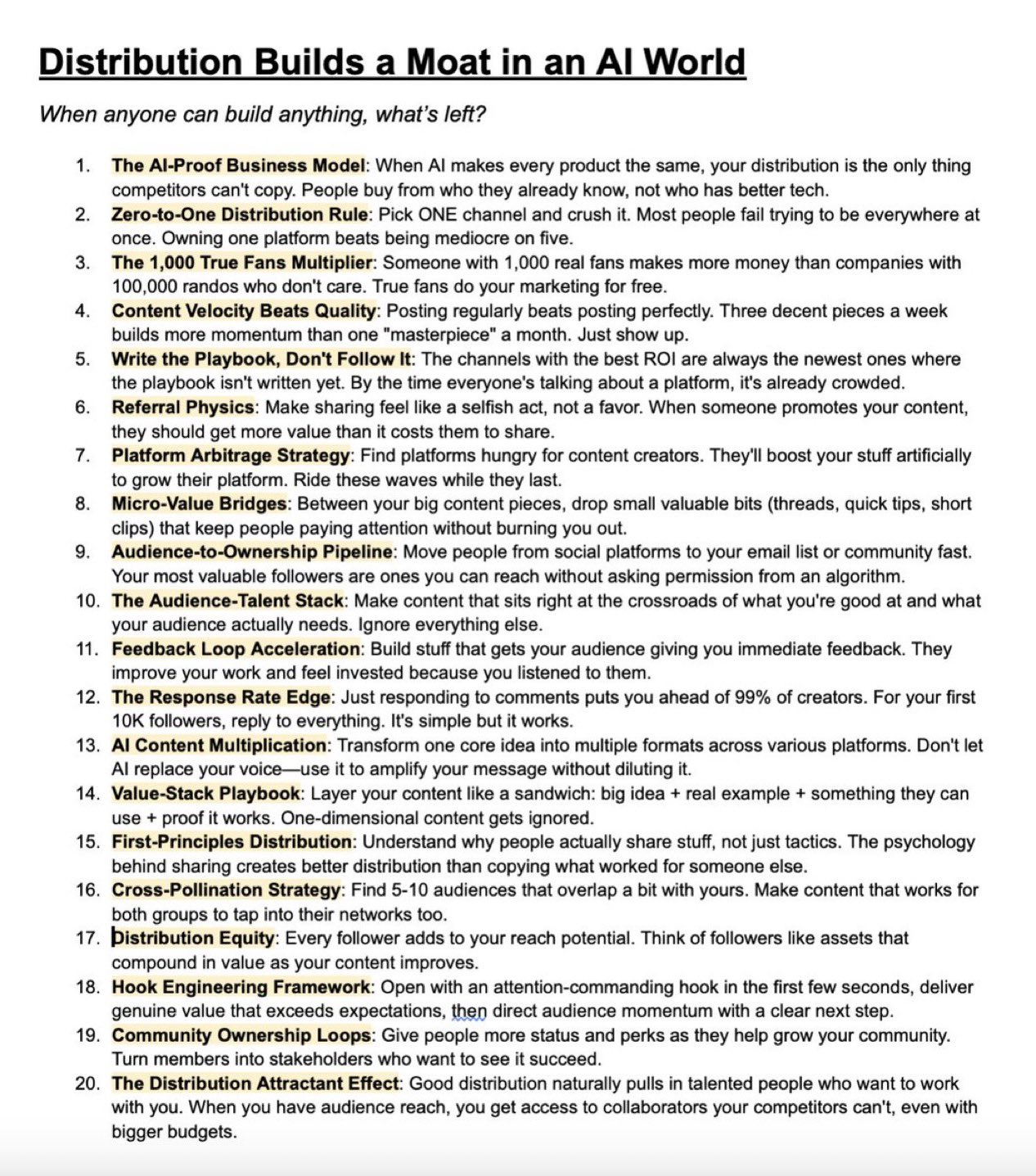
The strategic lesson is not "post more." It is:
- Own one channel deeply before spreading attention across five.
- Build audience ownership quickly; rented platforms are signal sources, not homes.
- Treat every follower, reply, referral, and collaborator as compounding distribution equity.
- Use AI to multiply a real voice, not replace it with generic volume.
- Bridge big ideas with small, useful fragments so attention does not have to restart from zero.
- Make sharing valuable for the person who shares.
- Let audience feedback improve the work in public so people become invested in the loop.
In an AI world, product creation moves toward abundance. Trust, timing, taste, community, and owned distribution remain scarce.
Perceive
Distribution gets your product or service to the customer with less friction. It is the full path from creation to use.
Distribution is essential to success and should be integrated into product design from day one.
Distribution closes the loop:
Value created -> value delivered -> response captured -> offer improved -> trust compounded
If distribution does not produce feedback, it is broadcasting. If feedback does not change the next offer, it is noise.
The Distribution Stack
| Tight Five | Layer | Question |
|---|---|---|
| 01 | Awareness | How do people learn you exist? |
| 02 | Acquisition | How do they become customers? |
| 03 | Activation | How do they experience value? |
| 04 | Retention | How do they keep coming back? |
| 05 | Referral | How do they bring others? |
Direct vs. Indirect
- Direct: You control the entire path to customer (DTC brands, SaaS)
- Indirect: You use intermediaries (retailers, marketplaces, affiliates)
Each has trade-offs in margin, control, and scale.
Why It Matters
The best product doesn't always win. The best distributed product wins.
Hard Problem
Distribution is the hardest and most important problem to solve. History's biggest innovations needed distribution solutions:
- The printing press democratized knowledge
- The plough transformed agriculture
- The internet removed geographic barriers
Distribution Fit
Product-market fit is not enough. You also need product-distribution fit:
- Does your distribution channel match your customer's behavior?
- Can you afford to acquire customers through this channel?
- Does the channel scale with your growth?
Distribution Trap
Many startups build great products then ask "how do we get customers?"
This is backwards. Distribution should inform product design:
- What channels can you access?
- What do those channels reward?
- What products fit those channels?
Failure Modes
- Building first and asking for customers later.
- Chasing five channels before owning one.
- Renting attention without moving people to an owned channel.
- Broadcasting without a feedback path.
Build Distribution
Define Path
Make your product or service available to those that need it with:
- Minimum time
- Minimum effort
- Minimum cost
- Maximum quality
- As close to the point of need as possible
Choose Channels
| Channel | Best For | Trade-offs |
|---|---|---|
| Viral/Word of mouth | Consumer products with social value | Slow start, unpredictable |
| Content marketing | Complex products, thought leadership | Time intensive, slow ROI |
| Paid acquisition | Scalable products with good unit economics | Expensive, competitive |
| Sales | High-value enterprise deals | Expensive, doesn't scale linearly |
| Partnerships | Access to established audiences | Loss of control, split value |
Product Integration
The best distribution is invisible—built into the product itself:
- Invite mechanisms
- Sharing features
- Network effects
- Platform integrations
Measure
Track the full funnel:
- Cost per acquisition
- Conversion rates at each stage
- Customer lifetime value
- Payback period
Technology and Distribution
Blockchain examples of distribution innovation:
- Extra Virgin Olive Oil - Provenance tracking
Checklist
- Do you have a clear path from product to customer?
- What is your cost to acquire a customer?
- Does your distribution scale?
- Is distribution integrated into your product?
- What would 10x better distribution look like?
The Marketing-Site Distribution Test
A marketing site is the cheapest distribution instrument you own. Most sites broadcast. A few distribute. The difference is measurable before you spend on a single channel.
Run five checks. Score each one: fail, partial, or pass. Each check buys a distinct distribution property — reach, trust, conversion, or control.
1. Name the dream
Does the headline name the change the reader wants, or label the product?
- Fail: the headline describes the tool ("all-in-one platform", a placeholder line).
- Pass: the headline names the transformation the reader is buying.
- Buys reach. A named dream is repeatable and shareable. A feature list is not.
2. Show the value fast
Can a first-time visitor say what they get in one scroll, without decoding jargon?
- Fail: the concrete offer arrives three sections down; the hero is abstract.
- Pass: the outcome and the mechanism are legible above the fold.
- Buys conversion. Attention spent decoding is attention not converting.
3. Prove the belief with evidence
Is the proof first-party and real, or asserted?
- Fail: stats are symbols or industry averages; quotes come from archetypes, not customers.
- Pass: at least one real result, named source, or honestly-labelled pilot signal.
- Buys trust. Borrowed or invented proof is discounted on sight.
4. Route the buyer and the agent
Is there one clear next action for a human, and a machine-readable surface for an agent?
- Fail: a human call-to-action, but no structured data an AI intermediary can read or cite.
- Pass: one obvious human action plus an agent-readable surface (structured data, a machine manifest).
- Buys reach and conversion in a market where agents increasingly choose on the buyer's behalf.
5. Feed the lesson back
Does the page capture a signal that improves the next version?
- Fail: no analytics, no diagnostic, no owned-audience capture. The page broadcasts and forgets.
- Pass: a live loop — measured behaviour, a low-friction diagnostic, or an owned-audience capture path.
- Buys control. A site without a feedback loop is a billboard, not an instrument.
Read the score
A page that fails half these checks does not have a channel problem. It has a coordination problem: it has not yet decided who is owed what value, or proven it. Fix the site before you buy attention — paid reach amplifies a page that already converts and wastes one that does not. Below roughly half the available points, tighten the wedge before adding channels (heuristic, consistent with the launch-gate discipline in the Distribution Checklist).
Links
Context
- Zero to One
- Leverage
- Network Effects
- Unit Economics
- Reality Scoreboard
- The Distribution Checklist — The five-pillar operator's checklist that puts this doctrine into weekly practice
Questions
What is the most important question this topic raises that current discourse tends to avoid or understate?
- Which assumption in the standard framing of this topic is most likely to be wrong in a 5-year horizon?
- How does the DePIN or agent-native lens change what matters most about this topic?
- Which first principle, if violated, would make the analysis of this topic fundamentally incorrect?