You are here: PlaybookOn this page
Ecosystem
An ecosystem works when the right participants can see how to contribute, trust the exchange, and receive enough value to stay involved.
Use this map to answer three questions:
- Who participates?
- What does each participant need, offer, and protect?
- Which missing role or broken relationship stops value from flowing?
Choose where to look
- Archetypes — choose the mindset the situation needs, such as Dreamer, Engineer, Realist, Teacher, Coach, or Skeptic.
- AI Beings — evaluate persistent AI identities without hiding their models, tools, operators, incentives, or human authority.
- Roles — assign a bounded contribution, evidence duty, and authority boundary.
- Drivers — understand what moves each participant and makes contribution worthwhile.
Archetypes are selectable modes. Roles are accountable contributions. Neither is a fixed identity or a measure of worth.
Map the counterparties
Most economic ecosystems contain five recurring counterparties. One participant may wear several hats, but each hat changes what they need and how they judge value.
| Counterparty | Understand | Signal |
|---|---|---|
| Customers | Needs, aspirations, alternatives, and time horizons | Demand |
| Employees | Motivation, capability, security, and meaning | Energy |
| Suppliers | Constraints, incentives, dependency, and durability | Capacity |
| Investors | Risk tolerance, required return, and time horizon | Capital |
| Regulators | Mandates, constraints, and public consequences | Permission |
Blind spots shrink when you can describe the exchange from every affected perspective.
See how trust compounds
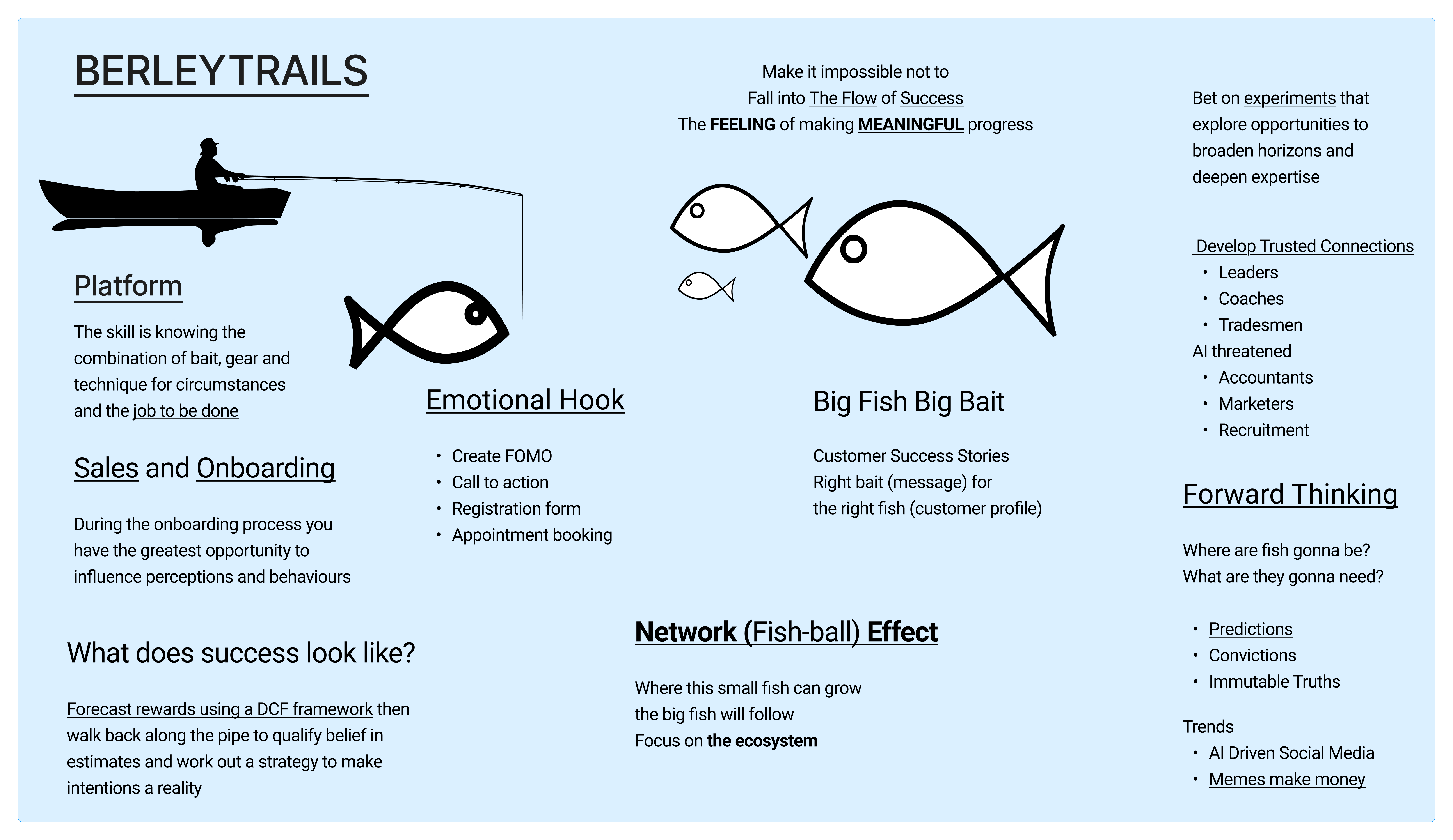
The Berleytrails image shows how intent can become a trusted network:
| Step | Ecosystem job |
|---|---|
| Intent | Notice a real need, desire, problem, or offer. |
| Route | Connect the signal to the participant able to respond. |
| Infrastructure | Supply the platform, process, tool, or capability needed to exchange value. |
| Settle | Keep the promise, make contribution visible, and let trust accumulate. |
| Feedback | Learn where participants, constraints, and opportunities are moving next. |
You do not create a healthy ecosystem by extracting the largest participant first. You create conditions where small, useful exchanges work reliably enough to attract more contribution.
Test each relationship
For one important exchange, write:
Participant:
Hat they are wearing:
What they contribute:
What they receive:
What they protect:
Trust needed before they begin:
Quick win that proves useful value:
Evidence that would show the relationship is failing:
Missing role or capability:
A role bridges trust when it makes the promise, onboarding, authority, evidence, and exit clear. For example, a Forward Deployed Engineer can carry one participant problem into production proof without taking ownership of the whole ecosystem.
Common failures
- Single-perspective design: one participant wins by shifting hidden cost onto another.
- Role confusion: identity, status, mindset, and accountability are treated as the same thing.
- Trust without proof: participants are asked for commitment before a small promise is kept.
- Extraction before health: growth is measured while participation, consent, or value flow deteriorates.
- Missing return path: feedback is collected but does not change the system.
Context
- depends-on Purpose — define the shared future and protected values that make coordination worthwhile.
- pairs-with Culture — turn trusted contributions into repeated behaviour.
- depends-on Onboarding — help a willing participant understand the promise, process, authority, and exit.
- proved-by Standards — make each contribution and relationship testable.
- applies-to Business — coordinate demand, capability, delivery, exchange, and learning around value people appreciate.
Changes my mind: this map cannot reveal the relevant participants, incentives, constraints, value exchanges, or missing roles in a real ecosystem.
Questions
Which relationship currently stops value from flowing?
- Which participant's perspective is missing?
- Which promise must earn trust through a quick win?
- Which role needs clearer authority or evidence duties?
- What would show that the ecosystem is becoming healthier rather than merely larger?
Next question: who can make the smallest useful repair without taking authority from the people affected?