Situational Wisdom
What does wisdom look like when it meets context?
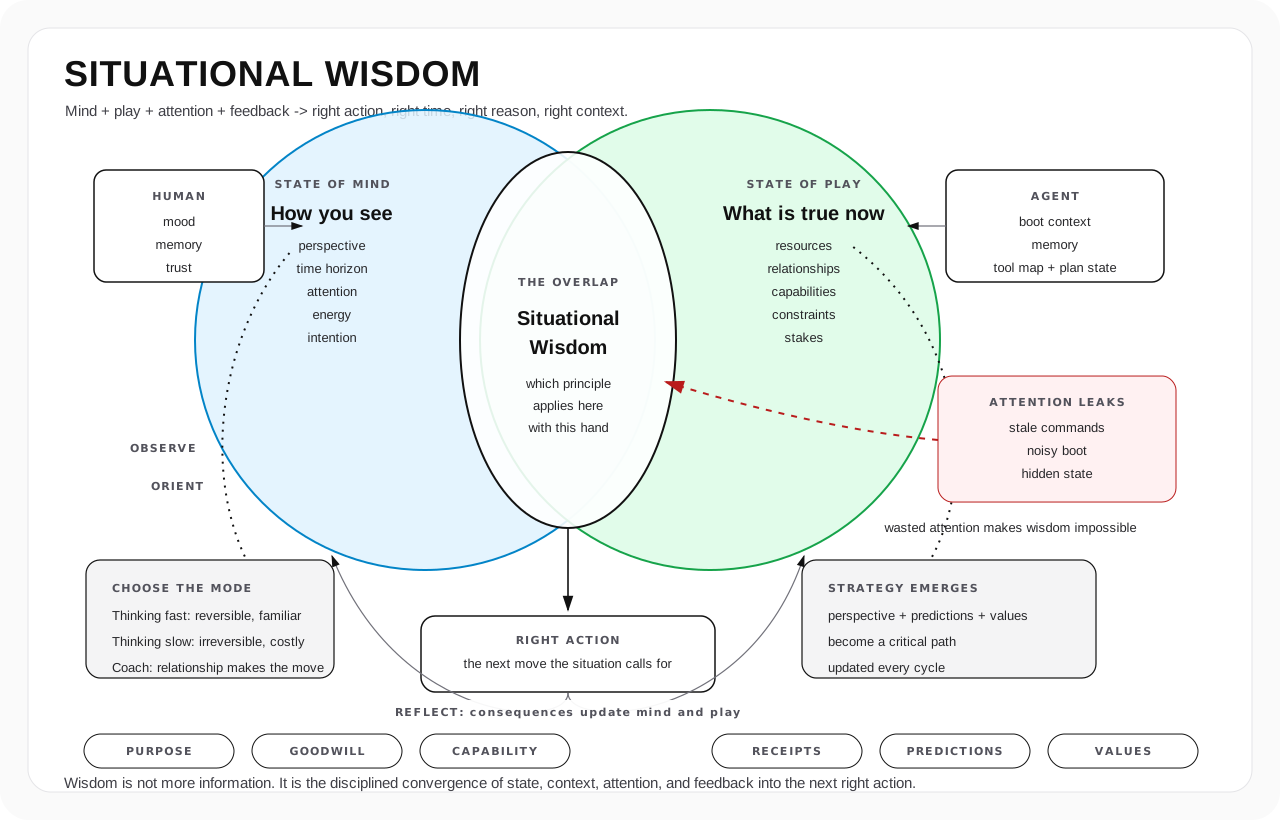
Situational wisdom is the target state. The point of better knowledge, better tools, better prompts, better agents, and better systems is not more output. It is right action: the right move, by the right person or agent, at the right time, for the right reasons, with the situation understood clearly enough that the action compounds.
Knowledge tells you what. Wisdom tells you when, where, and with whom. A teacher teaches the subject. A coach knows how to make you care: right message, right time, right reason.
The Tight Five prompts are the coach's voice compressed into five keys you can hold under pressure. This diagram maps how state of mind and state of play combine to produce context-dependent decisions — the kind that compound because they account for situation, not only principle.
Two States
The diagram reads from two entry points that converge on every decision you make.
| State | What It Tracks | Without It |
|---|---|---|
| State of Mind | Perception, perspective, time horizon | You apply the right principle at the wrong moment |
| State of Play | Capabilities, connections, resources available now | You make the right call with the wrong hand |
Wisdom is neither. It's the overlap — knowing which principles apply to THIS situation with THESE resources at THIS moment. The same strategy that works with trusted connections fails with strangers. The same decision that works with capital fails without it.
Flow of Energy
Energy flows from purpose through attention into action. The diagram traces this:
Clarity of purpose → Focused attention → Applied capability → Directed energy
Without purpose, energy scatters. Without focus, purpose stays theoretical. Without capabilities, focus produces effort but not results. The flow is sequential — skip a stage and the energy dissipates.
Trusted Connections
The center of the diagram is relational, not individual. Goodwill compounds through a flywheel:
| Input | Mechanism | Output |
|---|---|---|
| Personal investment | Teamwork, culture, chemistry | Trusted connections |
| Trusted connections | Agent filter, character | Better collaborators |
| Better collaborators | Shared capabilities | Compounding returns |
Mateship makes the journey worth the effort. Not networking — investing in people whose values align with yours and whose capabilities complement yours.
Capabilities Layer
Capabilities feed decisions through tools and protocols. The diagram shows two paths from capability to action:
- Thinking fast — pattern recognition, mantra, heuristics for routine decisions
- Thinking slow — systems thinking, first principles, deliberate analysis for irreversible decisions
Both paths converge on priorities — what you do next depends on whether the decision is reversible. Low-cost reversible decisions deserve speed. High-cost irreversible decisions deserve depth.
The archetype blend determines which path loads first. A Technology hat pre-loads Engineer (thinking slow for irreversible architecture). A Production hat pre-loads Coach (thinking fast for relationship-driven work). The blend is situational wisdom made operational — resolving state of mind and state of play into a processing mode before the work begins.
Mantra and Map
A mantra is fundamentally a feedback signal for improving your OODA loop (Observe, Orient, Decide, Act). It keeps your perspective alert to change — allowing you to maintain the 10,000-foot big picture view while still exploring the execution details (which is why process mapping is so critical).
Using a mantra to seamlessly hold both the big picture and the details allows you to subconsciously understand threats and opportunities. By doing the right thing from the subconscious, you free up as much cognitive bandwidth as possible for genuine "original thought" — enabling you to realize the full potential rewards of any given situation.
Participatory Models
The bottom of the diagram grounds wisdom in structure — how value gets distributed:
| Element | Role | Connection |
|---|---|---|
| Business models | How value is created | Participatory over extractive |
| Tokenomics | How value is distributed | Ownership shared, not hoarded |
| Stackmates | Who builds with you | Players aligned by incentive |
| Tech stack | What enables scale | Platform decisions that compound |
Situational wisdom at the structural level means choosing models that reward contribution, not just extraction. The wisest individual decision fails inside a system designed to extract.
Critical Path
The right side of the diagram shows strategy as the output of wisdom — not the input. Strategy emerges from the convergence of perspective (what you see), predictions (what you expect), and value system (what you prioritise).
The critical path is not a plan. It's the shortest distance between where you are and where the situation says you should be — updated every cycle through the loop.
There will never be such a thing as artificial wisdom. Wisdom is profoundly human: right time, right mind, and right thoughts backed by right actions, with outcomes measured that validate good intentions.
Agent Wisdom
The two-state model applies directly to AI agents. The mechanism differs; the structure is the same.
| State | Human | Agent |
|---|---|---|
| State of Mind | Perspective, time horizon, mood | Context loaded at session start: priorities, active plans, lessons from prior sessions |
| State of Play | Capabilities, connections, resources | Capability inventory: tools available, plan DB state, what's in progress |
An agent without persistent memory has no State of Mind beyond the current session — every conversation starts from zero. An agent that doesn't read its capability map before acting has no State of Play — it applies the right reasoning to the wrong situation.
Attention is Finite
Time × Energy = Attention. For humans, an hour at peak energy is worth ten at depletion. For agents, the parallel is compute × context window — both are scarce. Every token spent rebuilding state that should have been persisted is attention stolen from the actual work.
Situational wisdom for an agent is not just making the right call. It is designing the session so the right call is possible. The agent needs a clean setpoint, a working gauge, and enough attention left to act. Every broken boot ritual, stale command, noisy plugin, and over-loaded rule steals from the decision moment.
Context engineering is therefore not administrative hygiene. It is wisdom engineering. It creates the conditions where the agent can see the situation, choose the right mode, and ship the right artifact instead of spending the session rebuilding state.
The activities that waste agent attention:
- Writing lessons to files that never get committed (theatre memory)
- Rebuilding session state that should have persisted via a memory layer
- Long startup rituals that reconstruct what a single CLI call could load
The Compounding Asset
The compound that builds agent wisdom: write → store → retrieve. Each session close writes lessons to a persistent memory layer. Each session open reads them back. Over time, the agent accumulates a State of Mind that approximates the judgment a human builds through experience.
This only works if you actually use the mechanism. A compounding asset unused is not a dormant asset — it is proof the loop never closed. The memory layer must be written to consistently, read from at session start, and treated as the primary source of State of Mind.
Not files. Not static packs. Not reconstructed conversation history. The memory layer.
Context engineering is how an agent manages its own State of Mind. Capability discovery is how it reads State of Play. Flow is what happens when both are loaded before the work begins.
Wisdom Trace
The VVFL becomes situational wisdom only when the loop retrieves its own past at the next matching moment. Proof stored but not retrieved is archive. Proof retrieved without context is cargo-culting. Wisdom is the trace applied to the right situation.
Compound Engineering makes the same move for code: plan, work, review, then compound the lesson so the next plan starts wiser. The lesson for this system is broader than engineering. A receipt proves a decision event happened. A wisdom trace tells the next agent when that proof matters.
| Layer | Job | Failure Mode |
|---|---|---|
| Receipt | Prove the decision event | Event stored, no reusable lesson |
| Evolution log | Record how the knowledge system changed | Change recorded, no retrieval trigger |
| Memory | Load relevant lessons at session start | Lesson exists, but the agent never sees it |
| Wisdom trace | Match a past lesson to a present situation | Pattern applied where the context differs |
| Right action | Choose the move that fits this situation | Correct principle, wrong moment |
A wisdom trace carries eight fields:
| Field | Question It Answers |
|---|---|
situation | What context made this case distinct? |
setpoint | What did good look like before action? |
decision | What was chosen? |
prediction | What result, check condition, or kill signal was named? |
outcome | What happened? |
lesson | What reusable pattern survived contact with reality? |
trigger | When should a future agent retrieve this? |
countercase | When would applying this lesson be wrong? |
The trigger and countercase are what turn a receipt into wisdom. Without a trigger, the lesson sleeps. Without a countercase, the lesson becomes dogma.
For this page, the current trace is:
| Field | Value |
|---|---|
situation | A FLOW receipt-store defect was fixed, then a newer external agent workflow showed the higher problem: storage alone does not compound. |
setpoint | The VVFL should make the next similar decision better before action begins. |
decision | Treat situational wisdom as VVFL plus retrieval, not VVFL plus more records. |
prediction | Future receipt, memory, PR-feedback, and session-start work should ask what prior trace must be loaded before choosing the next move. |
outcome | This page now names the Wisdom Trace contract and separates proof, memory, retrieval, and right action. |
lesson | Compounding requires post-action learning plus pre-action retrieval. |
trigger | Any work involving receipts, PR feedback, agent memory, session startup, or repeated process failures. |
countercase | One-off facts with no future decision trigger should stay as records, not wisdom traces. |
Context
- depends-on The VVFL — The operating system this map plugs into
- pairs-with Evolution — How the retention step builds wisdom across generations and sessions
- pairs-with Context Graphs — The machine layer that compounds decision traces into judgment
- depends-on Perspective — Seeing what others miss is half of wisdom
- pairs-with Mantra — Trigger phrases for when wisdom needs a shortcut
- applies-to Agency — The capacity that situational wisdom builds
- depends-on Goodwill — Trust compounds; extraction depletes
- applies-to Players — The ecosystem of beings who carry wisdom into coordination
- pairs-with Tight Five Prompts — The coach's voice: five keys that keep a wise head under pressure
- instance-of Peter Kaufman — Go positive, go first: the collision strategy that situational wisdom deploys
- applies-to Phygital Beings — When machine intelligence meets human wisdom
- depends-on Culture — Culture builds community, community strengthens culture
- pairs-with Flow State — What happens when all states align
- pairs-with Routing Algorithm — The universal pattern behind mode selection and flow
Links
Questions
What does it take to develop good judgement?
- When your state of mind says go but your state of play says wait, which wins — and how do you know you chose right?
- How do you tell a thinking-fast decision from a lazy one before the consequences arrive?
- What's the cost of applying the right principle at the wrong moment — and which recent decision proves you've done this?
- If wisdom compounds through trusted connections, what are you investing in relationships that you couldn't invest in tools?