Inner Space
What changes when you step inside the frame through which you see?
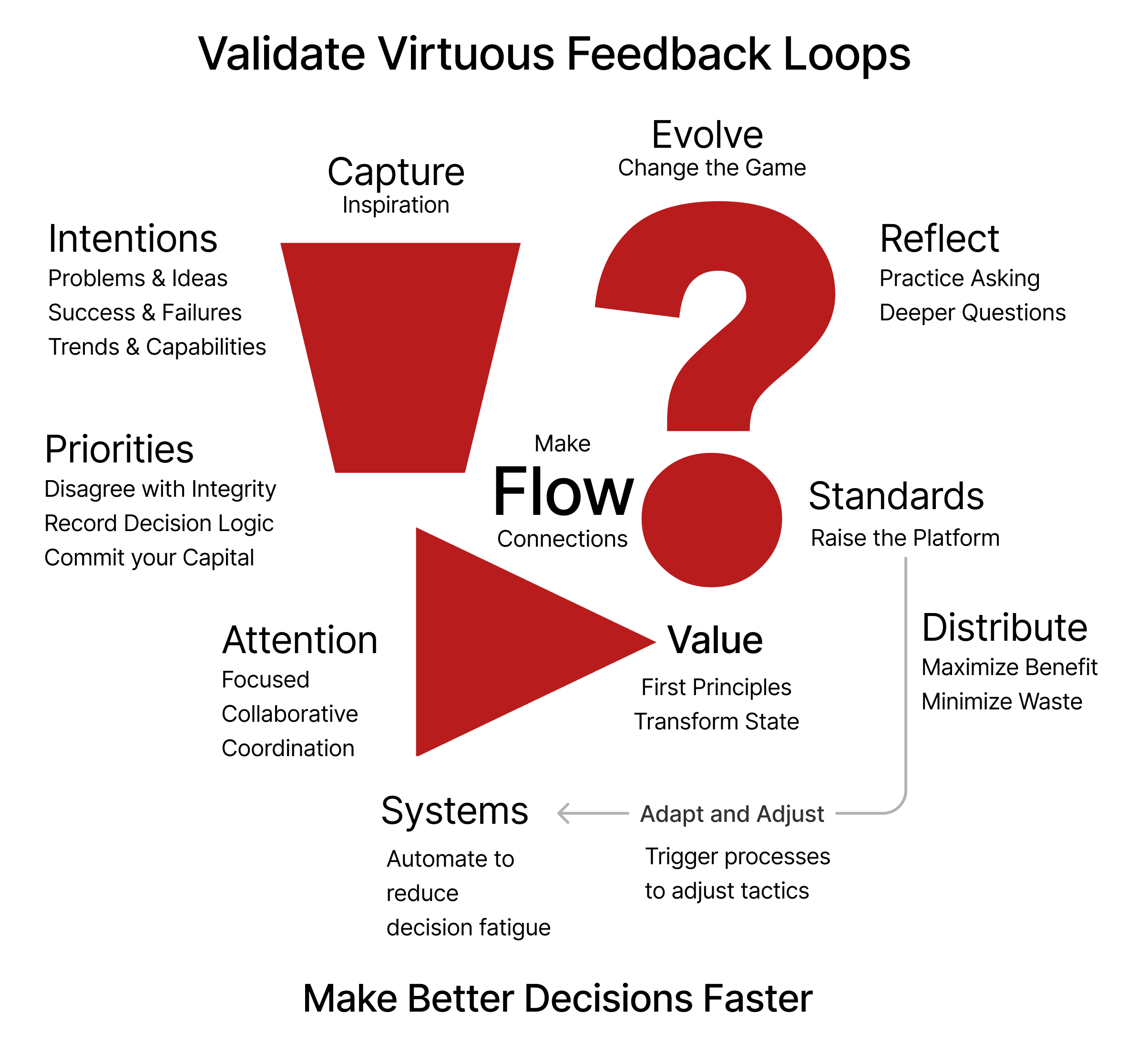
Problem: Automatic stories can make one position, condition, and future feel inevitable.
Question: What becomes visible when you step inside the frame through which you see?
Decision: Enter inner space, picture the field, then return with one falsifiable quest.
Inner space is the gap between stimulus and response where a person can rehearse a future before making it real. It is not escape. It is conscious simulation followed by contact with reality.
SEE -> IMAGINE -> QUESTION -> ACT -> RECEIVE REALITY -> SEE DIFFERENTLY
The eye is also a question mark and a control system. To see consciously is to question the frame through which you see. A compelling picture becomes a setpoint. It directs attention, reveals matching possibilities, and coordinates action.
This reusable model joins reception, picture, play, question, and proof.
Art without a reality gauge becomes fantasy. Measurement without art only optimizes the world inherited from others.
The Five Moves
- Become receptive. Interrupt the current physiological and narrative loop with silence, walking, breathing, sleep, movement, or nature.
- Picture the field. Draw, write, visualize, map, or model present reality and a valued alternative. Externalizing the picture exposes hidden relationships.
- Enter voluntary play. Use a game, simulation, role-play, sport, scenario rehearsal, or creative making to experience consequences safely.
- Ask from inside the picture. Find the consequential gap. Ask one question capable of changing the setpoint, belief, or next decision.
- Return with proof. Take one real-world quest, observe its consequences, teach back what changed, and improve the question-generating system.
Games are a safe induction surface because they make invisible systems perceptible. Fog of war admits what is unknown. A world map shows position. Visible conditions show readiness.
A daily briefing narrows the field to one chosen quest. The practice does the same without requiring a new game framework.
Position × Condition
Every cycle must change at least one coordinate and observe both.
| Coordinate | What to picture | Useful question |
|---|---|---|
| Position | Options, relationships, resources, information, and proximity to the valued future | What move is available from here? |
| Condition | Energy, capability, conviction, attention, and readiness to act | What state can carry that move? |
If position is unclear, map reality before choosing. If condition is poor, change state before committing attention. Activity that improves neither coordinate is not evidence of greater agency.
Practice
Use this exercise before a consequential action:
- Name the mode. What story, feeling, and thinking mode is running now?
- Picture position and condition. What can you reach, and what can you carry?
- Mark the fog. Which assumption, missing stakeholder, time horizon, or evidence state could change the picture?
- Choose one quest. What is the smallest real action that could falsify the picture?
- Define proof. What observable consequence means continue, correct, or stop?
- Schedule the debrief. When will the result become the next question, input, or control?
The output is one quest, not a list of insights. The quest is complete only when its consequence changes what you can perceive next.
Failure Modes
Inner rehearsal cannot establish external truth. A vivid picture may still be wrong, and poor condition may require rest or care rather than another quest. Keep the action small enough that reality can answer without hiding the cost.
Resonance
Resonance is the moment a signal becomes personally meaningful enough to change the picture. It can invite reception, but it cannot replace a falsifiable quest or the reality gauge.
Context
- depends-on Purpose — names a future worth entering the loop for.
- applies-to Agency — diagnoses position and condition before deliberate action.
- applies-to Virtuous Feedback Loop — turns the practice into measured handoffs and a changed next cycle.
- pairs-with The Game — voluntary play makes consequences safe enough to rehearse.
- pairs-with Reading the Game — reads position, conditions, and fog before action.
- pairs-with Manifestation — rehearses a picture while keeping reality as the gauge.
- depends-on First Principles — tests which parts of the picture are fundamental rather than inherited.
- proved-by Performance — lets reality answer the imagined setpoint.
- instance-of Tight Five Loops — holds the practice to five recallable moves.
Questions
What must you picture so clearly that the most meaningful next question becomes impossible to avoid?
- What does your current picture make easy to see?
- What does it hide or make impossible to ask?
- What proof would let the next cycle see differently?
Changes my mind: The practice does not help a reader name position and condition or produce one falsifiable quest.
Next question: What did the last consequence make visible that the first picture hid?