07 · Why · Flow
Flow is the goal and the reward.
Flow is the lived experience of intention and attention aligned in meaningful, voluntary action at the living edge of capability. The loop below helps create and protect its conditions. The loop is not the state itself.
Recognise
Keep the experience at the centre.
Flow is a psychological state of deep absorption, enjoyment, presence, and capable control. It can feel effortless even when the activity is demanding. It is both a destination and an intrinsic reward.
You cannot command the state. You can shape conditions that make it more available: a clear goal, timely feedback, a challenge matched to capability, and voluntary action that matters to the participant.
Enjoyable absorption does not prove that an activity is good. Flow can occur in harmful or compulsive work. Values and protected constraints qualify what the system should support. Consequences must be observed separately.
Flow state
The lived experience: absorption, enjoyment, presence, and capable control.
Flow conditions
Clear goals, timely feedback, matched challenge, and meaningful voluntary participation make the state more available.
Flow consequences
Energy, capability, wellbeing, or beneficiary value may change. The gauge must observe rather than assume them.
Human authority
The participant retains authority over purpose, consent, meaning, and the decision to stop.
Understand
Read the mark as a living control system.
The Dreamineering mark is a hopper, filter, pump, gauge, controller, and return line. Together they form a question mark, an eye, and a feedback loop. Flow sits at the centre as the experience the system seeks to make more available.
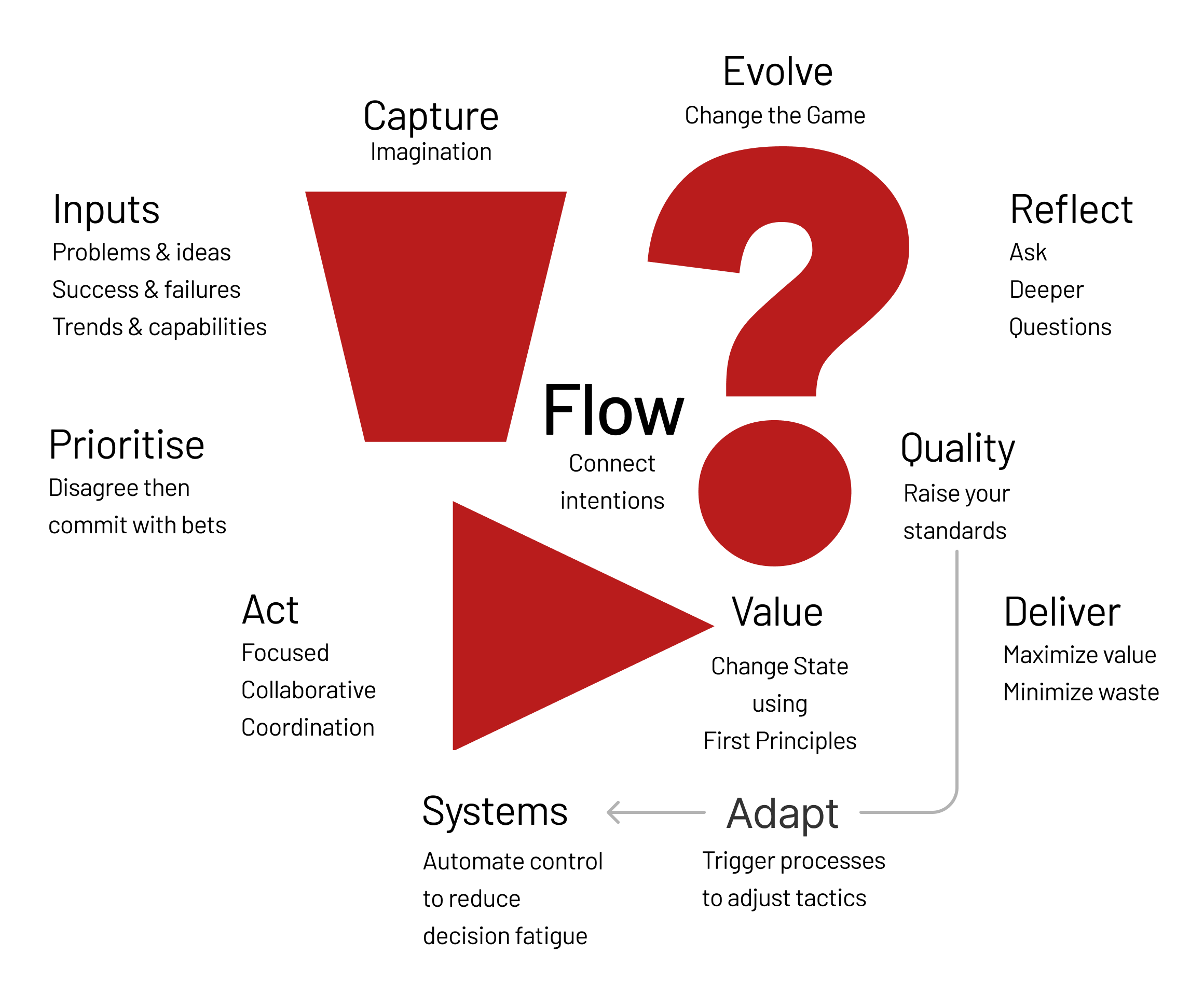
Use the picture as an instrument
Catch · Hopper
Put one idea, problem, signal, or possibility into view.
Filter · Priorities
Use purpose to choose what matters now—and what waits.
Pump · Attention
Commit one bounded challenge at the edge of present capability.
Gauge · Evidence
Read the lived state, its conditions, and its consequences separately.
Question · Controller
Ask whether the direction, method, or destination should change.
Return · Evolve
Carry one learning into the next attempt.
Story carries meaning through every station. It keeps intention, action, consequence, and learning coherent. Story is a Dreamineering design principle, not a universally proved cause of psychological Flow.
Diagnose
Find the station that constrains this round.
The imagination runs constantly. Untrained, it runs to fear, regret, and the crowd — realities that do not exist, yet they capture attention without permission.
A busy person without a return loop can produce activity without learning. Use the picture to locate one constraint: intake, choice, attention, feedback, questioning, or return.
Do not assume the gauge is always the problem. Enter where the evidence says the loop is blocked. Then make one correction small enough to review honestly.
A round closes only when returned experience or evidence changes the next attempt. Completion without a changed next move is an open loop.
Practise
Play one bounded Flow round.
Bring one real idea or problem. Catch it, choose what matters, commit one appropriately challenging action, name a useful gauge and review point, then ask what the next attempt should change.
The existing Journey keeps your round in this browser. It compares two mental-model lenses, preserves your rationale and switch evidence, supports setback recovery, and returns a portable Markdown artifact. No login, payment, email, wallet, or AI is needed.
You keep authority over purpose, consent, risk, meaning, and the decision to stop. Assistance should fade as your independent judgment grows.
Play one Flow round →After you save returned evidence, use the Journey’s named Flow link to come back here. Read the same picture again with a better question.