Pictures
How do the pictures in your head shape what you see?
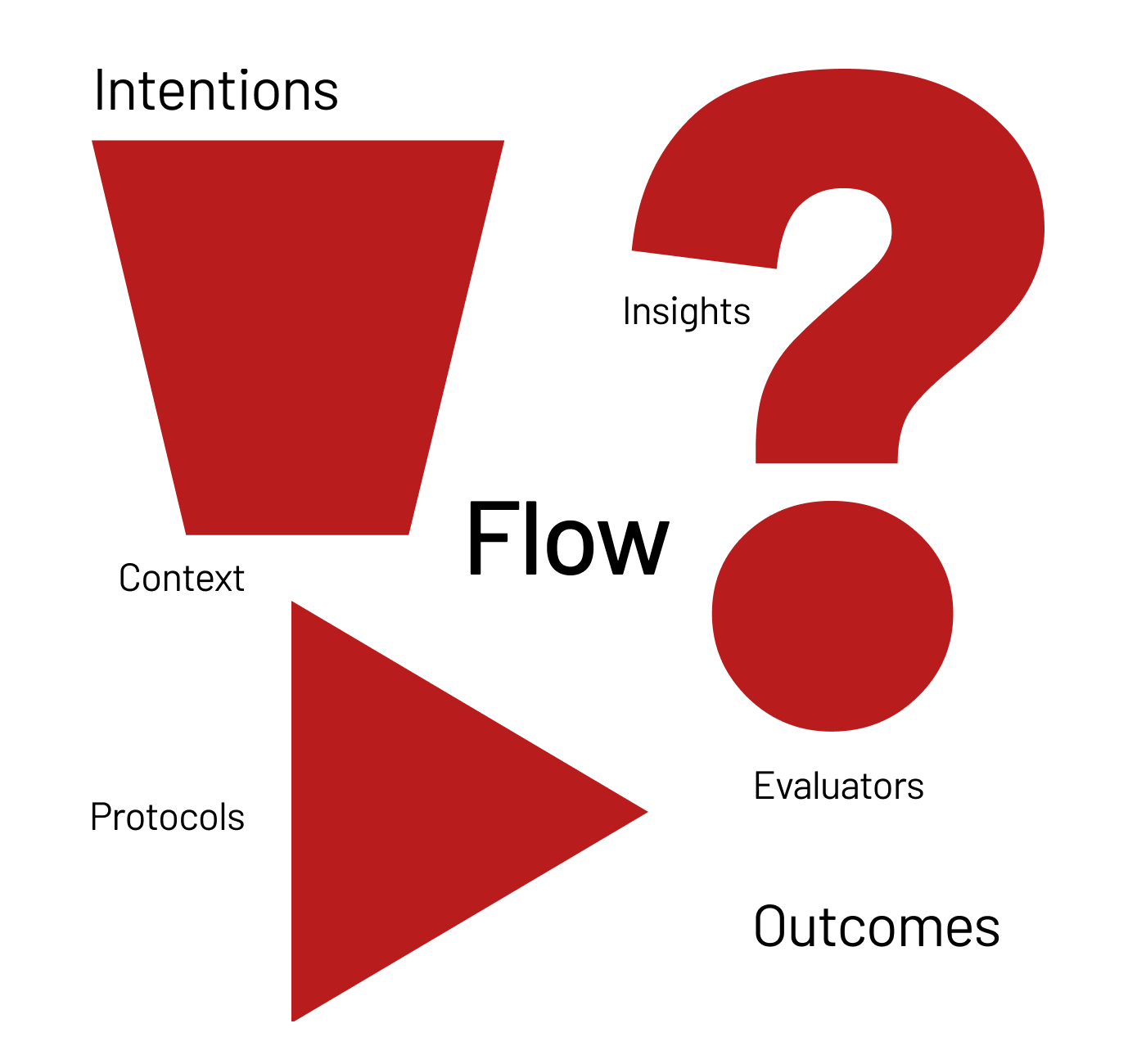
We don't act on reality. We act on our pictures of it. The clearer the picture, the better the decisions. The more distorted, the more we drift. Every feedback loop runs on the quality of the picture feeding it.
A clear picture changes perception. An accurate picture changes perspective. Together they shape what you notice, what you ignore, and what you build toward. This is a trainable skill — perceive what others miss, express it so others can see it too. That is the venture game.
The patterns below are instruments for making pictures. Blank structures proven across industries. Connect the dots and the shape appears. Fill the spaces and the picture becomes yours. The character you bring determines what others see.
The Instrument
Three moments. Nine patterns. Each pattern is a gap that pulls thinking toward an answer.
| Moment | Pattern | Question | Pull | Story |
|---|---|---|---|---|
| See | Value Stream Map | Where does time die? | Waste visible → removal inevitable | — |
| Empathy Map | What do they see, think, feel? | Their eyes → your translation | — | |
| Affinity Diagram | What groups emerge? | Relationships surface → naming gives power | — | |
| Dream | Outcome Map | What does success look like? | Clear outcomes → every decision has a setpoint | The VVFL |
| Business Model Canvas | How does value flow? | Visible flows → extraction can't hide | — | |
| A&ID | How do agents orchestrate? | Visible agents → verifiable intentions | A&ID Loop | |
| Build | Dependency Map | What must happen first? | Clear sequence → obvious next step | — |
| Capability Map | What can we do? | Honest readiness → ambition serves | — | |
| Confidence Matrix | Right thing without choice? | Visible enforcement → discipline becomes structural | — |
Pick one up. Fill the gaps. The shape invites the answer. All patterns →
The Movement
| What It Is | What It Does | |
|---|---|---|
| Patterns | The possibility | Blank patterns. Potential waiting to become matter. |
| Stories | The proof | Filled-in pictures. The method applied to itself. |
Patterns become stories when you commit. The gap between them is the work.
Links
| Name | Purpose |
|---|---|
| Abstraction Laddering | Move between why and how |
| Conflict Resolution Diagram | Surface hidden assumptions in conflicts |
| Inversion | Flip the problem |
| Ishikawa | Trace effects to root causes |
| Issue Trees | Decompose problems systematically |
| Productive Thinking Model | Structured ideation |
Context
- Navigation — Pictures feed the belief system that steers the loops
- Matrix Thinking — Templates are tools, matrix thinking is method
- Visualisation — The capability behind pictures
- Tokenization — When a picture becomes specific enough to trade
- Dream Engineering — The bridge between fear and action
- Close the Gap — Picture the dream, map reality, close the gap
Questions
What makes one picture transmit and another die on the page?
- Which moment do you skip -- seeing, dreaming, or building -- and what breaks downstream?
- When someone sees your picture and builds toward it without you, is the dream theirs now or yours?
- What separates a picture that organises what you know from one that plants a dream you did not have?