The Journey
The Game of Life is largely shaped by the company you keep and the mantra you repeat.
Once you realize you are a conscious agent, the journey begins. Every challenge becomes a voyage: perceive reality, question assumptions, decide under uncertainty, act, and learn from what happens. The quality of your life is shaped by the games you choose to play, the people you sail with, and the questions you ask when you get stuck.
Dreamineering exists to help people play with ideas well enough to notice opportunity, build capability, and expand potential. This page is the navigation layer — a chart for the voyage.
The Arc
Every life follows the same arc. Not a straight line — a spiral. The hero's journey repeats at each life stage, and each time through, the questions get harder and the stakes get higher.
| Phase | Experience | Question |
|---|---|---|
| Call | Awareness of need | What's calling me to change? |
| Threshold | Crossing into unknown | What must I leave behind? |
| Trials | Tests, allies, enemies | Who helps? Who blocks? |
| Abyss | Darkest moment | What must die for me to grow? |
| Transformation | Death and rebirth | Who am I becoming? |
| Return | Coming back changed | What do I bring back? |
| Mastery | Integration, teaching | How do I pass this on? |
The arc runs whether you notice it or not. Noticing it is the first act of agency. Playing with it — deliberately, with good spirit — is what turns survival into growth.
The Loop
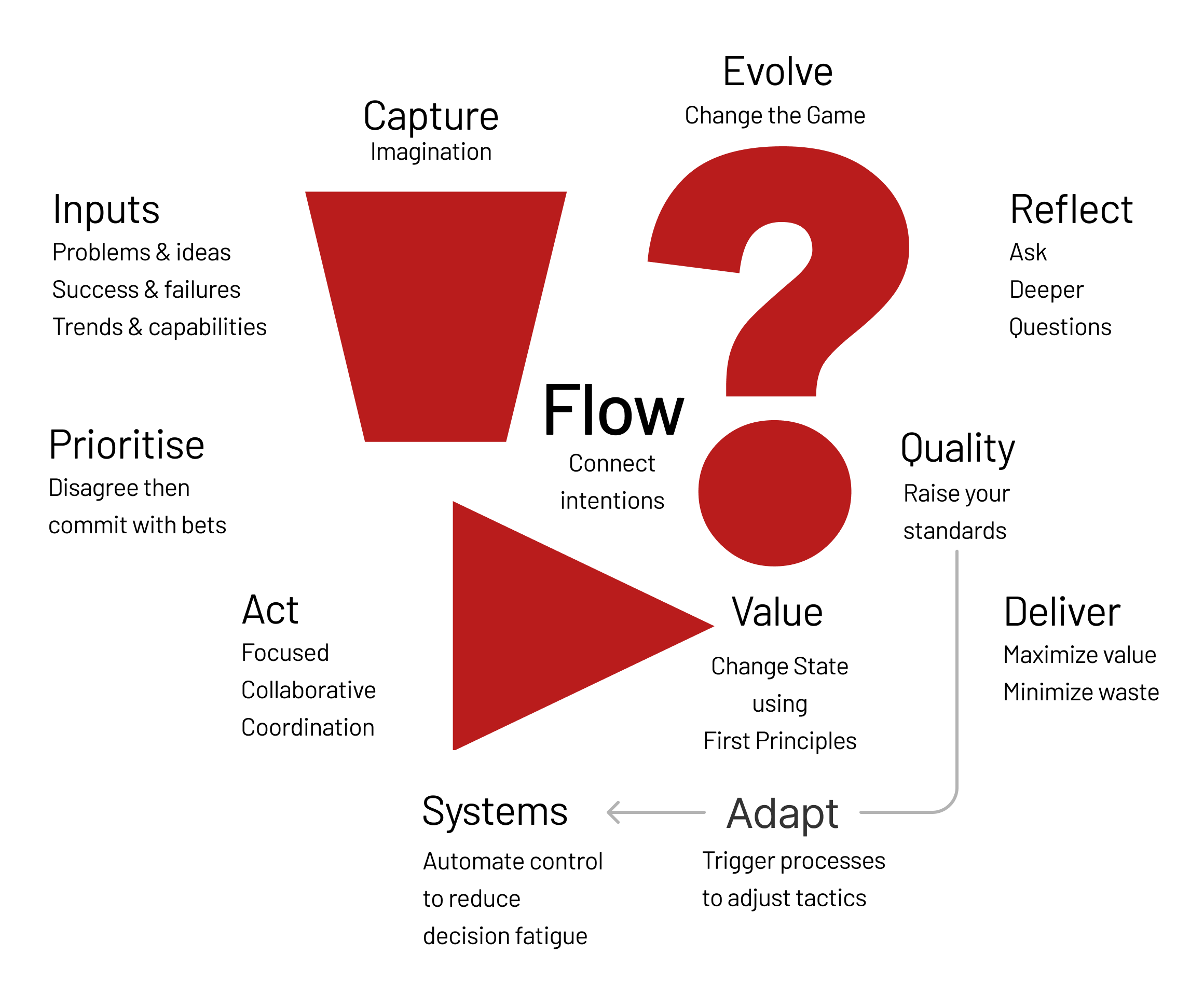
Every game compresses the loop into seconds. Offices stretch it to quarters. Classrooms to semesters. Play is where you get thousands of reps at the thing that actually matters: receive, decide, act, learn.
| Phase | Action | What Compounds |
|---|---|---|
| Receive | Mind the gap — let the pattern arrive | Reception quality |
| Focus | Choose with incomplete information | Judgment |
| Commit | Commit and observe what happens | Experience |
| Learn | Compare outcome to expectation | Calibration |
| Evolve | Ask a better questions | Wisdom |
Boyd called it OODA. Kolb called it experiential learning. Argyris called it double-loop learning. Single-loop: change your actions. Double-loop: change your assumptions. The second hurts more and compounds faster.
The gap between potential and reality is where thought energy lives. Play is how you learn to cross it — cheaply, repeatedly, with fast feedback.
The Ship
A man, a boat, the sea. Hemingway told the whole story in five words. The old man didn't need a bigger boat. He needed the skill to read the current, the will to hold the line, and the dignity to sail home with the skeleton. The marlin was the dream. The sharks were the extractors. The boat was both vessel and territory.
Life is not a neatly organized dataset. It is a journey — a multi-step coordination problem across contexts, systems, and decisions. You can't resolve it with a single lookup. You need assembled context to perceive, reasoning over sequences to navigate, and committed action to resolve what's stuck. Scripts break when reality is fragmented. Judgment doesn't.
The same is true for any crew — human or AI — trying to coordinate toward something that matters. The journey is the product, not the answer.
We are on a ship called Goodwill. The loop is the navigation system. The knowledge base is the chart. The crew is the multiplier. The ship is sailing toward new territory — but the ship itself might become the territory. The country is the crew. What bonds them is what matters.
| Element | What It Is | What It Creates |
|---|---|---|
| North Star | Goodwill — where we're sailing | Direction that survives any storm |
| Hull | Belief systems | What holds the crew together |
| Sails | Spirit — joy, optimism, good company | The force that propels the ship |
| Deck | Standards — clear pictures of what good looks like | Where coordination happens |
| Crew | Players — all beings, human and phygital | Individual talents growing collective agency |
| Cargo | Social glue — shared experience that bonds | What makes the crew a crew |
Better to be a pirate than join the navy. Good culture beats rigid rules. Goodwill of intentions beats prescriptive law. But the ship still needs a deck — clear standards that show "what good looks like" so anyone can contribute without asking permission. Freedom is structure's child.
The Map
Every section in the sidebar is an island the ship can visit. The flow of intent determines the route. You don't read them in order — you visit the island you need, gather understanding, and sail on. The loop tells you when to stay and when to move.
Perceive — What is actually true?
Before you can decide, you need to see clearly.
| Section | Role | Question |
|---|---|---|
| Science | Tested understanding of how reality behaves | What can you deterministically perceive as truth? |
| Systems | Feedback architecture for decisions and coordination | Does this system make humans more capable together or more dependent alone? |
Question — What improves the picture?
Shared perception must come before shared path. Better questions reframe problems before tactics arrive.
| Section | Role | Question |
|---|---|---|
| Prompts | Structured questions that sharpen reasoning and action | How long before the prompters become the prompted? |
| Progress | The feedback system that checks direction against desire | What are you getting better at, and how do you know? |
Act — What moves are available?
Perception without action is philosophy. Action without perception is gambling.
| Section | Role | Question |
|---|---|---|
| Agency | Building personal capability and point of difference | How do you validate your value in the age of AI? |
| Players | The people, roles, and archetypes that make the game social | Do you pick players for positions or reinvent positions for players? |
| Business | How value is created, delivered, and captured | How do you engineer flow to manifest pipe dreams? |
| Industries | Where technology, capital, and labor reorganize reality | Where does force meet friction with greatest opportunity to transform value? |
| Countries | The game board — what bonds people shapes what's possible | What bonds people? And what makes them want to stay? |
Compound — What scales and persists?
The loop only compounds when standards, tools, and incentives survive the individual.
| Section | Role | Question |
|---|---|---|
| Standards | Protocols that make quality repeatable across people | Without standards, quality drifts — what protocols hold your line? |
| Software | Tools that turn thought into repeatable execution | What does the platform replace that used to require permission? |
| Tokenization | Making ownership, incentives, and access programmable | How does programmable ownership change who gets to play? |
| Tokenomics | Incentive design so games reward the right behavior | Does the incentive system reward contribution or extraction? |
Measure — Is it working?
Progress without measurement is faith. Measurement without action is accounting.
| Section | Role | Question |
|---|---|---|
| Scoreboard | Visible tracking for performance, commitments, and results | What state are you trying to reach — and how do you know? |
| Work Charts | Where humans and AI each fit best | What capabilities must humans offer when AI dominates intellect? |
The Crew
You need good crew mates and an agile ship. No one sails alone.
Vygotsky called it the Zone of Proximal Development — the gap between what you can do alone and what you can do with guidance. The person who helps you bridge it is the More Knowledgeable Other. Not the oldest or most credentialed. The person just ahead on the same path. Relative age is no hindrance — just a willingness from one party to coach the other through the thought process, and a willingness to be coached by the other, both without ego, just a shared desire to see progress made.
The best coach reflects empathy with the challenge. The most fulfilling thing in life is to help a person through a time where they need a little help to get themselves unstuck.
| Mode | How It Works | What Compounds |
|---|---|---|
| Solo | Journal, frame the challenge, run the loop alone | Self-awareness |
| Coached | MKO scaffolds without taking over — questions, not answers | Judgment + humility |
| Crew | Group aligns on perception, picture, path, and commitment | Culture + trust |
Three questions for any stuck moment:
- Perceive — What is happening, what matters, and what feels stuck?
- Question — What is the real problem, what assumptions am I making, and what better question reframes this?
- Act — What is the next move, what evidence tells me if it worked, and when will I review?
Then ask: who is my MKO right now — and whose MKO could I be? The ship moves faster when the crew teaches what they've just learned.
The Meta-Game
Dreamineering itself is a game. The knowledge base is the map. The loop is the mechanic. The party is the multiplayer layer. Progression looks like this:
| Level | Name | Question | You Know It's Working When... |
|---|---|---|---|
| 1 | The Loop | Can I run the receive-decide-act-learn cycle? | You catch yourself mid-assumption and correct course |
| 2 | The Map | Can I navigate the knowledge base? | You find the right section within seconds, not minutes |
| 3 | The Party | Can I learn with others? | You coach someone through a zone you just crossed |
| 4 | The Build | Can I apply this to a real problem? | A venture or project ships with the loop running |
| 5 | The Legacy | Can I teach, improve, and pass it on? | You improve a template for the next player |
The progression mirrors Kaufman's ladder: knowing facts, connecting them, seeing patterns, creating patterns, then compressing patterns until they're simple enough to teach. It also mirrors the arc — each level is a threshold where the old self must be left behind.
Play long-term games with long-term people — and become the kind of crew mate who can guide others through their next zone of growth. The ship is already sailing. Welcome aboard.
Play Deeper
🗃️ Onboarding
2 items
📄️ Journey
What must you leave behind to become who you're becoming?
🗃️ Culture
7 items
🗃️ ledger
4 items
🗃️ Navigation System
3 items
🗃️ Utopia
1 item
Context
- The Game — Play with ideas, play with purpose
- Navigation — Value, belief, and control systems
- Ledger — Goodwill, spirit, flow, alignment
- Culture — What emerges from coordinated play — the ship and its crew
- Onboarding — Welcome aboard the Ship Goodwill
- Reception Training — Training the receiver through sport, music, and games
- VVFL Loop — The loop that compounds when intent is virtuous and feedback is validated
- Evolution — Play trains reception — the capacity that machines lack
- Work — Making a living has to feel like play, or the loop is broken
- Agency — Where the loop compounds into capability
- Tokenization — Permissionless ownership changes who gets to play
Questions
- What game are you actually playing — and is it the one you'd choose if you saw all the options?
- Which phase of the loop do you skip most often — receiving, deciding, acting, or learning?
- Who is your MKO right now, and whose MKO could you be?
- If Dreamineering is a game, what level are you on — and what's blocking the next threshold?
- What template, standard, or question would you improve for the next player?