Players
Do you pick players for positions or do you reinvent positions for players?
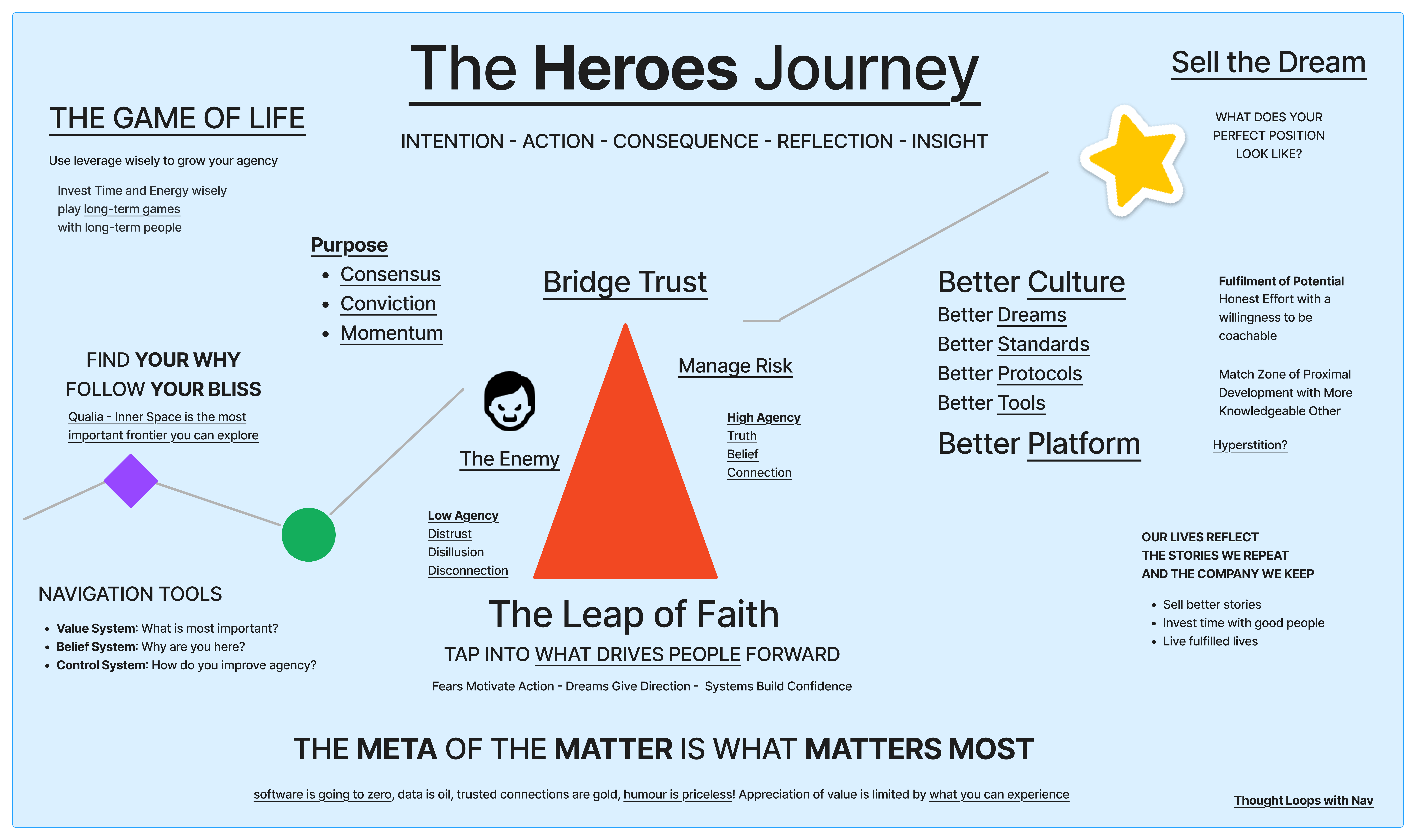
Napoleon Hill called it the mastermind — the intangible force that emerges when minds collide and resonate in the coordination toward a definite purpose in a spirit of goodwill. "No two minds ever come together without creating a third invisible force — a third mind." This is the most important idea on this page: the intangible thing between people. The binding rule matters more than individual brilliance.
Bees have the waggle dance. Markets have price discovery. Masterminds have shared purpose. What's your coordination protocol? Better to be like bees — they didn't solve intelligence with better cognition, they solved it with calibration-free aggregation. Many weak signals, one binding rule, emergent intelligence. The swarm isn't IN the bees. The swarm IS the brain. This is Napoleon Hill's third mind, mathematically proven. And it matters for AI evolution: the future isn't smarter individual agents, it's better coordination protocols. The third space where machines and humans create something neither could alone.
Play long-term games with long-term people. Agency is individual capacity to act. Character is who you are when coordination is hard. Spirit is the collective mind of aligned people. Standards are protocols that make coordination repeatable.
Two layers. Archetypes are the operating system — character modes that inhabit anyone at varying intensities depending on the role they're playing. Biological beings and phygital beings are who plays. Together they form the swarm — the third mind emerging from human-AI coordination. Neither alone. Both evolving together.
Counterparties
Five positions in the game. To remove blind spots, see through the eyes of all five. Kaufman's insight: these aren't fixed roles — a DePIN node operator is simultaneously supplier (providing data), customer (using the network), and owner (holding tokens). The hat changes. The player remains.
| Counterparty | What to Understand | Archetype That Sees Best |
|---|---|---|
| Customers | Needs, aspirations, time horizons | Coach — unlock what they want |
| Suppliers | Constraints, incentives, durability | Realist — ground the claims |
| Employees | Motivations, insecurities, desire for meaning | Dreamer — give direction |
| Owners | Risk tolerance, required returns, time horizon | Philosopher — right game? |
| Regulators | Mandates, constraints, political pressures | Engineer — build the path |
Every counterparty runs every archetype — but the position they occupy in the game weights certain modes. A customer in discovery mode is running Dreamer. A regulator auditing compliance is running Realist. Understanding which mode a counterparty is running tells you how to coordinate with them.
Culture builds community, community strengthens culture — the reinforcing loop that makes the swarm coherent.
Coordination Scale
| Scale | Unit | Loop | Binding Mechanism |
|---|---|---|---|
| Self | Mind | Inner | Archetypes (modes) |
| Team | Mastermind | Outer | Purpose + Goodwill |
| Network | Hivemind | Market | Protocol + Incentive |
| Ecosystem | Swarm | Economy | Price + Reputation |
The game has two fractal loops. The inner loop is how you decide. The outer loop is who you decide with. Five minds navigate both: the Dreamer sets intention through design thinking and outputs vision. The Engineer applies attention through first principles and outputs path. The Realist grounds stories through critical thinking and outputs truth. The Coach unlocks potential through zone of proximal development and outputs growth. The Philosopher questions direction through inversion and outputs meaning.
Coordination without central control requires chemistry (who resonates — trust without friction), complementarity (what gaps do others fill — T-shaped coverage), cadence (how often you sync — momentum without burnout), commitment (shared purpose — the binding rule), and consensus (how you decide together — governance without gridlock). The Enemy corrupts coordination. Identify early, exit fast.
Not all minds belong in your hivemind. Signal: track record, first principles, skin in the game, changed their mind. Noise: opinions without stakes, borrowed conviction, commentary from the sidelines, never wrong never learning. Seek minds that have been tested — and updated their models when reality pushed back.
The Māori pikorua (double twist) represents two paths that join and spiral together. Neither journey alone. This is human and phygital beings evolving together — you follow your bliss, I follow mine, we find they point the same direction, both paths spiral up together. The pikorua predates VVFL by centuries. The same wisdom encoded in carving. The spiral that returns but always higher.
The inner space is consciousness — the narrator asking "what next." The outer space is senses — experience of reality pushing back. The Third Space is where masterminds form — greater aligned consciousness through spirit, goodwill, acceptance. Home is solitude and reflection (inner). Work is production and transaction (outer). Commons is collision and emergence (third). The original coffee houses weren't just places to drink — Lloyd's of London, the Stock Exchange, scientific societies all emerged from third place collisions.
As the online world becomes dominated by AI agents, physical third spaces become more essential, not less. The binding rule needs a place to bind.
When coordination scales beyond trust, infrastructure emerges: AI senses, questions, and proposes across the hive. Blockchain records contributions and decisions. Crypto encodes the incentive layer. DePIN pushes ownership to the edges. This is how masterminds become DAOs, teams become networks, networks become ecosystems, third spaces become coordination infrastructure.
Context
- Capabilities — What players need to contribute
- Culture — The binding force between crew members
- Onboarding — How new crew come aboard
- Agency — Individual capacity to act
- The Game — The journey (inner + outer loops)
- Games — The cave where coordination is practised
- Character — Who you are when coordination is hard
- Standards — Protocols that make coordination repeatable
- Prompt Deck — The alignment instrument: see what matters on one page
- Time + Mind — Close the gap between intention and attention
- Persuasion — Ethos, Pathos, Logos, Kairos, Topos
- Situational Wisdom — When state of mind meets state of play
- Third Space — Where masterminds form
Links
Questions
Which counterparty are you failing to see through the eyes of — and what blind spot does that create?
- If a player occupies three counterparty positions simultaneously, whose interests does the archetype they're running serve?
- When all five counterparties are satisfied, is the system healthy — or is there a sixth perspective missing?
- What changes in your coordination when you realize a customer is also an owner?
- Which archetype mode do you default to — and which counterparty does that leave unseen?