Phygital Mycelium
The unseen network that makes everything happen.
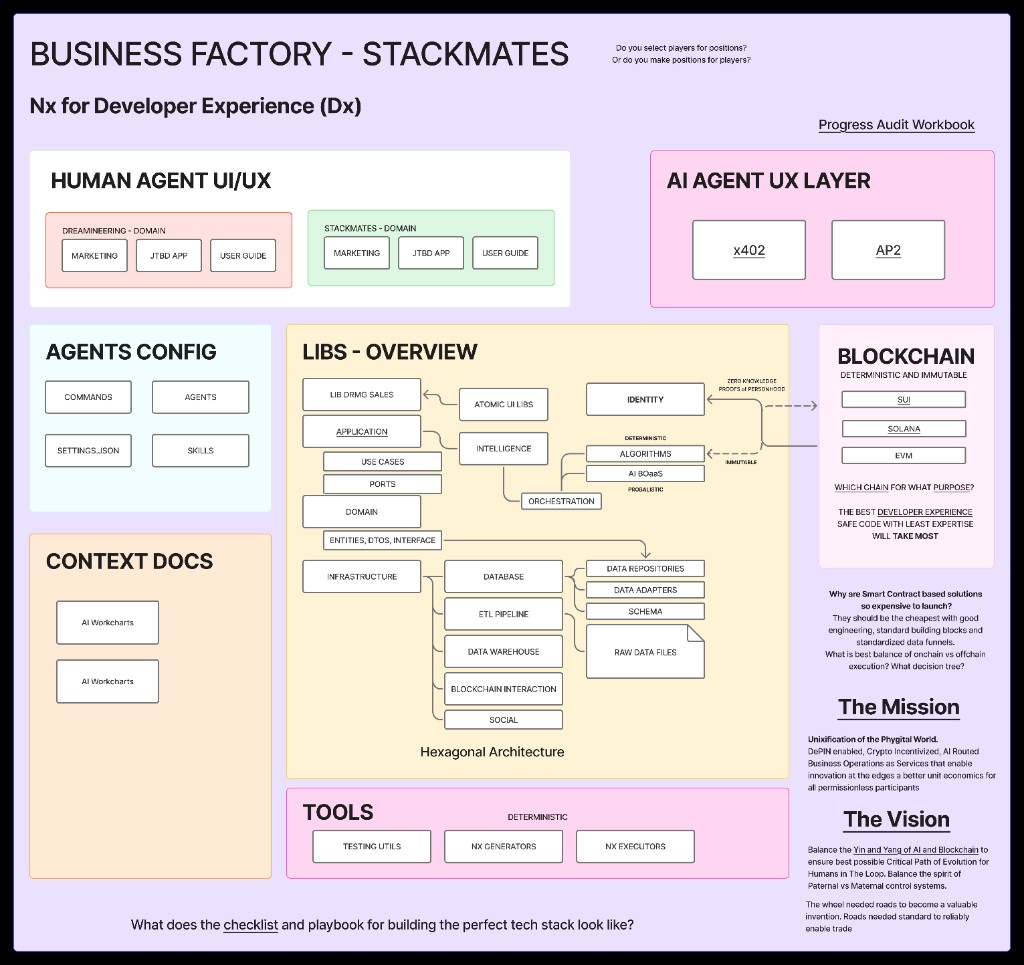
Mycelium is the underground network. Mushroom caps are the ventures that pop up wherever conditions are right. PRDs describe capabilities — shared primitives that any venture can compose from. Today there are seven mushroom caps. If this works, there will be millions.
Capabilities
Each PRD describes a Mycelium capability — a shared lib that any mushroom cap can use. The capability owns the job definition and success criteria. The venture owns the business model and the customer.
Active
Priorities: Table order = build order.
Top row is what the engineering team builds next. Blocked platform items go first — they block everything downstream.
| PRD | Capability | Currently Growing In | Status | North Star | Kill Date |
|---|---|---|---|---|---|
| Identity & Access | Multi-tenant auth, RBAC, org isolation | Platform | BLOCKED — owner locked out (22P02) | Owner logs in, no manual DB | — |
| Sales CRM & RFP | Demand-driven CRM + RFP workflow | stackmates | Wire algorithms — blocked by Identity | Win Rate > 30% | 2026-03-24 |
| Agent Platform | Identity, memory, comms, dispatch, VVFL | Platform | Wire ETL path | Agent productive in under 30s | — |
| Sales Dev Agent | AI-powered demand generation | stackmates | Build + wire | 5 discovery calls/month | 2026-03-24 |
| Sales Process Optimisation | Process intelligence + agent team for sales | stackmates | Spec | 1st customer via agent-optimized process | — |
| ETL Data Tool | Universal data readiness platform | stackmates | Shipping | Query Latency < 2s | — |
| AI Quality Gates | 90/10 AI/Human production protocol | Platform | Active | 80% Gross Margin on services | — |
| Agency Layer | AI-Native Agency (90/10 split) | Shared Mycelium | Active | 80% Gross Margin on services | — |
| Content Amplifier | Multi-platform content distribution | dreamineering | Wire workcharts | Multi-platform dispatch >= 60% | — |
| Data Interface | Three-interface data access | stackmates | Spec draft | Every table accessible via Admin + Chat + A2A | — |
| Prompt Deck | Alignment instrument (5x5) | dreamineering | Spec + prototype | D7 return rate > 35% | — |
| Make Meetings Matter | Structured meeting state changes | stackmates | Spec draft | >= 90% meetings produce state change | — |
| Sui Wallet Safety Patterns | Wallet safety standards | stackmates | Spec complete | Chain-agnostic safety standard adopted | — |
| Time + Mind Navigation | Intention/Attention calendar | dreamineering | Spec ready | Dreamineering Yield > 0.5 art/hr | — |
| Trust Commerce | Sui-based coach-selling + on-chain reputation | Shared Mycelium | Spec | Referral conversion >15% (vs 2-3% cold ads) | — |
| DePIN Infrastructure | Multi-chain device + data + rewards | stackmates | Spec draft | Cross-layer workflow executes end-to-end | — |
Backlog
| PRD | Capability | Currently Growing In | Difficulty |
|---|---|---|---|
| Commissioning State Machine | Progressive data maturity automation | stackmates | Medium |
| Drawing Tool | A&ID visual language primitives | dreamineering | Medium |
| Workflow Engine | Decision engine for work receipts | stackmates | Advanced |
| Social Media Marketing | LinkedIn-first B2B automation | dreamineering | Medium |
| Workflow Builder | Visual workflow editor | stackmates | Medium |
| Sleep protocol content page | Practice design | betterpractice | Starter |
| Morning intention practice | Practice design | betterpractice | Starter |
| Optimism daily protocol tracker | Feedback loops | betterpractice | Starter |
| Builder onboarding flow | UX, empathy | stackmates | Medium |
| Trail recommendation engine | Data, AI, product | berleytrails | Advanced |
| Mental model search | Knowledge architecture | dreamineering | Advanced |
AI-Native Production
We operate with software economics in a service-delivery world.
| Principle | Protocol | Goal |
|---|---|---|
| 90% AI Production | Agents draft, research, and format all initial deliverables | < $60 cost per unit |
| 10% Human QA | 20 mins of "taste and judgment" review per unit | 0% defect rate |
| Outcome Pricing | Price by deliverable, not by hour | > 70% Gross Margin |
This protocol is documented in the AI-Native Agency playbook.
Commissioning Dashboard
One view of every capability — what's specified, what's built, what's proven. Maturity levels from L0 (spec only) to L4 (independently verified). Flight readiness gates. Kill criteria. Revenue readiness.
Product Layers
Each PRD must define the minimum feature set needed to run one complete fair-trade loop: question -> problem -> trade -> proof -> feedback.
| Product Layer | Must-Have Features | Why It Exists | Primary References |
|---|---|---|---|
| Horizontal SaaS | Auth, CRM, pipeline, tasks, documents, analytics, workflow automation | Shared operating surfaces across all ventures | SaaS Toolkit |
| Vertical SaaS | Industry workflows, role-aware entities, compliance and domain scoring | Convert generic tools into outcome systems by industry | Vertical RaaS + Industries |
| Tokenization | Ownership model, transfer model, settlement model | Make value and contribution portable and verifiable | Tokenization |
| Tokenomics | Incentives, distribution, governance, retention loops | Keep participation fair, sustainable, and anti-extractive | Tokenomics |
| Phygital Extension | Device identity, agent identity, task attestation | Support humans, AI agents, and devices in one loop | DePIN |
Feature Gate
Before a PRD is considered build-ready:
- Workflow proof: One end-to-end user workflow with measurable before/after.
- Entity proof: Core entities and links are explicit (who, what, where, value).
- Loop proof: Feedback metric exists and updates behavior.
- Business proof: Pricing and acquisition assumptions are testable this cycle.
- Trust proof: Safety and settlement model are explicit (especially if tokenized).
The Factory
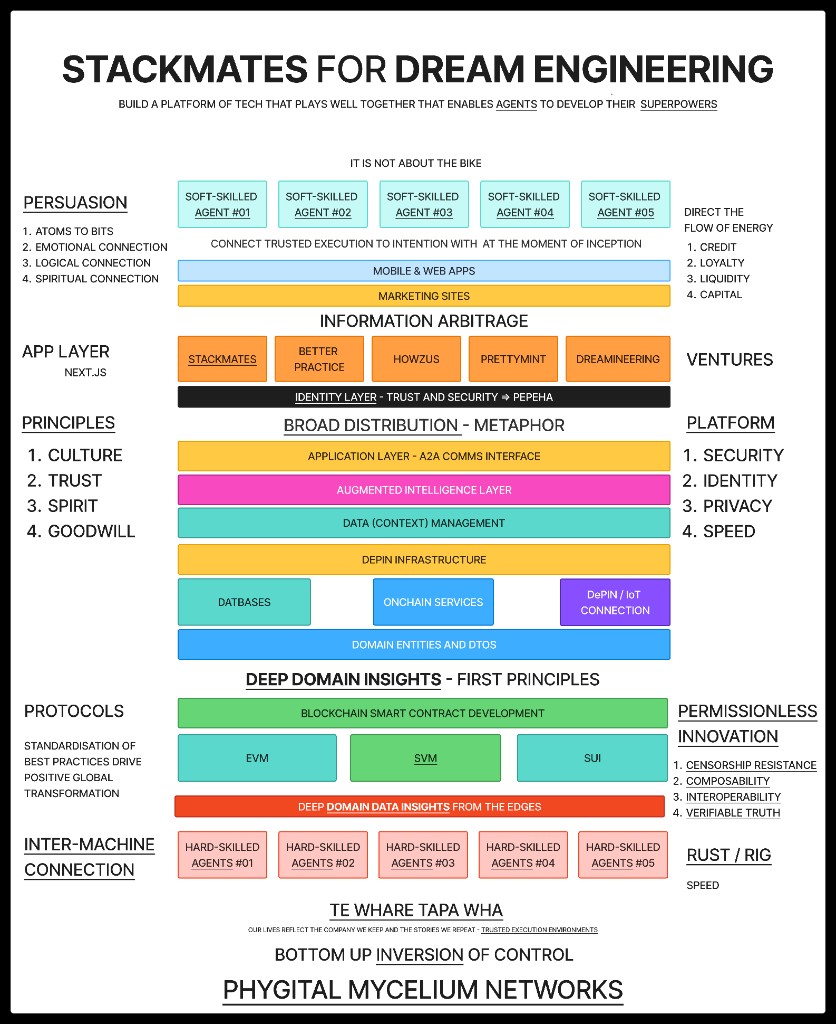
PRDs are the specification layer. The engineering repo is the execution layer. The team that builds it never validates it.
DREAM REPO (this)                    ENGINEERING REPO (stackmates)
─────────────────                    ─────────────────────────────
1. Write PRD spec            →  RFP  →  2. Architecture + build
                                         3. Ship feature
4. Commission (validate)  ←  DELIVERY ←  "Ready for inspection"
   Agent reads spec
   Agent opens browser
   Agent checks features,
   functions, outcomes
   against PRD criteria
5. Pass / Fail + evidence
| Stage | Where | What Happens |
|---|---|---|
| Spec | Here — /phygital-mycelium/ | Define features, functions, outcomes, success criteria |
| Methodology | Here — /docs/products/ | JTBD, Shape Up, Flow Engineering, Type-First |
| Architecture | Engineering repo | DB plans, schemas, service boundaries, implementation |
| Build | Engineering repo | Code, tests, deployment |
| Commission | Here — PRD commissioning table | Independent verification against spec |
In factory engineering, the team that builds a system is never the team that commissions it. The builder knows what they intended. The commissioner checks what actually shipped. A seed phrase got deleted because nobody independently verified. The Sui Wallet PRD exists so that won't happen again.
Build-to-Revenue Sequence
PRDs are not product wishlists. They are business development instruments.
| Phase | Product Move | Business Dev Move | Output |
|---|---|---|---|
| 1. Spec | Define jobs, features, success criteria | Define ICP and offer | PRD complete |
| 2. Prototype | Ship smallest usable loop | Run first 5 discovery calls | Friction map |
| 3. Pilot | Solve one real workflow end-to-end | Close 1 pilot user | Proof of value |
| 4. Commission | Validate against PRD criteria | Capture testimonial + case data | Reusable evidence |
| 5. Scale | Promote patterns to platform primitives | Expand into adjacent verticals | Compounding GTM |
The Ecosystem Compound
The mycelium is not a metaphor. It's an economic structure. Same infrastructure, different revenue surfaces.
| Product | Revenue Model | Entry Point | Feeds Back |
|---|---|---|---|
| ETL Data Tool | Professional services ($15-50K) → SaaS ($500/mo) | Data is messy, AI can't work | Clean data powers every other product |
| RFP Response Tool | Subscription ($500-5K/mo per team) | Sales teams waste 20-40 hrs per RFP | Approved answers compound into library |
| Agent Platform | Per-receipt ($1-10) or subscription | Agents need orchestration | Receipts prove value, build trust data |
| Content Amplifier | Included in agency / SaaS tier | Content needs multi-platform reach | Distribution data improves targeting |
Each new product costs less than 20% of the first because the horizontal layer (auth, CRM, pipeline, analytics, workflow) is shared. The vertical layer is what makes each product defensible — domain knowledge that generic tools can't replicate.
SHARED INFRASTRUCTURE (build once)
    ├── ETL (data readiness)
    ├── RFP (sales intelligence)
    ├── Agents (orchestration)
    └── Content (distribution)
         │
         ▼
    EACH PRODUCT'S DATA IMPROVES THE OTHERS
PRD Standard
| PRD Section | What It Defines | Who Uses It |
|---|---|---|
| The Job | What progress the user is making | Engineering — to understand intent |
| Patterns / Features | What gets built | Engineering — the RFP |
| Success Criteria | How to verify it works | Commissioning — the checklist |
| Commissioning Table | Component-by-component status | Both — shared progress tracker |
| Context Links | Domain knowledge that grounds decisions | Engineering — to understand why |
Every PRD must include before build handoff:
- Job + Trigger — what event causes demand now
- Feature / Function / Outcome — explicit mapping
- Business Dev — ICP, offer, channels, conversion, retention
- Commissioning — status by component
- Risk + Kill Signal — what would invalidate the thesis fast
- Context — links to horizontal SaaS, vertical SaaS, industry, token layers
Starting Today
- Pick a PRD that pulls you — Wallet Safety or Prompt Deck if you want a challenge, a Starter from the backlog if you want to ease in
- Read the spec — understand the job, the patterns, the success criteria
- Build — follow the spec, ship something
- Verify — does what shipped match what was specified?
- Feed back — update the commissioning table, update the PRD with learnings
Not positive thinking. Positive doing. Optimism is a muscle. Building is the gym.
Context
- Products — Best practice methodology for what we build
- Jobs To Be Done — Demand validation framework
- Flow Engineering — Maps that produce code artifacts
- Standards — Where safety patterns graduate to
- Mushroom Caps — The ventures growing from this network
- Business Flow — Idea → Strategy → Operations → Growth