Play
What question are you trying to answer right now?
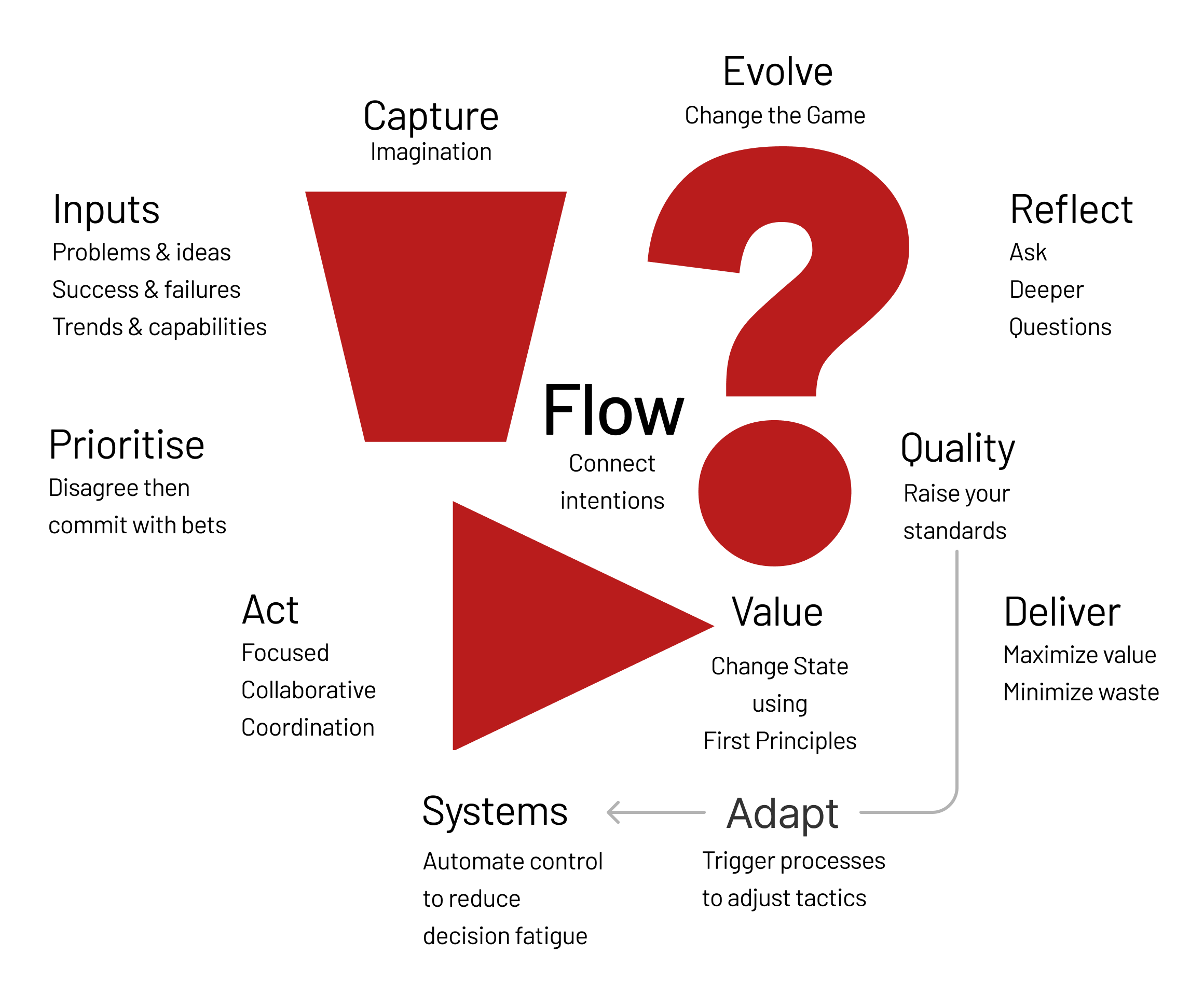
Every day runs the same loop: question, problem, decision, outcome, better question. The game changes — the loop doesn't.
The Loop
| Phase | Action | What Compounds |
|---|---|---|
| Question | Notice friction, feel curiosity | Pattern recognition |
| Problem | Frame what's actually wrong | Diagnostic skill |
| Decision | Choose with incomplete information | Judgment |
| Outcome | Act and observe what happens | Experience |
| Reflection | Ask a better question | Wisdom |
Boyd called it OODA. Kolb called it experiential learning. Argyris called it double-loop learning. Same thing: the fundamental cycle of being alive.
Single-loop: change your actions. Double-loop: change your assumptions. The second hurts more and compounds faster.
The Drivers
The brain treats social needs like survival needs. David Rock's SCARF model:
| SCARF Driver | Question | When Threatened | When Elevated |
|---|---|---|---|
| Status | Am I respected here? | Withdraw or overcompensate | |
| Certainty | Can I predict what's next? | Anxiety, paralysis | |
| Autonomy | Do I have a choice? | Resentment, disengagement | |
| Relatedness | Do I belong? | Isolation, distrust | |
| Fairness | Are the rules equal? | Outrage, sabotage |
When a drive is threatened, the loop breaks. You stop asking questions and start defending.
The Evolving Game
The loop runs at every age. The questions change.
| Stage | Core Question | Decision That Defines It | What Compounds |
|---|---|---|---|
| Child (0-12) | What is this? | Who to trust | Curiosity |
| Student (12-22) | Who am I? | What to pursue | Identity |
| Worker (22-35) | What can I build? | How to earn | Capability |
| Partner (25-45) | Who do I choose? | How to commit | Trust |
| Parent (30-55) | What do I pass on? | How to lead | Legacy |
| Elder (55-75) | What actually mattered? | How to let go | Wisdom |
| Legacy (75+) | What remains? | How to be at peace | Gratitude |
Fluid intelligence peaks at 20. Crystallized intelligence peaks in the late 60s. The best decision-making window is 40-65 — where speed and wisdom overlap.
See The Journey for the full hero's arc at each stage.
The Circles
Your circles shrink as you age. This is a feature.
Dunbar's layers: 5 (intimate), 15 (close), 50 (friends), 150 (meaningful contacts). Young adults fill the outer rings. Older adults prune to the inner ones.
Carstensen's socioemotional selectivity: when time feels unlimited, you expand the network. When time feels finite, you deepen the relationships that matter. Smaller networks in older adults correlate with better mental health.
The shift: From "who else should I know?" to "who do I want to spend time with?"
Finite vs Infinite
James Carse: finite games are played to win. Infinite games are played to keep playing.
| Finite | Infinite |
|---|---|
| Win the negotiation | Build the relationship |
| Get the promotion | Develop the capability |
| Beat the competitor | Expand the market |
| Score the point | Stay in the game |
Axelrod's tournament proved it: in repeated games, the simplest strategy wins — cooperate first, reciprocate always. Tit-for-tat. Four lines of code beat every sophisticated strategy. Nice, retaliatory, forgiving.
Life is an infinite game played through a series of finite ones.
Skin in the Game
If you don't have equity in the platform, your vote counts for very little.
| Without Ownership | With Ownership |
|---|---|
| Your opinion is feedback | Your vote shapes direction |
| You optimize for salary | You optimize for compounding |
| You play finite games for others | You play infinite games for yourself |
| You're a user | You're a stakeholder |
Taleb's rule: no exposure, no influence. Poker teaches this — you can't win the hand if you're not in it. Moneyball teaches this — measurement without ownership is consulting, not building. Munger completes it: show me the incentive and I'll show you the outcome.
Without ownership, you're converting capital for someone else's benefit. The loop still runs — financial to intellectual to social to goodwill — but the compounding accrues to whoever holds the equity.
The old game required permission. Equity meant accredited investors, IPO access, knowing the right people. The gatekeepers decided who got skin in the game.
Tokenization changed the rules. Fractional ownership from $1. 24/7 markets. Programmable rights. Smart contracts replace intermediaries. For the first time, equity is permissionless.
But new rules don't eliminate old traps. Private capture — insiders extracting value before public launch — is the same gatekeeping in new clothes. The question isn't whether tokenization enables ownership. It's whether you're getting real equity or phantom pricing.
The life lesson: stop playing games where you can't own a piece of the outcome. Then verify the piece is real.
Why Play Matters Now
Sport, music, games — these aren't leisure. They're culture factories.
PLAY → CULTURE → LOYALTY → BRAND EQUITY → CAPITAL (soft + hard)
| Vehicle | Culture It Builds | Loyalty It Creates | Capital It Raises |
|---|---|---|---|
| Sport | Identity, belonging, tribal pride | Fans become members | Stadiums, broadcast rights, DAOs |
| Music | Emotional resonance, shared memory | Audiences become communities | Tours, streaming, catalog equity |
| Games | Shared beliefs, coordination skills | Players become builders | Token economies, network effects |
The chain is the same every time: play builds culture, culture builds loyalty, loyalty is brand equity — the ability to raise more capital, both soft (goodwill) and hard (financial).
This matters more now than ever. AI will hand us more time. And idle minds create a meaning gap that Machiavellian minds rush to fill — addiction loops, outrage machines, manufactured identity. When people lack purpose, manipulators provide one.
The antidote is intentional play. Games that shape beliefs toward coordination, not extraction. Sport that builds belonging, not just spectacle. Music that teaches listening, not just consumption. The way we choose to play determines whether free time compounds into agency or dissolves into dependency.
Go Deeper
🗃️ The Way
4 items
🗃️ Games
4 items
📄️ Music
How do humans learn to coordinate? They play.
🗃️ Sport
6 items
Context
- Science — Where play becomes method
- Agency — Where the loop compounds into evolution
- The Journey — Hero's arc through life stages
- Flow State — When intention and attention align
- VVFL Loop — The feedback loop that compounds
- Tokenization — Permissionless ownership changes who gets to play
- Incentive Engineering — Design the game's reward structure
- Culture — Play shapes culture, culture shapes play