Prompt Deck Spec
How do we build an instrument that gets smarter each time someone uses it?
Alignment of Intentions
Everyone has a different idea of how things are and where things are heading. The Tight-Five prompt deck system is a tool for bringing ideas together so they are aligned and incompressible, maximally simplification of complexity with maximum meaning and value.
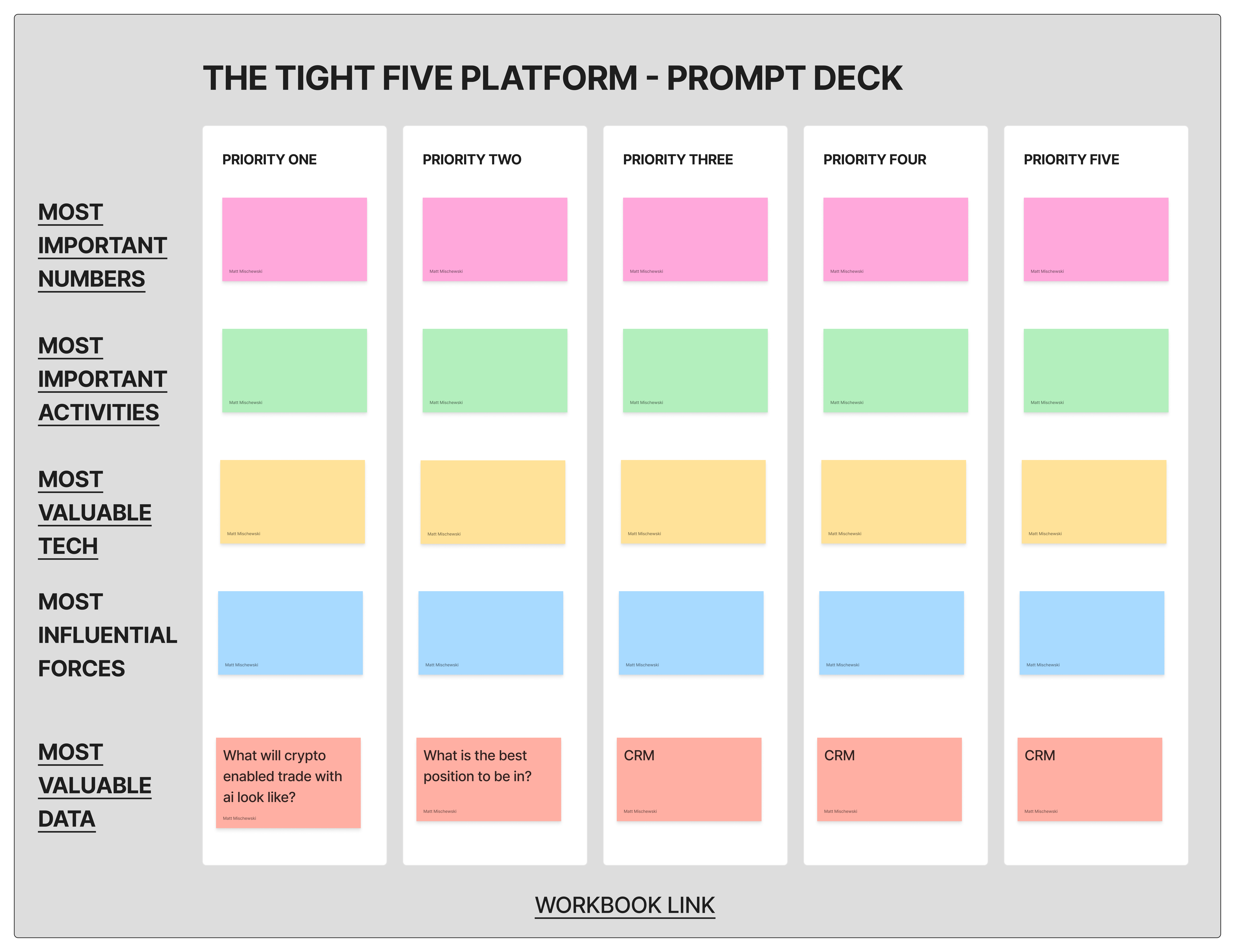
- Scattered Ideas, and Opinions on how the world works and where it is heading
- Consensus of the biggest most important opportunities and challenges to overcome
- 100% belief and commitment to a plan with focused attention and know-how to add value with zero friction.
Shared Values, Complimentary Talents, Aligned Beliefs, Clear Intentions, Can do spirit.
Most Important Problem
People compress their world into five things that matter — then lose the compression. Strategy offsites produce clarity that evaporates. Journals capture reflection that never compounds. Pitch decks freeze a moment that immediately ages. The instrument that makes compression deliberate, repeatable, and visible doesn't exist yet. The prototype proves the interaction works. Now it needs to persist, evolve, and serve real users.
Tight Five Planning Frame
| Tight Five | Planning Question | Decision Standard | Depth |
|---|---|---|---|
| Principles | What truths constrain us? | Five is the cognitive limit. Evergreen beats one-shot. Gaps are the strategy. | Principles |
| Performance | How do we know it works? | D7 return rate > 35%. One person fills, returns, updates. | Performance |
| Platform | What do we control directly? | CDD prototype, Stackmates auth/storage, 1,200+ pages of domain content | Platform |
| Protocols | How do we coordinate? | Fill → Gaps → Questions → Research → Update → Compare | Protocols |
| Players | Who creates harmony? | Misaligned operators, founders preparing pitches, people in life transitions | Players |
Decision Framework
| Decision Gate | Tight Five Check | Decision Rule | Evidence |
|---|---|---|---|
| Go / No-Go | Principles | Kill if D7 return = 0 after 10 external users | D7 return rate |
| Scope | Platform | Ship Mission Control first, Card View second | Grid completion rate |
| Quality | Performance | Grid must load in <1s, save in <500ms | LCP, interaction latency |
| Scale | Players + Performance | Scale when 3 teams share grids externally | Share rate > 20% of active |
Risk + Kill Signal
| Risk | Mitigation |
|---|---|
| People fill once, never return | Weekly review ritual prompt. Snapshot comparison. Kill if D7 = 0 after 10 users. |
| 5x5 feels too constrained | Scale selector and templates show flexibility. The constraint IS the value. |
| AI coaching overshadows self-reflection | Conversation mode is V3. Pep Talk mode launches without AI. |
| Investors expect slides, not grids | Export to presentation format. Share link with clean read-only view. |
| Convex adds complexity for a single-user MVP | Start with local storage, migrate to Convex when collaboration needed |
Kill signal: 10 external users fill a grid. If zero return within 7 days, it's a novelty, not an instrument. Stop building and revisit the job.
Relationship to Other PRDs
| PRD | Relationship | Data Flow |
|---|---|---|
| Time + Mind | Peer — complementary instrument | Prompt Deck aligns WHAT matters → Time+Mind closes gap between WHAT and DID |
| Agent Platform | Platform — depends on | Auth, AI agent paths, data layer |
| Sales Dev Agent | Peer — uses deck for ICP alignment | Filled grid feeds ICP qualification |
Plan-to-Deck Update
- Review prototype usage and external feedback weekly
- Identify one interaction pattern that isn't landing
- Convert to one clearer prompt or simpler UI flow
- Update Prompt Deck
- Retest with next external user
Context
- Principles — The job, why now, the convergence
- Performance — Priority score, success criteria
- Platform — Components, architecture, data model
- Protocols — Features, commissioning, build sequence
- Players — Demand-side jobs, ICP, psycho-logic
- Tight Five Platform — The pattern the product implements
- Live Prototype — Current CDD build