Tight Five Platform
What's the maximum number of things you can hold in mind and still act?
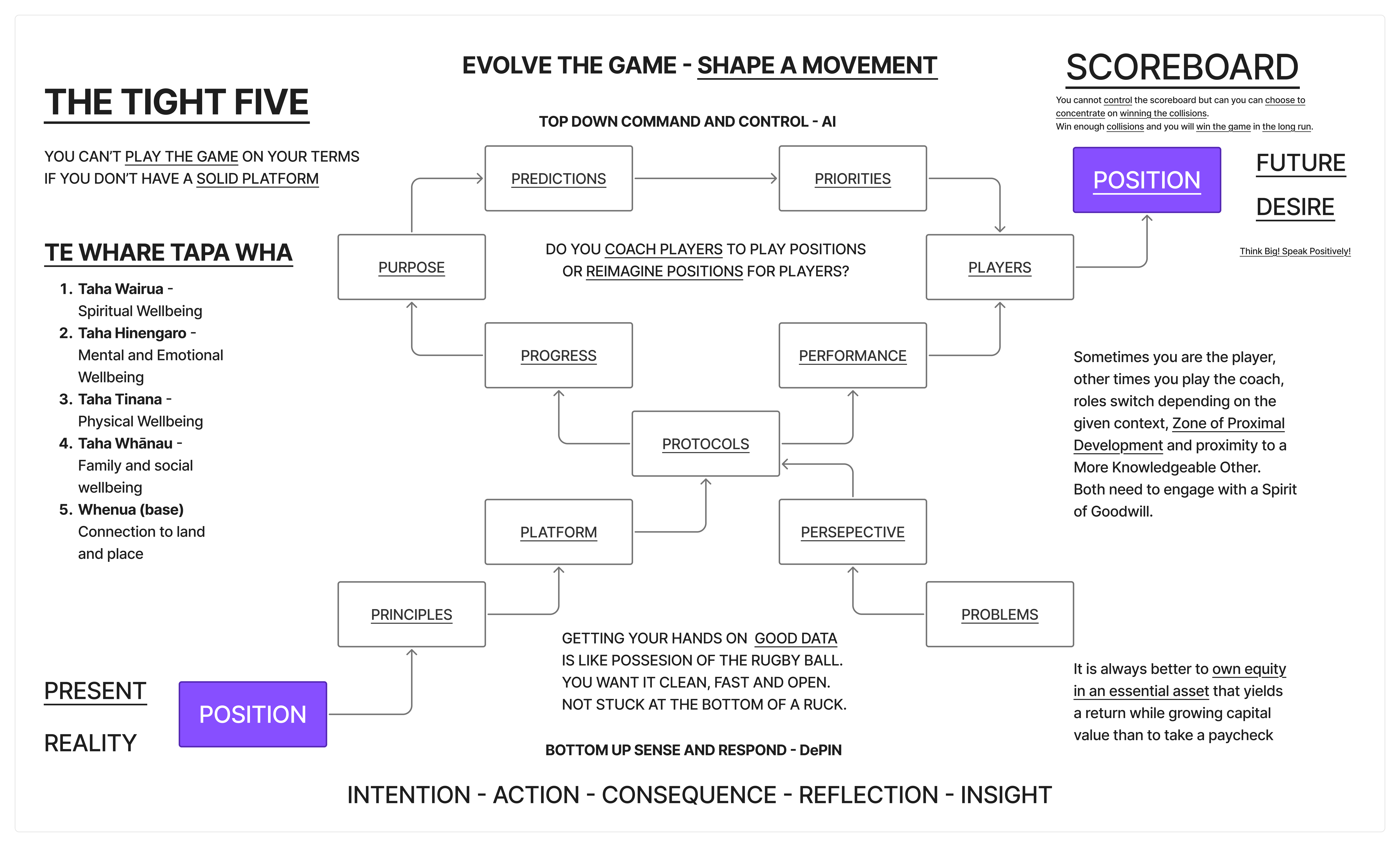
Miller's Number says seven, plus or minus two. But holding isn't acting. Five is the sweet spot — enough to capture a complete system, few enough to stay in working memory while you decide what to do next.
The Tight Five is a cognitive technology: any domain worth mastering can be compressed into five tightly-bound elements. The skill is knowing which five matter for the context you're in.
Meta and Matter
The Tight Five is meta — the schema that organises schemas. Different domains produce different fives. The pattern is always the same: five, tight, bound.
| Domain | The Five | What Binds Them |
|---|---|---|
| Business | Principles, Performance, Platform, Protocols, Players | Value creation |
| Wellbeing | Wairua, Hinengaro, Tinana, Whanau, Whenua | Holistic health |
| Rugby | 2 props, hooker, 2 locks | The scrum |
| Music | 4 Beatles + George Martin | The sound |
| Questions | Why? What's true? What do I control? Who's with me? Is it working? | The loop |
| Agency | Capabilities, Character, Drive, Foundations, Money | Agency |
| Rhetoric | Ethos, Logos, Pathos, Kairos, Topos | Persuasion |
| Optimism | Breaking Cycle, ABC Reframe, Luck Engineering, Stoic Balance, Daily Protocol | Training the muscle |
| Archetypes | Dreamer, Realist, Engineer, Coach, Philosopher | The swarm |
| Prompt Deck | Capture, Inquire, Design, Platform, People | The instrument |
Each instance is five. Each five is different. What makes them "tight" is the binding — remove one and the system collapses. What makes them "five" is cognitive science — beyond five, humans lose grip.
Why Tight
Three meanings. One word.
| Meaning | Origin | What It Means |
|---|---|---|
| Bound | Rugby | The tight five are bound together under pressure — remove one prop and the scrum collapses |
| Polished | Comedy | A comedian's tight five is their best five minutes — refined until every word lands, every pause earns its place |
| Incompressible | Both | Nothing can be removed without the system falling apart |
In rugby, the tight five do the unglamorous work that makes the flashy stuff possible. Without props, hooker, and locks providing the platform, the backs can't play the game they intend to play. You're reacting, not creating.
In comedy, a tight five is not a short set. It's an incompressible set. Comedians perform hundreds of times, cutting everything that doesn't land, until what remains is pure signal. That's why the best pitches sound effortless — they've been compressed until nothing remains that doesn't serve the audience.
A house with four walls and no whenua (land) falls. Four Beatles without George Martin pull apart. A business with Principles and Platform but no Players is a machine with nobody to serve.
The count isn't the point. The binding is.
Meta Defines Matter
Schemas influence ability to pay attention and learn quickly. The schema isn't describing reality — it's selecting which reality you can perceive.
| Meta | Matter |
|---|---|
| Schema | Knowledge |
| Pattern | Instance |
| Intention | Attention |
| Dream | Engineering |
| Invisible | Visible |
| The five you choose | The world you see |
The quality of your meta determines the quality of your matter. Whoever defines the organising pattern controls what becomes real.
This is why the meta of the matter, matters the most.
Instance: Business
When the domain is business, the Tight Five becomes the 5Ps:
| P | What It Is | Question | Weak Signal |
|---|---|---|---|
| Principles | Understand the truth. First truths, immutable values. | What truths guide you? | Decisions feel random |
| Performance | Good vs bad. Impact vs noise. Clarity of focus. | How do you know it's working? | Activity without outcomes |
| Platform | Assets, resources, tools, technology you can muster. | What do you control? | Dependent on others |
| Protocols | Best practice standards with available platform. | How do you coordinate? | Success doesn't compound |
| Players | Consumers, contributors, community. The ecosystem. | Who creates harmony? | Isolated agency |
This instance organises every industry analysis on the site, every meta article playbook, and the /docs/ structure itself:
| Docs Section | P |
|---|---|
| Principles | Principles |
| Performance | Performance |
| Platform | Platform |
| Protocols + Standards | Protocols |
| Players | Players |
Applied fractally: Marketing gets five subfolders. Space gets five subfolders. Countries get scored on five dimensions. Same meta, different matter.
The Sequence
The order isn't alphabetical. It's a commissioning sequence.
In process engineering, commissioning verifies a built system actually works — component by component, loop by loop. Each valve progresses through discrete states: idea → spec → drawing → procurement → installed → wired → controls proven → operating. Readiness is the weighted blend of all components at different points on that progression.
The Five P's work the same way. Commission understanding of any domain in this order:
| P | Why This Position |
|---|---|
| Principles | What's true? Without this, every downstream decision is guesswork |
| Performance | What does good and bad look like? Without this, you're building blind |
| Platform | What creates leverage? Only meaningful once you know what you're measuring |
| Protocols | How do you coordinate? Only valuable when built around performance targets |
| Players | Who does what? Only assessable against the system they operate in |
Performance second gives clarity — define what good cheese looks like before designing the pipework.
The data footprint is the commissioning instrument. Every industry is a data model. Every business function is a data model. Understanding the data model is understanding the domain. The instrument tells you which subsystems are wired, which are installed but unproven, which are still drawings.
95% of business operations are commodity — marketing, finance, HR run the same ~40 jobs dressed in different names. The mycelium shares that 95%. Your point of difference — the 5% — goes on top.
Instance: Wellbeing
When the domain is hauora (wellbeing), the Tight Five becomes Te Whare Tapa Wha:
| Element | Dimension | The Wall |
|---|---|---|
| Taha Wairua | Spiritual | Purpose, meaning, connection to something larger |
| Taha Hinengaro | Mental | Thoughts, feelings, cognitive health |
| Taha Tinana | Physical | Body, movement, material presence |
| Taha Whanau | Social | Family, belonging, relationships |
| Whenua | Foundation | Land, place, what grounds everything |
Same principle. Different five. Remove one wall and the house falls.
Instance: Questions
When the domain is self-examination, the Tight Five becomes five questions that never stop mattering:
| # | Question | Builds |
|---|---|---|
| 1 | Why does this matter? | Clarity |
| 2 | What truths guide you? | Trust |
| 3 | What do you control? | Leverage |
| 4 | What do you see others don't? | Conviction |
| 5 | How do you know it's working? | Agency |
Clarity → Trust → Leverage → Conviction → Agency. Each pass through the loop produces deeper answers. Recursion, not repetition. The meta article explores each in depth.
The Instrument
The Tight Five is also a product — a prompt deck that helps people find their own five. The Time + Mind instrument closes the gap between what you intended and what actually happened. Together: the Prompt Deck aligns WHAT matters, Time+Mind closes the gap between WHAT and DID. The pattern recurses through three levels:
| Level | The Five | Output |
|---|---|---|
| Discovery | Capture, Inquire, Design, Platform, People | Ideas to explore |
| Strategic | Principles, Performance, Platform, Protocols, Players | Clarity on what and why |
| Tactical | 5 Facts → 5 Questions → 5 Answers → 5 Ideas → 1 Decision | Execution loop |
Two modes: Pep Talk (inner loop — sell yourself first) and Pitch (outer loop — align others to your vision). The first and most important sale is always to yourself. The instrument that turns the meta-pattern into action.
Context
- Standards — Where protocols compound into predictability
- Data Footprint — The commissioning instrument
- Knowledge Schema — The data model IS the schema
- Matrix Thinking — How do you see the meta in the matter?
- The Tight Five — The article that sells the framework
- Selling — The dream side of dream engineering
- Prompt Deck PRD — The product: 5x5 alignment instrument
- Time + Mind PRD — The complement: intention vs attention
- Players — Who uses the instrument — every player wears different hats