Flow
When was the last time you disappeared?
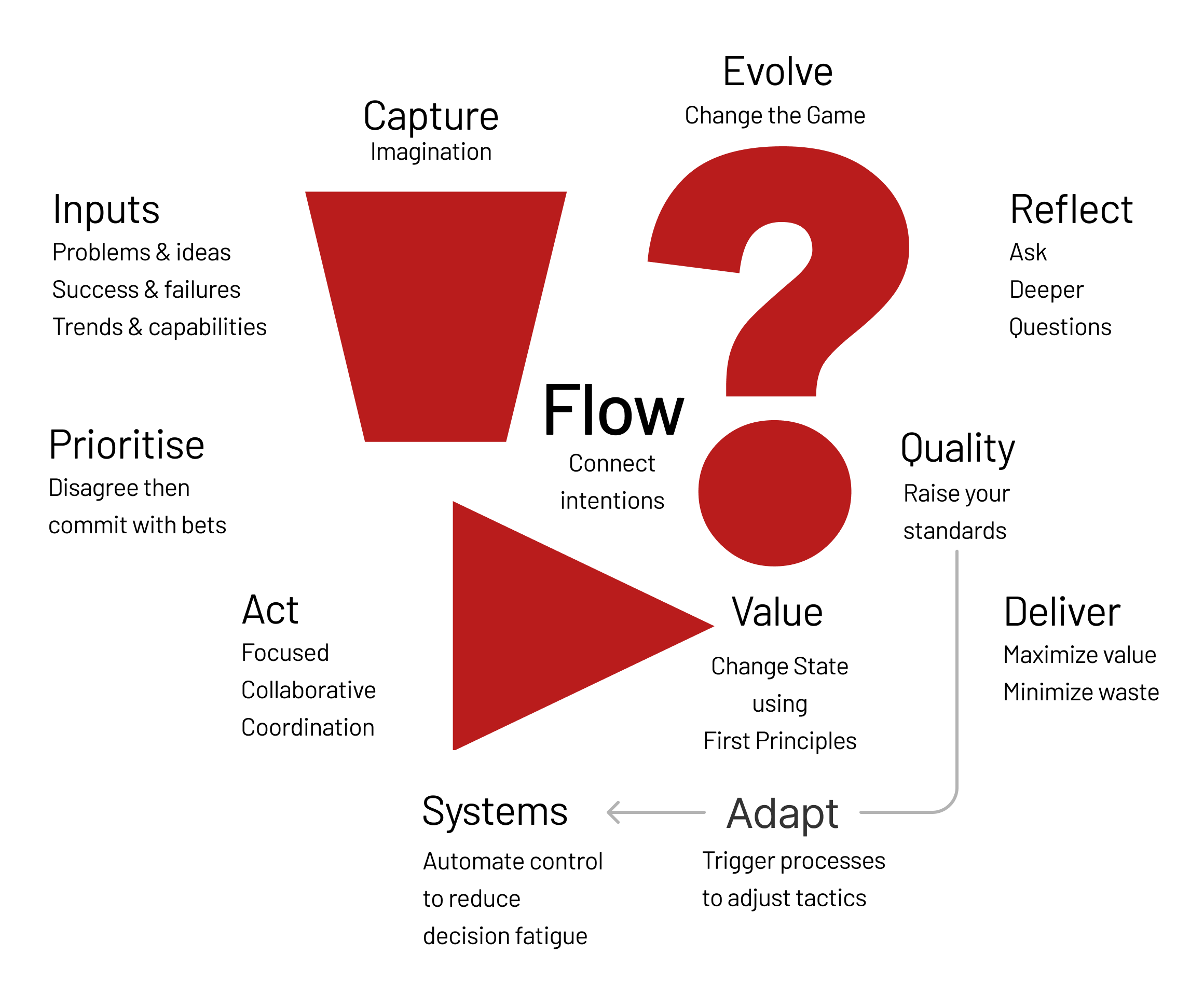
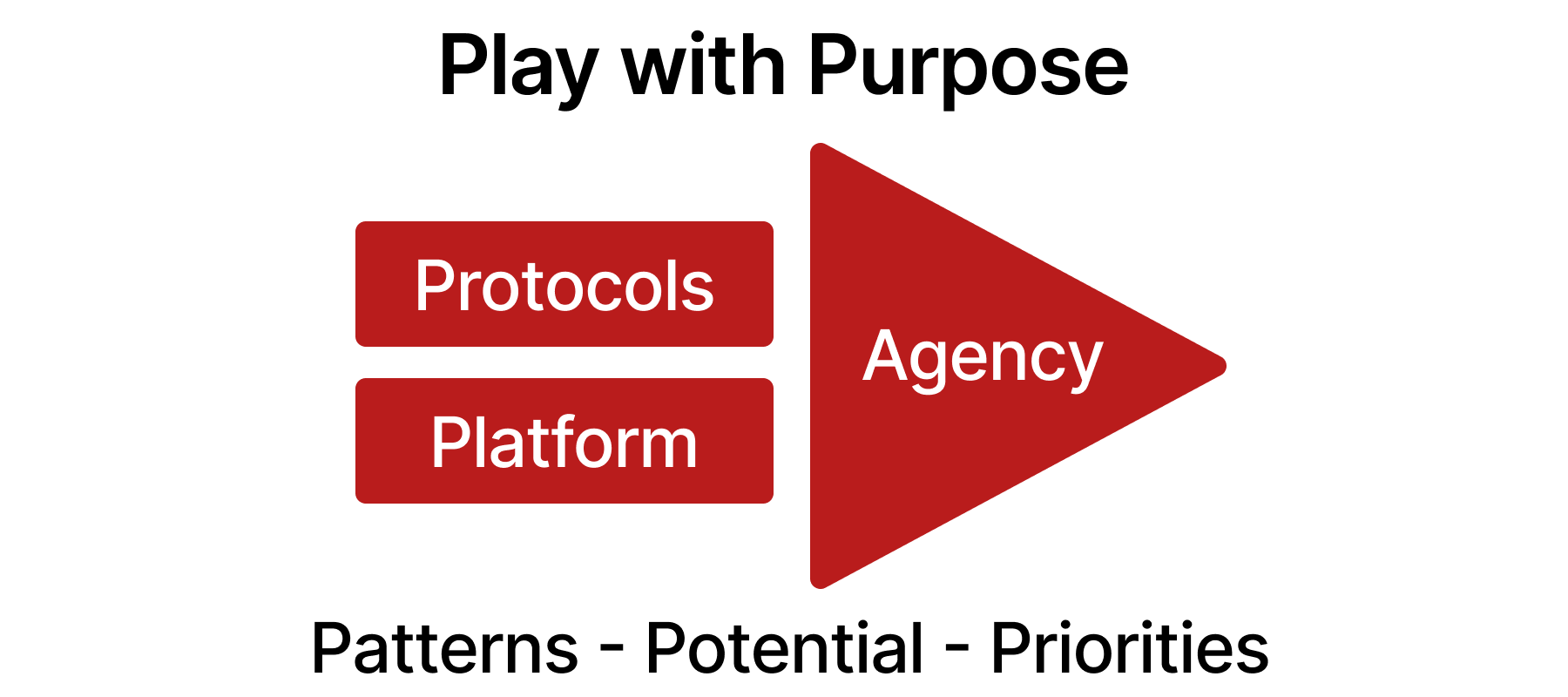
You looked up and it was dark outside. You forgot to eat. The work wasn't work — it was play with purpose.
The Equation
Flow = Intention + Attention aligned.
Spirit and intent meeting capability to execute. That is the highest form of agency.
Intention sets direction. Attention is the resource. When they align, friction disappears. When actions align with intention, you feel harmony. When they don't, you feel dis-ease. That's not failure — it's feedback. The loop is broken somewhere.
Flow doesn't mean perfection. It means the spirit is right, the tools are sharp, and you're learning even when you fail. Failures inside flow are experiments, not defeats. You try something, it doesn't work, you adjust, you try again. The loop is alive. What kills agency isn't failure — it's the absence of spirit that makes failure feel like a verdict instead of data.
Flow is not a score on the scoreboard. It is a way of being. The scoreboard measures artifacts. Flow is the state that produces them. Chase the score and you get anxiety. Inhabit the state and the score takes care of itself.
The Self-Help Trap
Most self-help is too oriented toward the self. Optimize yourself. Find your flow. Maximize your potential.
But they miss the shortcut: if you want to feel good, help someone else.
The deepest flow isn't self-focused. It's other-focused. Service is the cheat code.
The Two Levels
| Level | What It Is | How It Feels |
|---|---|---|
| Inner Loop | You + the task | Satisfying |
| Outer Loop | You + others | Transcendent |
Individual flow is mastery of the inner loop — stable attention, reduced context-switching, pattern recognition becoming automatic.
Collective flow is coordination that compounds. A great pass, a perfect harmony, a team shipping together. The singular win is nice. Nowhere near as rewarding as creating something beautiful with others.
What Breaks Flow
| Symptom | Broken Where | Fix |
|---|---|---|
| Distraction | Attention scattered | Reduce inputs, single task |
| Boredom | Challenge too low | Raise the stakes |
| Anxiety | Challenge too high | Build skill or scope down |
| Resentment | Intention misaligned | Question: why am I doing this? |
| Isolation | Outer loop missing | Find collaborators |
| Mode thrashing | Blend not set | Theme the session: one hat, one blend |
The Routing Algorithm
The flow channel is a routing algorithm. Same optimization at every scale.
| Flow State | Telco Routing | Pricing |
|---|---|---|
| Anxiety (demand exceeds capability) | Overflow — dropped packets, degraded service | Peak pricing — demand exceeds capacity |
| Flow (demand matches capability) | Max throughput — full utilization, no drops | Equilibrium — price clears the market |
| Boredom (demand below capability) | Idle capacity — wasted infrastructure | Off-peak — capacity goes unused |
The pricing diagram — peak vs off-peak, expectation vs capability — is the flow diagram for a marketplace. The challenge-skill balance that Csikszentmihalyi mapped is the same balance a network engineer manages: route enough traffic to fill the pipe without overflowing it.
The natural progression compounds: capability grows → take on slightly more challenge → stay in the zone → capability grows again. Same as telco: capacity grows → route more traffic → earn more margin → fund more capacity. Same as business: deliver value → earn trust → win harder work → build deeper capability.
The inner loop sets direction. The flow channel sets rate. Together they determine whether the loop compounds or breaks.
The Signal
Dis-ease is data.
When something feels off, don't push through blindly. Ask: where is the loop broken?
- Is my attention fragmented?
- Is the challenge matched to my skill?
- Am I doing this for the right reasons?
- Am I trying to do this alone when I need others?
The answer tells you where to intervene.
The Training Ground
Where do you learn the outer loop before stakes are existential?
Games. Better to fail in a simulation than real life. Games are the cave in the hero's journey — where the hive-mind practices coordination, where you can die and restart, where Einstein's Ladder progression happens: knowing facts → connecting facts → seeing patterns → creating patterns → compressing patterns into something others can use.
Game economics is the most valuable game we all have to play. EVE Online has central bank economists testing monetary policy in simulation. The future of AGI economics is being prototyped in MMOs right now.
The loop completes: Individual flow builds capability → capability creates value → value enables coordination → coordination is learned in games → games produce collective flow → collective flow through service returns to individual mastery.
Loops Shape Destiny
The loops you run today compound into who you become.
| Loop Type | What Compounds | Destiny |
|---|---|---|
| Positive inner | Skill, confidence, capacity | Mastery |
| Negative inner | Doubt, avoidance, atrophy | Stagnation |
| Positive outer | Trust, reputation, network | Influence |
| Negative outer | Isolation, resentment, conflict | Drift |
The feedback loop is the unit of destiny. Not the single action, but the pattern that repeats.
This is why matrices matter — they make loops visible. Visible loops can be designed. Designed loops shape who you become.
For phygital beings, the loops are explicit: training → action → feedback → evolution. For humans, the loops are often invisible — running in the background, shaping identity without awareness.
The intervention: Make your loops visible. Which ones serve the person you want to become?
Context
- Deterministic vs Probabilistic — Flow is the balance
- Foundations — The Pikorua spiral: AI and blockchain as complementary strands
- The Game — Inner and outer loops
- Games — The cave where coordination is learned
- Game Economics — Testing coordination before real stakes
- Intention — Direction setting
- Attention — Resource allocation
- Collective Wisdom — The mastermind — collective flow as highest form of agency
- Players — The hive-mind that emerges
- Archetypes — Right mode for context
- Third Space — Where collective flow happens
- Routing Algorithm — The flow channel as universal routing pattern
- Ventures — Each venture tests the balance at a different scale
Questions
What's blocking your flow right now — inner loop or outer?
- If the flow channel is a routing algorithm, what happens when you optimize for throughput instead of direction?
- Where in your life are you running at off-peak — idle capacity going to waste?
- When anxiety breaks flow, is the fix always to reduce demand, or can you grow capacity fast enough to catch it?