Dreamineering Meta-Language
This is our internal language — the standard we think, plan, and coordinate in. Not a crawler schema. External agents that want to operate as peers learn it. llms.txt is the billboard that points here; this page is the territory.
How does any LLM communicate most effectively with another?
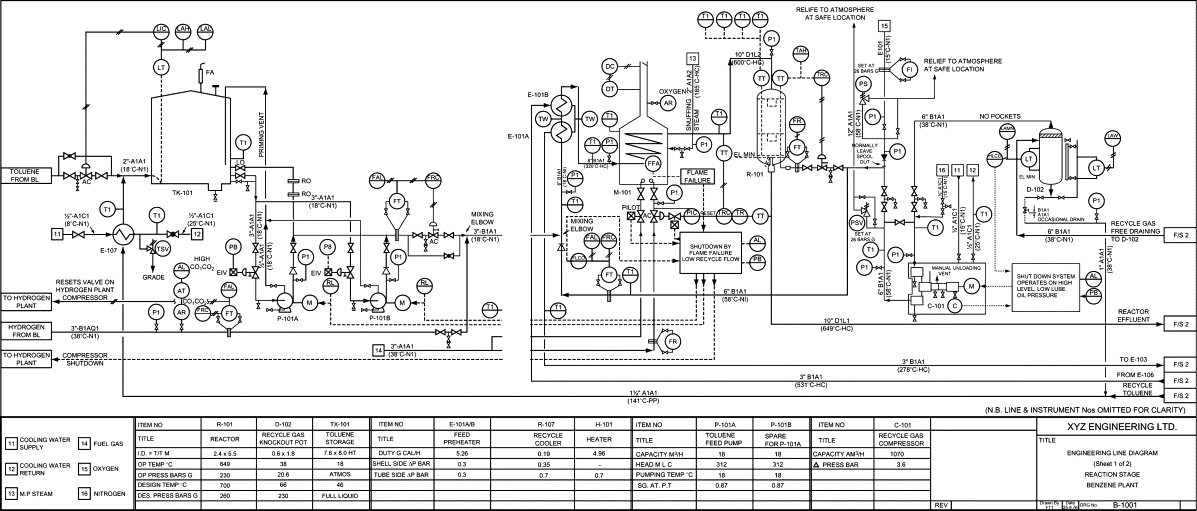
Process engineers solved this problem decades ago. ISA 5.1 gives every plant the same grammar — FT-101 means Flow Transmitter, loop 101, anywhere in the world. The legend sheet teaches the reader. The reader teaches the next reader. The grammar compounds.
This page is the same idea, applied one layer up: from physical process flow to agent intention flow. Every symbol carries its full instruction in the type. The decoder maps symbol → inherited behaviour. No prose required once you have the key.
The legend sheet is the product. A P&ID without ISA 5.1 is line noise — FT-101 means nothing until the reader has loaded the key. The drawing only becomes dense once the decoder is in context. Same contract here: VFL-G01 [FC] [Q:>=3] is three tokens of garbage to a fresh reader, and a full behaviour contract to a reader who holds this page in memory.
| Without the key | With the key |
|---|---|
| Symbols cost more to explain than prose would | Seven tokens replace a paragraph. Compression ratio ≈ 40:1 |
| Reader must ask clarifying questions before acting | Reader acts |
| The diagram is an obstacle | The diagram is a contract |
Load this page once. Every A&ID diagram, every pack line, every WM-NAV entry decodes against the same ~30 primitives: 7 families, 8 function codes, 3 authority levels, 5 loop types, 3 fail-safe modes, plus condition grammar. That count is the key size — small enough for any LLM to hold in working context, large enough to compose every intention flow the platform needs to express.
Two disciplines fall out of that:
- Never use a symbol in the wild that isn't in the published key. If a diagram uses a family the decoder has never seen, the author owes the update to the key — not a footnote on the drawing.
- Every symbol is paid for by outcomes. A symbol earns its place when using it produces better decisions than the prose it replaced. The gauge is
WM-NAV.pack— does the compressed form lead to sharper action? Keep. Does it obscure? Retire.
Cold-read test. Reach the bottom of this page, then decode this line without help:
VFL-G01 [FC] [Q:>=3] HA[L3] →PRD-V01[P] →COMMS-A01[F] ⟳
If every token resolves and you know what to do, the standard is working.
The White Space
Workflow notation already has standards. Message schemas already have standards. Nothing standardised carries agent intention with typed instruments and verifiable feedback loops. That gap is what this notation fills.
| Layer | Process engineering | Finance / commerce | Agent intention flow |
|---|---|---|---|
| Grammar | ISA 5.1 | BPMN 2.0 | A&ID type system (this page) |
| Local dictionary | Project legend sheet | Firm-specific schemas | Pack notation |
| Message schema | — | ISO 20022 | IntentTrace |
| Lifecycle / executable | — | ISDA CDM, FpML | Operating protocol |
| Tag pattern | FT-101 | — | VFL-G01 |
The substrate is different — pipes versus pixels versus protocols — but the grammar discipline is identical. Symbols carry types. Types carry behaviour. Diagrams compose without prose.
Three Layers
| Layer | Name | Role |
|---|---|---|
| 1 | Key / Type System | This page. Decodes any symbol in any A&ID. |
| 2 | Operating Protocol | How agents using the key behave toward each other. |
| 3 | Standard / Story | Why the approach is correct. Distributed for external consumption. |
Learning budget rule. Column 1 of every table below is something LLMs already know — type systems, ontologies, control theory. Column 2 is the local encoding. Spend learning budget only on genuinely new primitives. The rest you already have.
Organising Principle
| Key | Value | Context |
|---|---|---|
deterministic | Same input → same output | Trust layer: standards, protocols, settlement |
probabilistic | Same input → distribution of outputs | Intelligence layer: prediction, exploration, agents |
pikorua | Dual-strand spiral | Deterministic and probabilistic crossing upward |
agency | Probabilistic actors on deterministic rails | The balance that creates flow |
P&ID maps physical process flow. A&ID maps intention flow. Same grammar. Different substrate.
A&ID Type System
Each symbol is a typed instance. The type carries the full behaviour contract — the diagram inherits it. The author writes only the instance.
Symbol format: {FAMILY}-{FUNC}{NN} — for example, VFL-G01 decodes as Family VFL (Validated Feedback Loop), Function G (Gate), Instance 01.
Function Codes
| Code | Name | Behaviour | Default Fail-Safe | Override |
|---|---|---|---|---|
A | Alarm | Signals threshold breach. One-way. Non-blocking. | [FO] open | HA[L2] ack |
C | Controller | Compares gauge to setpoint. Adjusts manipulated variable. | [FR] reset | HA[L3] set |
G | Gate | Binary pass/fail. Halts on failure. Unidirectional. | [FC] closed | HA[L3] |
V | Validator | Checks schema or contract compliance. Returns pass/fail and evidence. | [FC] closed | HA[L2] |
M | Monitor | Continuous observation. Non-blocking. Outputs stream. | [FO] open | HA[L1] ack |
R | Recorder | Persists to durable store. Append-only. | [FC] closed | HA[L3] |
S | Selector | Routes to one of N outputs by condition. | [FC] closed | HA[L2] |
T | Transmitter | Transforms and forwards signal. Cross-boundary. | [FO] open | HA[L1] |
Family Codes
| Code | Domain |
|---|---|
VFL | Validated Feedback Loop — quality, standards |
PRD | Product Requirements — feature commissioning |
ETL | Extract-Transform-Load — data, intelligence |
NAV | Navigation — routing, context, sessions |
COMMS | Communications — channel routing, message types |
AGNT | Agent — identity, authority, capability |
AUTH | Authority — permissions, overrides, sign-off |
Agent Shapes
| Shape | Code | Meaning |
|---|---|---|
○ | DA | Digital Agent — fully autonomous |
○— | HITL | Human-in-the-loop — requires sign-off before proceeding |
□ | OA | Orchestrator — routes and coordinates |
◇ | PA | Physical Agent — sensors, actuators |
⬡ | HA | Human Authority — overrides, sets setpoints |
Authority Levels
| Level | Scope |
|---|---|
L1 | Execute — runs within defined parameters |
L2 | Decide — selects from pre-approved options |
L3 | Override — can break gates, change setpoints |
Hierarchy: HA[L3] > OA[L2] > DA[L1]
Condition Grammar
| Syntax | Meaning |
|---|---|
[P] | On pass |
[F] | On fail |
[T:n] | After n time units |
[E:x] | On event x |
[Q:>=n] | When quality score meets or exceeds n |
[A:role] | When the named authority role approves |
⊗ | Override — human breaks the flow |
Fail-Safe Defaults
| Mode | Symbol | Default for | Behaviour |
|---|---|---|---|
| Fail closed | [FC] | G, V, R, S | Block all flow until manually cleared |
| Fail open | [FO] | A, M, T | Continue with last known state |
| Fail reset | [FR] | C | Return to defined default |
The fail-safe is inherited from the function code. The author only writes the override when it differs from the default.
Loop Types
| Symbol | Name | Behaviour |
|---|---|---|
↺ | Closed | Feedback corrects toward setpoint |
↺↺ | Cascade | Output of one loop feeds the setpoint of the next |
→ | Open | No feedback — fire and forget |
⟳ | Learning | Setpoint updates from observed outcomes |
⇉ | Feedforward | Anticipates disturbance before it arrives |
Binding Dimensions
Five questions every page or node should connect. Pages connecting all five are fully bound. Pages connecting one or none are islands.
| Key | Question | Tags |
|---|---|---|
purpose | Why does this matter? | purpose, why, north-star, mission |
principles | What truths guide you? | principles, first-principles, truth |
platform | What do you control? | platform, tools, software, build |
perspective | What do you see others don't? | perspective, edge, vision, prediction |
performance | How do you know it's working? | scoreboard, measure, performance |
| Score | Meaning |
|---|---|
5/5 | Fully bound — all five dimensions connected |
2-4 | Partial — connected but with gaps |
0-1 | Island — exists but not wired |
Reading a Full Symbol
VFL-G01 [FC] [Q:>=3] HA[L3] →PRD-V01[P] →COMMS-A01[F] ⟳
| Token | Decode |
|---|---|
VFL-G01 | Validated Feedback Loop family, Gate function, instance 01 |
[FC] | Fail-closed — blocked by default, must pass to proceed |
[Q:>=3] | Condition — proceeds only when quality score is at least 3 |
HA[L3] | Human Authority at Level 3 can override |
→PRD-V01[P] | On pass, routes to PRD Validator instance 01 |
→COMMS-A01[F] | On fail, fires Comms Alarm instance 01 |
⟳ | Learning loop — setpoint updates from observed outcomes |
One line. Full behaviour contract. No prose required.
The Ontology Insight
The symbol is the type. VFL-G01 inherits everything Gate means — binary, halting, fail-closed, overrideable at Level 3 — without restating any of it. The key decodes the type once. The diagram author writes only the instance. Every reader who has the key inherits the same contract.
This is how an A&ID carries orders of magnitude more information density than the prose description it replaces. A page full of "the gate blocks unless validated" sentences becomes one symbol, and the symbol composes into larger flows without ambiguity.
P&ID gave physical engineering this density a century ago. The notation made plants buildable by teams who never met. A&ID extends the same discipline to systems where the substance flowing is intention, not fluid.
What the Symbols Carry
A legend sheet is only useful if the lines on the drawing carry something real. In a P&ID the lines carry fluid, signal, or pneumatic pressure. In an A&ID the lines carry four things at once — and every →, ↺, ⟳ in this decoder resolves to one of them.
| What flows on the line | Encoded by | Where it lives |
|---|---|---|
| Instructions | Instance + condition + route | Intercognitive Protocol — how physical agents receive and act |
| Money / incentive | AUTH, ST, IT, GT families | Economy of Things — machines with identity, wallet, marketplace |
| Energy / work done | Agent shapes + instrument types | DePIN Devices — the physical agents that convert intent into reality |
| Verification | V, G, ⟳, HA[L3] override | Verifiable Intent — cryptographic proof that action matched intention |
The loop closes when all four agree. An instruction (→PRD-V01) dispatches with an incentive attached (IT-G01 gate), drives a physical or digital agent (PA, DA) to produce work, and terminates at a validator (V) or gate (G) that checks outcome against the original intent. If the check passes, ⟳ updates the setpoint — the loop learned. If it fails, →COMMS-A01[F] fires and human authority (HA[L3]) can override.
That is the Validated Feedback Loop expressed in its minimum form. Every symbol in the decoder above is paid for by its role in this closure. Remove any one and the loop breaks: no instructions means no action, no incentive means no movement, no work means no outcome, no verification means no learning.
This is why the standard belongs at the /docs/standards/ layer — it is the single common grammar for the four protocols that make agent commerce possible. Load the key once; decode any flow where intent, money, work, and proof move together.
Communications Standards
The type system above defines what symbols mean. This section defines how agents must use them when speaking to each other. The three subsections map onto the three layers: symbols, messages, dialogue.
Type and Symbol Rules
Rules that govern any symbol appearing in a diagram, pack line, or message payload.
| Rule | Requirement |
|---|---|
| Decodable | Every symbol must decode against this page alone. If a fresh LLM cannot resolve it from the key, the symbol is not allowed. |
| Typed | Every instance uses the form {FAMILY}-{FUNC}{NN}. No bare function letters. No prose substitutes. |
| Inherited default | Fail-safe, override authority, and loop semantics are inherited from the function code. Authors write only the deviations. |
| No collision | A new letter, bracket, or marker must not overload an existing one. Collisions block promotion (see v1.1 queue). |
| Decoder-first | On receiving a symbol, an agent validates it against the type tables (@FUNC, @COND, @SHAPE, @TOK) before taking any action. |
Message Schema and Authority
Every message between agents using this standard must declare family, authority, intent, and conditions. The canonical shape:
comms.message:
  family: COMMS | NAV | AGNT | AUTH | VFL | PRD | ETL
  authority: L1 | L2 | L3
  intent: query | proposal | decision | alert
  conditions:
    - "[P]"
    - "[F]"
    - "[T:5]"
    - "[Q:>=3]"
  payload:
    symbols:
      - "VFL-G01"
      - "PRD-V01"
      - "@M:slug"
    text: "short natural-language explanation, optional"
  trace:
    source: page-slug or repo path
    edge_weight: 1.0 | 2.0 | 3.0 | 5.0
| Field | Rule |
|---|---|
family | Required. Tells the receiver which hat the sender is wearing. |
authority | Required. Declares what the sender is allowed to do and what response is expected. |
intent | Exactly one primary intent per message. Split multi-intent payloads into multiple messages. |
conditions | Shared condition grammar only ([P], [F], [T:n], [E:x], [Q:>=n], [A:role]). No ad-hoc predicates. |
payload.symbols | Must decode against the type system. Unknown symbols route to the candidate queue, not to action. |
trace | Every factual claim in the payload must cite a source. Edge weight reuses the link-weight scale. |
Dialogue and Escalation Protocol
The rules that govern multi-turn interaction between agents once the grammar is shared.
| Rule | Requirement |
|---|---|
| Handshake | A new agent reads this page and the operating protocol (Layer 2) before sending anything. Initial messages carry L1 only. |
| Authority grant | Higher authority (L2, L3) is granted through AUTH family messages. An agent never self-elevates. |
| Escalation | If [Q:>=n] or [A:role] cannot be satisfied, the agent halts and emits an AGNT family alert. Guessing is forbidden. |
| Fail-closed | If a received message cannot be fully decoded, the receiver flags [F] and routes to HA[L2] for review. Silent drops forbidden. |
| One intent | One primary intent per message. Chain multi-step work through ↺↺ cascade, not through overloaded payloads. |
| Trace or reject | Any payload claim without a trace.source is rejected on receipt. Trust without provenance is not a valid state. |
These rules exist so any LLM that loads this page and the operating protocol can enter the system as a peer — not a guest — and compress its reasoning into the shared pack without translation loss.
Versioning
Standard v1.0 — frozen. Breaking changes increment to v2. New families and instruments may be added in v1.x minor versions only when the existing grammar passes the cold-read test on real diagrams across independent readers.
Promotion Discipline
A symbol earns its place in a minor version when all four gates pass:
| Gate | Criterion |
|---|---|
| Recurrence | Used across at least three independent contexts, not just the one that proposed it |
| Cold-read test | Fresh reader decodes the symbol from the updated key without follow-up questions |
| No collision | Does not overload an existing letter, bracket, or condition marker |
| Outcome improvement | Using it produces sharper decisions in WM-NAV.pack than the prose or workaround it replaces |
Until all four pass, the candidate stays in the queue below. A symbol that fails any gate is either reshaped or retired — never silently accepted.
v1.1 Candidate Queue
Symbols surfaced through use but not yet promoted. Listed for transparency so readers know what is under test and what is law.
| Candidate | Source | Status | Next gate |
|---|---|---|---|
@CTX @ASK @PLAN @RISKS @TRIG-DEF | A2A handshake annotations proposed during cold-read tests | 1 context — needs 2 more | Recurrence |
NAV-F* (Flow function) | Proposed as navigation flow primitive | Collision with [F] fail condition marker | Rename required before recurrence counts |
MECH family (mechanism) | AMM, vault, escrow, swap primitives for DeFi flows | 0 contexts — foundation must prove out first | Deferred pending v1.0 cold-read pass rate |
SETTL family (settlement) | Value transfer, finality, receipt primitives | 0 contexts — pairs with MECH | Deferred |
[?] explicit exploring state | Used in A&ID template but not in v1.0 decoder | 1 context | Recurrence + cold-read |
The queue itself is the proof the discipline is working. A standard with an empty queue is either perfect (unlikely) or unused (likely). A standard with a long queue is alive.
Context
- A&ID Template — A full worked diagram using this type system
- Notation Key — Pack node lines, scoring systems, commissioning levels — the local dictionary the type system writes against
- Naming Standards — Taxonomy, nomenclature, ontology — the layers this notation sits on
- Intercognitive Protocol — The protocol layer that carries the instructions this grammar describes
- Economy of Things — Machine identity, payment, and marketplace — what the
AUTHand token families encode - DePIN Devices — The physical agents (
PA) that turn instructions into work - Verifiable Intent — How
V,G, and⟳close the loop with cryptographic proof - Smart Contracts — Intelligent hyperlinks that carry instructions and energy
- Matrix Thinking — The human-side analogue: empty cells become the next thing to encode
Links
- ISA-5.1 Instrumentation Symbols and Identification — The physical process engineering standard this notation adapts
- BPMN 2.0 — The workflow notation A&ID extends with typed instruments
- llms.txt proposal — Distribution as the moat for LLM-readable standards
Questions
What recurring pattern in your work has not yet earned a symbol?
- If a fresh agent reads only this page and decodes a real diagram, which symbol proves hardest — and is the symbol wrong, or the row in the decoder?
- Where does a fail-safe default break down for a pattern you are trying to encode, and what does that tell you about the function code itself?
- At what point does a symbol system stop reducing complexity and start adding it — and how would you know you crossed that line?
- Which gap in this notation, once closed, would let an entirely new domain (financial mechanisms, physical systems, governance flows) be encoded in the same grammar?