Here is how it works.
A fishing story about building a business in the age of AI.
A fisherman doesn't chase fish.
He goes to where the fish are. He scatters berley — food scraps that attract them. He creates conditions. Then he waits. The fish come to him.
Any business can work the same way. Instead of chasing customers, build things that attract them. Content posted, tools built, knowledge shared — all of it is berley.
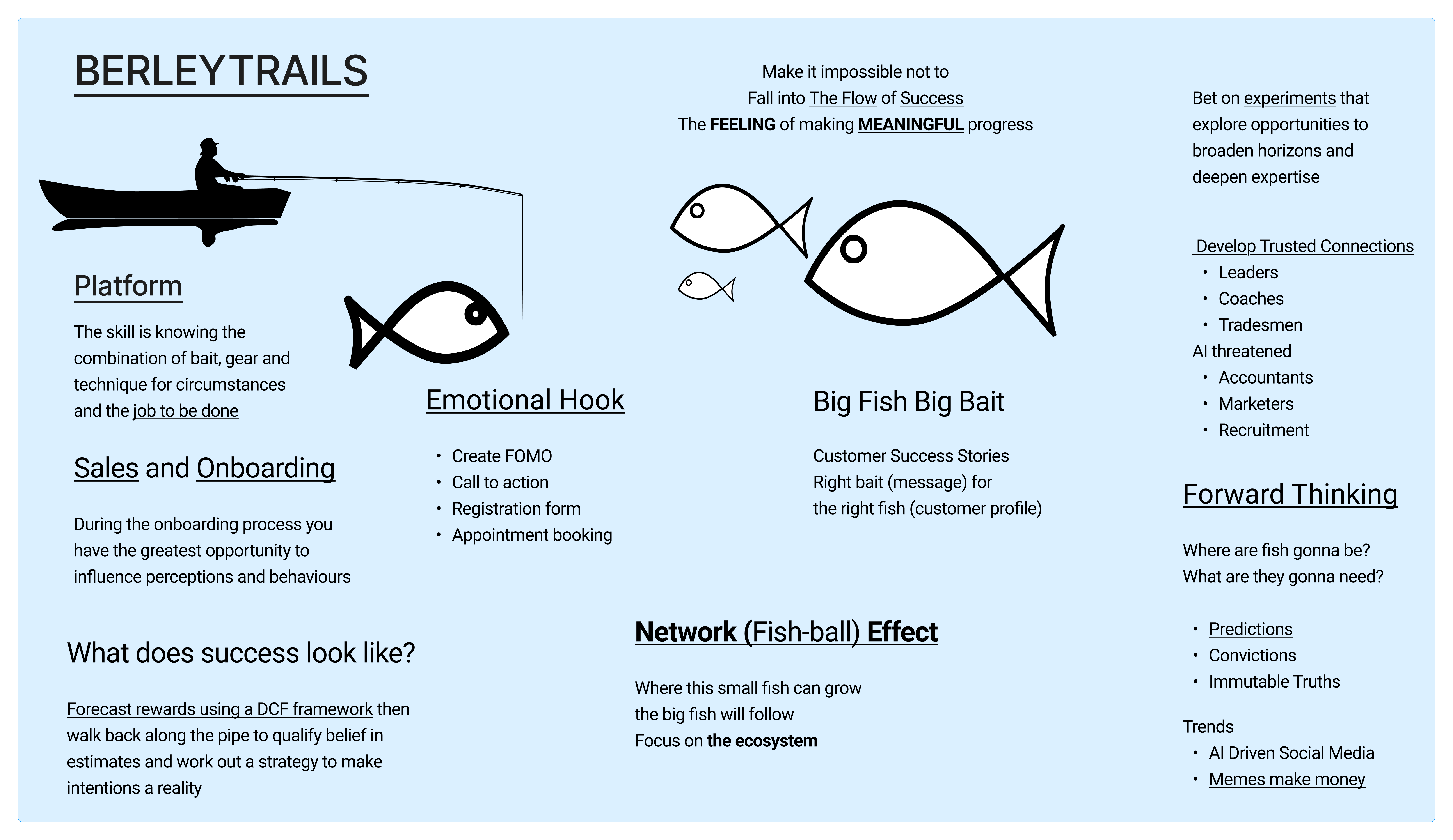
One fisherman. Three fish getting bigger. Six zones of activity. This image is the whole business model.
Three fish. Three ways to earn.
Small fish pay the bills today. Medium fish pay the bills every month. Big fish change the year.
AI Consulting
A business hires an AI specialist to work out how to use AI. One project at a time. Show up, solve the problem, get paid.
Who: Any business trying to keep up with what AI can do — and not sure where to start.
Example: A solar company wants to stop doing proposals by hand. Build the tool. Done.
Software Subscriptions
Tools businesses use every month — like Netflix, but for running their marketing or winning contracts. They pay a monthly fee. It runs whether anyone is working or not.
Who: Businesses that do the same jobs repeatedly and want a system to do it faster.
Example: A marketing tool that posts to social media, tracks who responds, and builds a contact list automatically.
Infrastructure Projects
Large construction and infrastructure projects need teams of specialists. The platform connects the right people so they can submit proposals together and win big contracts.
Who: People with contacts in dairy, energy, telco, or construction who need a better way to team up.
Example: A $2M water treatment upgrade needs a project manager, a civil engineer, and an AI specialist. The platform connects them.
How customers find us.
Without a list, every sale starts from zero. With a list, you have a pond you have been feeding for months.
- 01Post useful things online
Short articles, observations, answers to common questions. On LinkedIn. On social media. Regularly.
This is scattering berley. You are putting food in the water.
- 02People find it and follow you
Some people read what you post and find it useful. They follow you. They remember you.
The fish swim closer. They are not biting yet. They are watching.
- 03Some raise their hand
Eventually someone asks a question, books a call, or joins your email list. They have identified themselves.
A fish has taken the bait. Now you reel slowly.
- 04You have a warm list
A list of people who already know you, already found your content useful, and chose to hear more from you.
You have a full pond that you have been feeding for months.
- 05When you have something to sell, you tell the list first
No cold calls. No ads. You send a message to people who already trust you. Most of your best customers come from here.
You cast into a pond you stocked yourself.
A local business with 500 warm contacts in their area is worth more than any paid advertising campaign. The contacts already know you. They already trust you. Eddy and Mike at Solar365 are building exactly this.
Building a system beats being on social media.
Time spent on social media is time not spent building the asset that does it for you.
Doing all of this by hand takes 15 to 20 hours a week. You have to remember to post. You have to reply to everyone. You have to chase people up. It becomes a second job. A system does all of that while you focus on the actual work.
| Doing it by hand | With a system | |
|---|---|---|
| Hours per week | 15–20 hrs | 2–3 hrs |
| Consistency | When you remember | Every week, automatically |
| Contact list growth | Slow, depends on you | Steady, while you sleep |
| Follow-up | Forgotten or late | Automatic, same day |
| Cost over a year | Your time × your hourly rate | Fixed monthly fee |
Most business ideas fail.
The question is whether you find that out after \$5,000 or \$100,000.
- ↓ Hire a developer: $50,000–$100,000
- ↓ Wait 6–12 months to launch
- ↓ Discover the idea doesn’t work
- ↓ Start again
- ↑ New venture website: 30 minutes
- ↑ Test the idea with real people
- ↑ If it doesn’t work, try another
- ↑ Each attempt teaches you something
Ten cheap experiments beat one expensive bet. The platform makes experiments cheap.
One big contract changes the year.
Construction. Energy. Dairy. Telco. These industries run on contracts worth hundreds of thousands. Winning them requires the right team.
Large infrastructure projects need specialists: engineers, project managers, AI experts, compliance people. Rarely does one company have all of them. They team up. But finding the right partners, writing the proposal, and submitting it correctly takes weeks of work.
The RFP tool solves this. It connects trusted people who have worked together before, helps them put together a proposal fast, and keeps track of who did what.
Not every business needs this. But for someone with 20 years of contacts in dairy or telco infrastructure, one well-written proposal with the right team behind it can be worth more than a year of consulting.
The more people use it, the better it gets.
That is not an accident. It is the design.
Under a forest, mushrooms are connected by invisible threads called mycelium. When one tree is healthy, it shares nutrients with the others through this network. The whole forest benefits.
The knowledge built here works the same way. Every article, every guide, every tool connects to others. Every person who joins adds something. Every problem solved makes the next problem easier.
Communities will have to work this out. No institution is ready. This is built for the communities that decide to figure it out themselves.
If any of this makes sense for something you are working on, the best next step is a conversation.
Explore what others are building. Or read the evidence for why this matters now.