Business Ideas
How do you recognize a great idea when it comes along?
Where do great ideas come from? What is the most effective way to capture them?
The Horizon
When AI agents outperform your employees at everything a computer can do, what's left to build on?
Companies with assets won't recruit. They'll deploy agents. Millions of knowledge workers will discover their job was a workflow, not a relationship. The ones who thrive already know their tribe.
Technical ability was the differentiator when computers were hard. Now computers are easy. The scarce asset flips: who you know, not what you know. Rapport over resume. Craft over credentials. Culture over code.
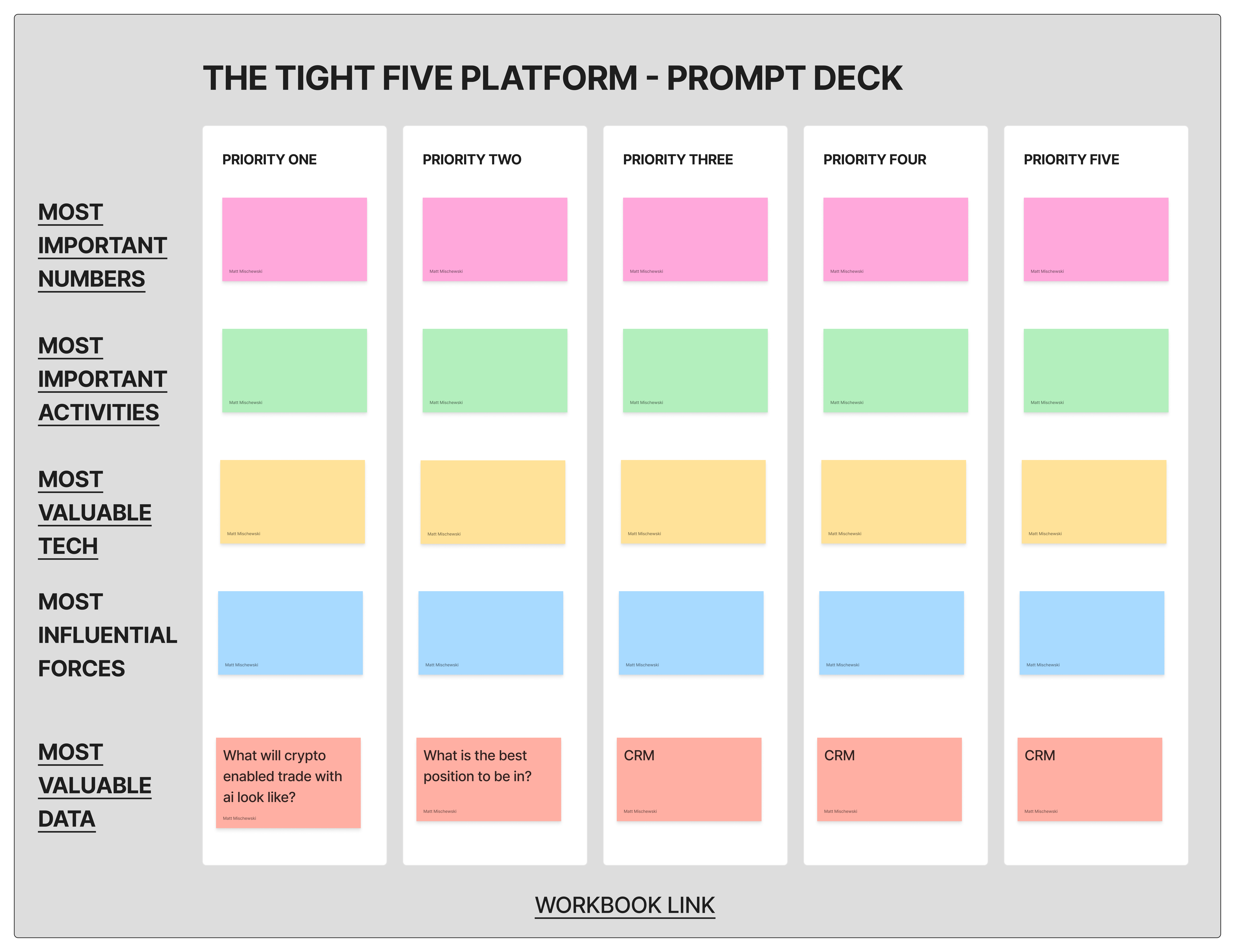
Whether you're launching something new or reinventing an existing business with fresh eyes, the same question applies: who trusts you enough to build with you? Play the alignment game — five priorities, five dimensions, twenty-five questions you can't dodge.
The Machine
Standard templates + repeatable process + multiple perspectives + imagination = business playbooks that evolve.
PRINCIPLES (what you walk)
     × THINKING SYSTEMS (how you look)
     × ARCHETYPES (who you become)
     = PICTURES (opportunities you see)
     → TEMPLATES (structure you fill)
     → VENTURES (playbooks you manifest)
     → FEEDBACK (evidence that evolves the template)
Each completed venture improves the template for the next one. That's the legacy rule.
The Checklist
Use the checklist below to start evolving your assets of persuasion
1. Title & One-Liner
- Business name:
- One-liner (who, what, differentiation): Example: "Token-incentivised solar routing network for hospitality venues."
2. Problem & Why Now
- What system is broken / value is leaking?
- Who feels the pain most (segment, region, stakeholder)?
- Why this is urgent now (regulation, AI displacement, market timing)?
- Why your approach is necessary (misaligned incentives, coordination failure)?
3. System & Opportunity
- "Universe to where we sit" (the full system and your slot in it):
- Market size and value at stake (rough, directional):
- Physical or digital network (what nodes/assets do you deploy or own):
- Assets (hardware, software, data, relationships)
- Who owns/hosts them (households, SMEs, enterprises, communities)
4. Solution & Product
- Plain-language product description (no jargon):
- Primary users and their core job to be done:
- Key differentiator — what puts you "top right" on the market map:
- What's proprietary vs what builds on existing platforms?
- What (if anything) is tokenised or novel in your business model?
5. Competition Mini-Map
- Incumbents / reference competitors (3-7 investors will recognise):
- Adjacent players / global analogues:
- Why you win:
- Relationship / local alignment advantages:
- Better economics or UX for operators / users:
- Platform + AI/analytics advantages:
6. Execution & Unit Economics
- Current stage (idea / prototype / pilot / revenue) and traction:
- Footprint so far (devices, users, sites, volume):
- Unit economics (for one "node" or customer):
- Cost to acquire and deploy/serve:
- Expected revenue and margin:
- 12-24 month plan and success criteria:
7. Business Model
- Who pays into the system (and in what form)?
- Who earns, and for doing what work?
- How value is captured and distributed (fees, yield, equity, revenue share):
- What drives behaviour (incentives, pricing, network effects):
8. Team & Credibility
- Founders and key team (2-4 bullets):
- Relevant domain experience:
- Who in the ecosystem trusts you and why:
- Prior exits or scaled products:
- Advisors / backers / key relationships:
9. Governance & Risk
- Entity and governance structure:
- Regulatory considerations for your jurisdiction(s):
- Data sovereignty and control:
- Key risks and mitigations:
10. The Ask
- Amount and instrument (equity, SAFE, convertible, revenue share, blend):
- Use of funds (approx % split):
- Product & technology:
- Operations / infrastructure:
- Go-to-market & partnerships:
- What you want from lead investors:
- Strategic intros:
- Operational help:
The Critical Path
Every new business must complete a mandatory, non-core setup path before it can deliver value. This path is orthogonal to the value proposition. It gates launch timing, investor readiness, and the ability to hire or collect revenue.
The shape is the same in San Francisco, Auckland, and Berlin: an annoying, fragile, high-stakes to-do list.
| Domain | What | Risk if Skipped |
|---|---|---|
| Legal shell | Entity type, registration, tax IDs, founder equity, charter docs | Cannot raise, hire, or trade |
| Financial rails | Bank account, payment processor, accounting, bookkeeping, expense tracking | Cannot collect or track revenue |
| Compliance | Licenses, permits, tax registrations, privacy policies, insurance, filing calendar | Fines, shutdown, investor flight |
| People | Employment contracts, payroll, benefits, onboarding, time tracking | Cannot hire legally |
| Operating tools | Email, document store, CRM, project management, website | Cannot coordinate or sell |
Each domain has jurisdictional and sector nuance. But the structure is nearly universal and repeatable. Checklists, templates, and automations can cover most of it.
The trap: This path is high risk and low joy. Errors wreck funding and cashflow, but doing it well gives no competitive moat. Every hour a founder spends on it is an hour not compounding on the actual value proposition. The solution is to treat it as a parameterised workflow — answer a structured interview about what you are trying to do and where, then approve a sequence of actions.
Run the generic critical path exactly once, as a system. The first run is investment. Every subsequent venture is almost free.
Execution Phases
Business development follows three repeating phases:
| Phase | Question | Output |
|---|---|---|
| Ideas | What is worth building? | Prompt Deck + validated thesis |
| Establishment | How do we make it real and reliable? | Initial customers + operating protocols |
| Growth | How do we compound value responsibly? | Repeatable expansion with stronger standards |
Growth is not just balance-sheet expansion. It is also trust, goodwill, and spirit becoming more measurable and more transferable.
Growth Ledger
Use a wider ledger than finance-only reporting:
| Ledger | What It Tracks | Typical Measures |
|---|---|---|
| Financial | Economic viability | Revenue, margin, cashflow, runway |
| Operational | Execution reliability | Cycle time, defects, on-time delivery |
| Goodwill | Relationship quality and trust | Retention, referrals, NPS, partner depth |
| Spirit | Felt quality of the work | Energy, meaning, team health, willingness to continue |
When financial performance rises while goodwill and spirit fall, growth is fragile. Durable growth requires all four ledgers moving in the right direction over time.
Validation
Before pitching, build conviction in your rhetoric:
| Element | Purpose | Application |
|---|---|---|
| Ethos | Establishes Trust | Open with character |
| Logos | Builds Understanding | Develop core argument |
| Pathos | Creates Movement | Amplify emotional resonance |
| Kairos | Ensures Relevance | Choose optimal moment |
| Topos | Bridges Gaps | Frame within shared context |
The Persuasion Loop
Once your idea is defined, build the assets that sell it:
BUSINESS IDEA → PITCH DECK → LANDING PAGE → SALES PITCH → PRESENTING → SELLING → FEEDBACK
       ↑                                                                              |
       └──────────────────────────────────────────────────────────────────────────────┘
Each asset has a different rhetoric focus. Each feeds the others.
The loop looks like persuasion. It is actually filtration. Each asset is berley — content that attracts the right fish before you cast. The landing page self-selects. The sales pitch qualifies. The presentation confirms. By the time you're selling, the person across the table already wants what you have. You didn't convince them. The berley trail filtered for people with open input ports — character before capability, willingness before teaching. The flywheel runs when graduates become recruiters, not because you ask them to, but because the system made them better and they want that for others.
Realizations
This template in action:
| Venture | Domain | Status |
|---|---|---|
| Better Practice | betterpractice.space | Defining |
| Prettymint | prettymint.io | Defining |
| Stackmates | stackmates.io | Defining |
| Howzus | howzus.com | Defining |
| Touch For Fun | touchfor.fun | Defining |
| Berley Trails | berleytrails.com | Defining |
| Dreamineering | dreamineering.com | Defining |
Worked example: The Prediction Game PRD runs this template end-to-end on Sui — from gap discovery through financial model to settlement proof.
See all ventures at Dreamineering Ventures.
The Loop
DEVELOP (plan) → REALIZE (mycelium) → MEASURE (scoreboard) → DEVELOP
The template gets you from idea to plan. Ventures is where the plan becomes a venture. The Scoreboard tells you if it's working. If it's not — back here with fresh eyes.
Context
- The Journey — Every venture follows the hero's journey — call, trials, transformation, mastery
- Flow — Flow is the execution state where intention meets capability
- Deterministic vs Probabilistic — Templates are deterministic rails, ventures are probabilistic experiments
- Strategy — Integration layer: Inspiration to Strategy to Operations to Growth
- Platform — The shared infrastructure problem mycelium solves
- Business Instruments — Control loops at each stage
- Selling Philosophy — Attract self-teachers, don't chase consumers
- Ventures — Ventures in action
- Scoreboard — Is it working?
- Jobs To Be Done — Find demand by studying friction
- Questions — The Tight Five framework
- Validate a Great Idea — Spending data, wedge strategies, trust economics
Questions
What would happen if every new business inherited the template lessons of every business before it?
- Which of the ten sections above exposes your biggest gap — and what would filling it change?
- When does a template become a constraint instead of an accelerant — and how do you know when to break the format?
- If the persuasion loop feeds back to the business idea, what evidence from a previous cycle would change what you write next?