Productivity
How do you create the conditions where your best intentions flow into valued outcomes?
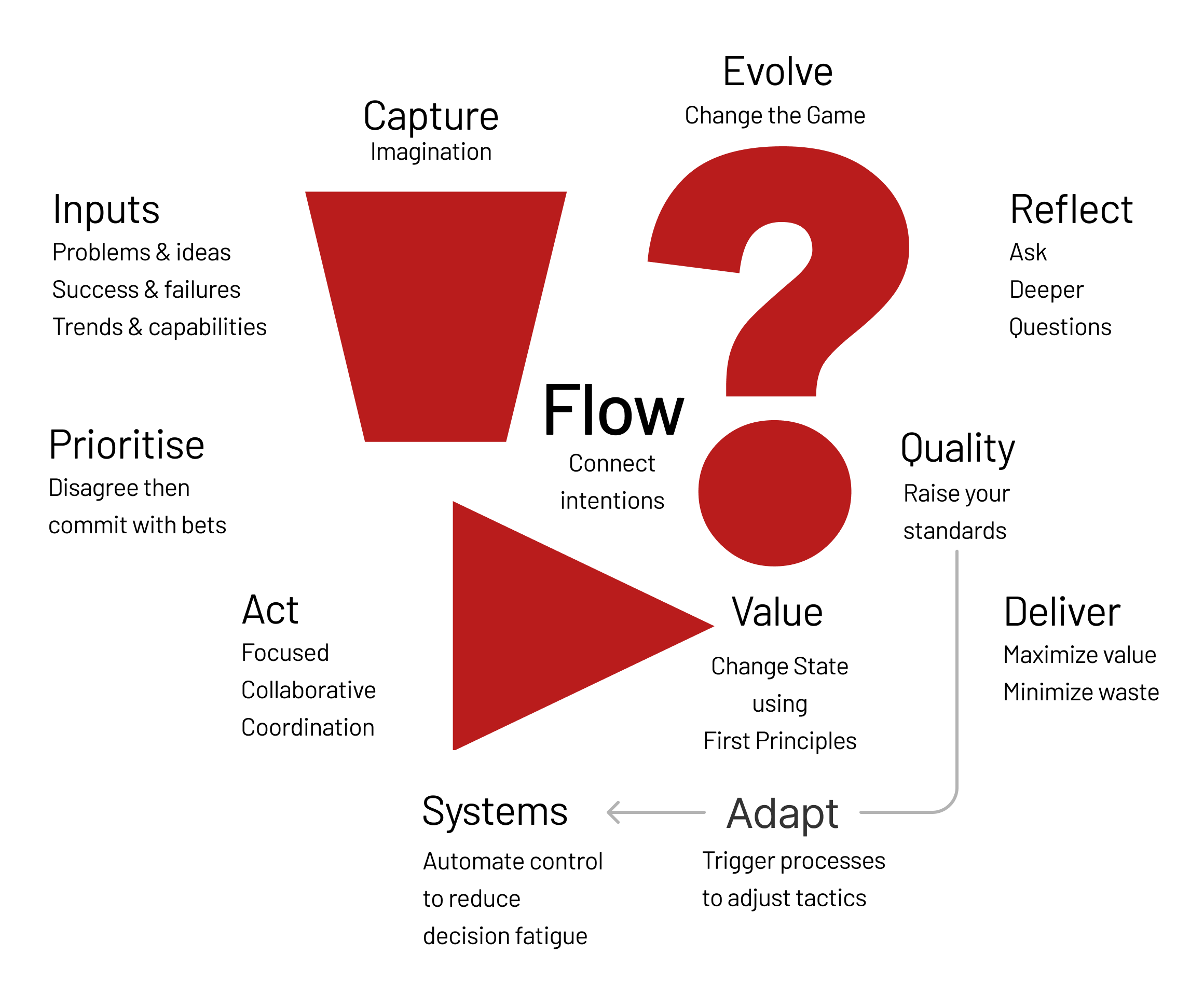
Principles
You do not rise to the level of your ambitions. You fall to the level of your preparation.
Two modes of productivity. Deep work in isolation builds the vertical bar — the foundation nobody sees. Connection with others builds the horizontal bar — the reach that makes depth matter. The quality of the transition between them determines whether you compound or just stay busy.
The Loop
Plan time and space. Enter the right frame of mind. Then the loop turns:
| Station | What It Does | When It Breaks |
|---|---|---|
| Perception | See what is actually happening | You react to noise, not signal |
| Prediction | Anticipate what matters next | You plan for yesterday |
| Priority | Choose the one thing that moves the needle | Everything feels urgent |
| Performance | Act with full attention on what you chose | Context switching kills flow |
| Philosophy | Ask the better question that improves the loop | You repeat without reflecting |
Better questions produce better plans. Better plans produce better mindset. Better mindset produces flow. Flow while resonating with others is peak experience.
The Prompt Deck is the instrument for running this loop. The Meeting Template is the instrument for running it with others.
Capability Stack
Productivity without the right capabilities is efficient movement in the wrong direction. Each domain requires a different capability mix — and serves a different priority dimension.
| Domain | Capabilities Required | Serves |
|---|---|---|
| Planning | Planning, Visualisation, Systems Thinking, Focus | All 5 Ps — the allocation instrument |
| Communication | Writing, Listening, Questioning, Languages | Persuasion, Purpose |
| Meetings | Presenting, Orchestration, Empathy, Questioning | All 5 Ps — the collision instrument |
| Progress | Pattern Recognition, Working Memory, Truth Recognition, Investing | Predictions, Perspective |
What you choose to be productive AT is a priorities decision. The capabilities determine whether you can execute it. The loop: capabilities feed priorities feed productivity feed back to capabilities.
Dig Deeper
Build the vertical bar:
- Planning — Feedback loops at every cadence, from daily intention to quarterly recalibration
- Personal Protocols — Engineer systems that protect deep work from the enemy within
Build the horizontal bar:
- Communication — Structure, substance, connection — every message is a bet on someone's attention
- Meetings — Synchronous collisions that create momentum or waste lifetimes
Context
- The State of Flow — What happens when the loop aligns
- Time and Energy — The raw material
- Tight Five Prompts — The cognitive instrument
- The Meeting — The loop with others
- Memory Systems — Why five, not seven
- Communication — Structure, Substance, Connection
- T-Shaped Capabilities — Deep work builds the vertical bar, connection builds the horizontal
- Capabilities — What each productivity domain requires
- Priorities — What determines where productivity is pointed
Questions
What would change if you treated your state of mind as the first priority, not the last?
- If perception is the first station, what are you doing to see clearly before you plan?
- When the loop stalls, which station broke — and how would you know?
- What is the difference between being busy and running the loop well?
- When do you need isolation and when do you need collision — and what happens when you get the timing wrong?