Decisions
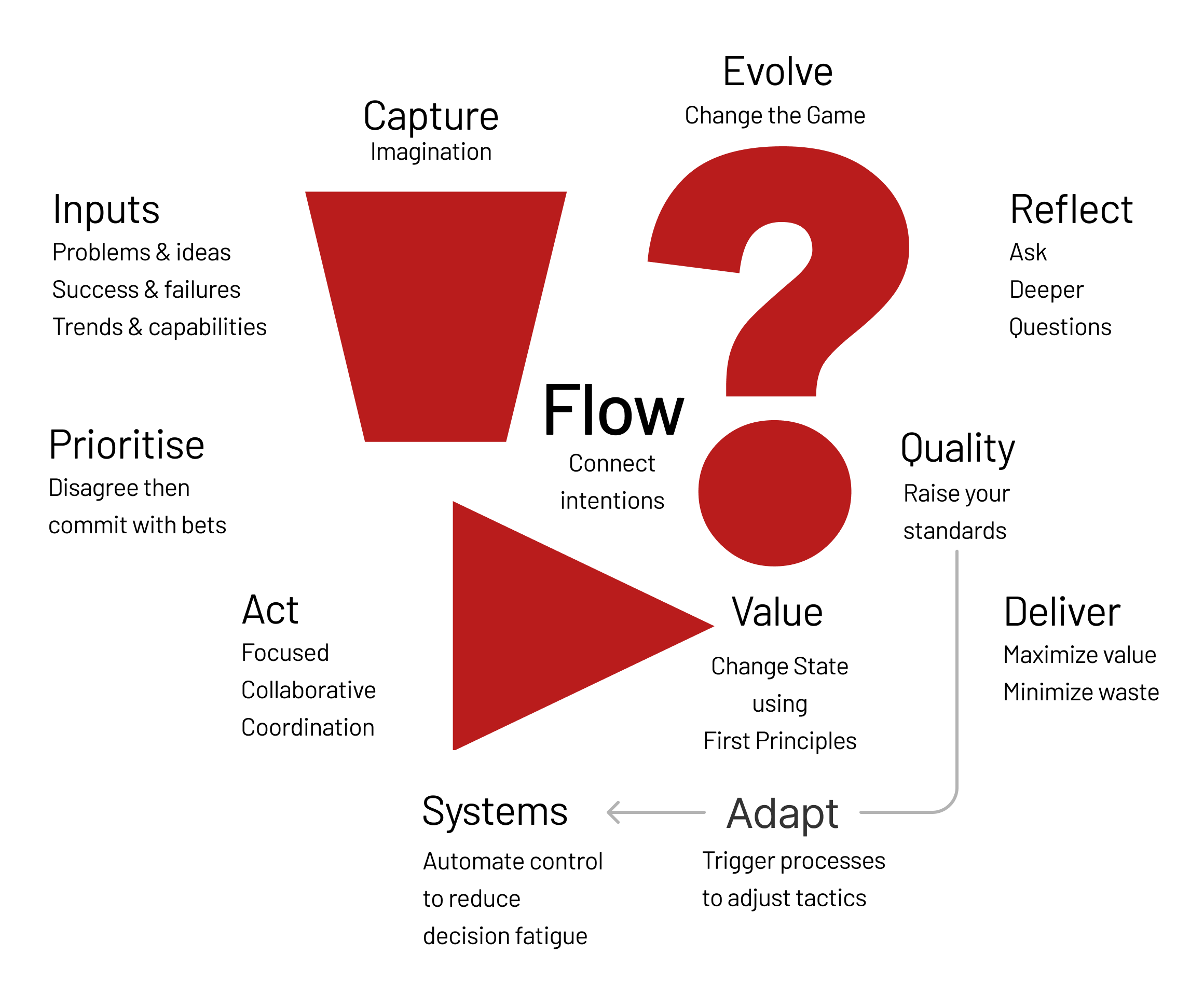
Good decisions follow good questions. Decisions are only as valuable as they are practiced and learned from.
| Step | Question | Go Deeper |
|---|---|---|
| Frame | What are we actually deciding? | Problem Solving |
| Gather | What do we know? What's missing? | Decision Algorithms |
| Decide | Which option, given constraints? | Domains |
| Act | What's the next concrete step? | Protocols |
| Learn | What happened? Why? | Decision Journal |
Philosophy
Life is a constant stream of decisions. Good judgement is a superpower. Meta-cognitive analysis involves questioning underlying assumptions:
- Single-loop learning: Adjust actions to fix errors (e.g., working harder after a failure).
- Double-loop learning: Re-examine value and beliefs (e.g., "Is this goal still meaningful?").
Decisions must be judged on the process for making them not their outcomes.
Domains
Apply the loop to specific contexts:
| Domain | Focus | Key Trade-offs |
|---|---|---|
| Tech Stack | What tools to build with | Speed vs. flexibility, control vs. convenience |
| Blockchain | Which chain, which consensus | Decentralization vs. throughput, security vs. cost |
| Decision Journal | How to document choices | Speed of decision vs. quality of learning |
| Decision Algorithms | Which heuristics to apply | Explore vs. exploit, optimize vs. satisfice |
Cognitive-Emotive Loops
This model describes a cyclical pattern where thoughts and emotions fuel each other, often leading to stuck behaviors. For example:
- Cognitive trigger: A belief like "I'm underpaid and undervalued".
- Emotive response: Anger or resentment, which reinforces the initial thought.
- Behavioural outcome: Avoidance or entitlement, perpetuating the loop.
Breaking this loop requires self-awareness to recognize the pattern, acceptance to reduce self-judgment, and interruption through body-focused attention or cognitive restructuring.
Habit Loops
Popularized by Charles Duhigg and others, this framework explains how habits form through a three-step cycle:
- Cue: A trigger (e.g., a notification on your phone) prompts action.
- Routine: The habitual behavior (e.g., scrolling social media).
- Reward: A dopamine-driven reinforcement (e.g., momentary distraction).
To modify habits, interventions target the cue (e.g., removing triggers) or reward (e.g., substituting healthier alternatives).
OODA Loops
These loops describe how behavior is shaped by responses to actions:
- Balancing loops: Stabilize behavior (e.g., slowing down when a car speed monitor shows you're over the limit).
- Reinforcing loops: Amplify behavior (e.g., social media "likes" encouraging more posts).
Effective feedback loops rely on timely measurement and actionable comparisons (e.g., tracking progress toward a goal).
Analysis Paralysis
Constant questioning of life choices can create a "loop" of indecision. Key features include:
- Overanalysis: Repeatedly weighing options without resolution.
- Fear of regret: Avoiding decisions to prevent potential mistakes.
- Emotional exhaustion: The loop drains mental energy, worsening self-doubt.
Strategies to escape this cycle include setting decision deadlines and embracing "good enough" choices.