Business Development
Innovation at speed of inspiration.
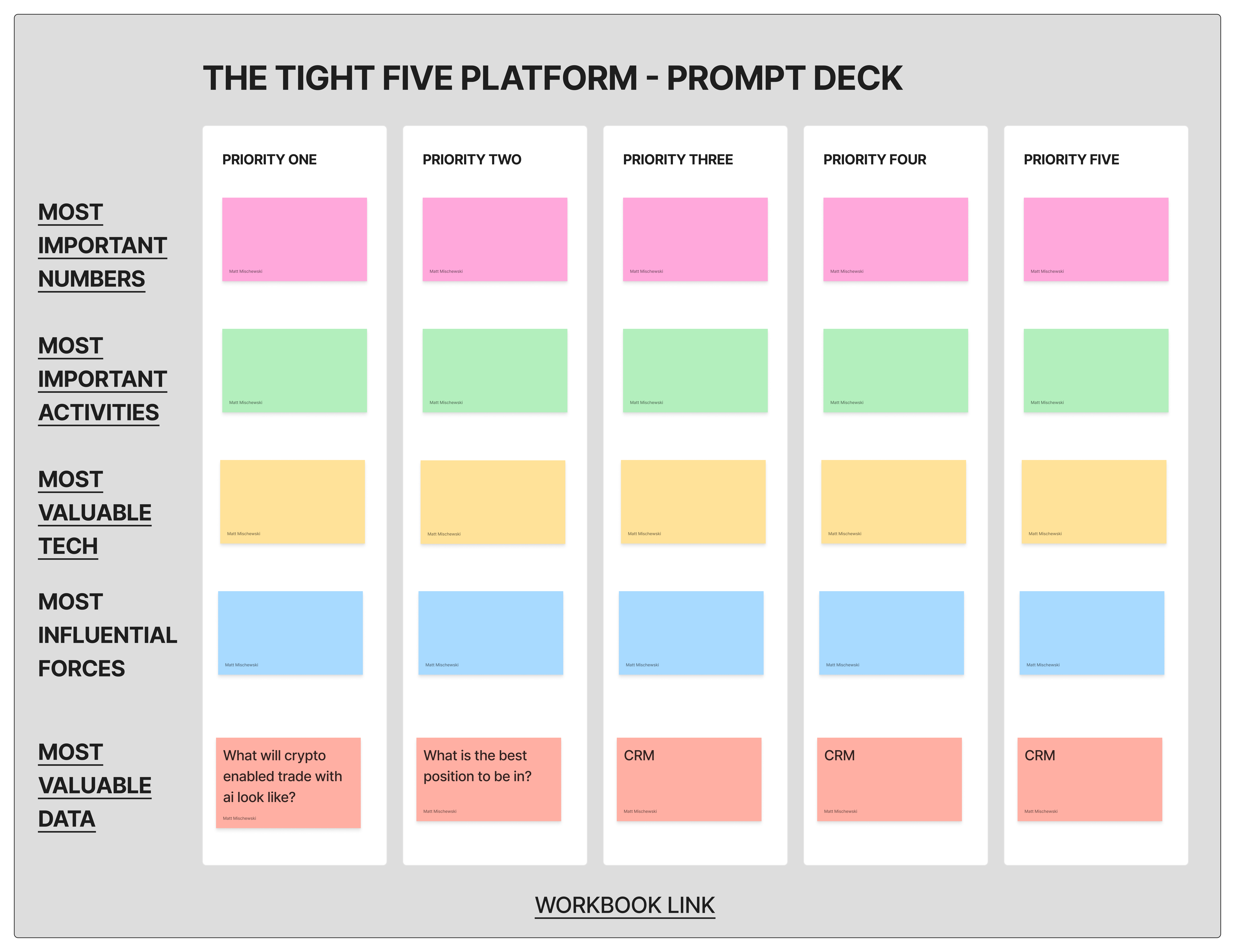
When AI agents outperform your employees at everything a computer can do, what's left to build on?
Companies with assets won't recruit. They'll deploy agents. Millions of knowledge workers will discover their job was a workflow, not a relationship. The ones who thrive already know their tribe.
Technical ability was the differentiator when computers were hard. Now computers are easy. The scarce asset flips: who you know, not what you know. Rapport over resume. Craft over credentials. Culture over code.
Whether you're launching something new or reinventing an existing business with fresh eyes, the same question applies: who trusts you enough to build with you? Play the alignment game — five priorities, five dimensions, twenty-five questions you can't dodge.
Use this as a fill-in template. Keep the whole page to 1 side of A4.
Dig Deeper
📄️ Process
The integration layer connecting Ideas → Strategy → Operations → Growth.
🗃️ Inspiration
1 item
📄️ Platform
Collective wisdom and evolving standards so businesses go straight to their value proposition
1. Title & One-Liner
- Business name:
- One-liner (who, what, differentiation): Example: "Token-incentivised solar routing network for hospitality venues."
2. Problem & Why Now
- What system is broken / value is leaking?
- Who feels the pain most (segment, region, stakeholder)?
- Why this is urgent now (regulation, AI displacement, market timing)?
- Why your approach is necessary (misaligned incentives, coordination failure)?
3. System & Opportunity
- "Universe to where we sit" (the full system and your slot in it):
- Market size and value at stake (rough, directional):
- Physical or digital network (what nodes/assets do you leverage):
- Assets (hardware, software, data, relationships)
- Who owns/hosts them (households, SMEs, enterprises, communities)
4. Solution & Product
- Plain-language product description (no jargon):
- Primary users and their core job to be done:
- Key differentiator — what puts you "top right" on the market map:
- What's proprietary vs what leverages existing platforms?
- What (if anything) is tokenised or novel in your business model?
5. Competition Mini-Map
- Incumbents / reference competitors (3-7 investors will recognise):
- Adjacent players / global analogues:
- Why you win:
- Relationship / local alignment advantages:
- Better economics or UX for operators / users:
- Platform + AI/analytics advantages:
6. Execution & Unit Economics
- Current stage (idea / prototype / pilot / revenue) and traction:
- Footprint so far (devices, users, sites, volume):
- Unit economics (for one "node" or customer):
- Cost to acquire and deploy/serve:
- Expected revenue and margin:
- 12-24 month plan and success criteria:
7. Business Model
- Who pays into the system (and in what form)?
- Who earns, and for doing what work?
- How value is captured and distributed (fees, yield, equity, revenue share):
- What drives behaviour (incentives, pricing, network effects):
8. Team & Credibility
- Founders and key team (2-4 bullets):
- Relevant domain experience:
- Who in the ecosystem trusts you and why:
- Prior exits or scaled products:
- Advisors / backers / key relationships:
9. Governance & Risk
- Entity and governance structure:
- Regulatory considerations for your jurisdiction(s):
- Data sovereignty and control:
- Key risks and mitigations:
10. The Ask
- Amount and instrument (equity, SAFE, convertible, revenue share, blend):
- Use of funds (approx % split):
- Product & technology:
- Operations / infrastructure:
- Go-to-market & partnerships:
- What you want from lead investors:
- Strategic intros:
- Operational help:
Three Phases
Business development follows three repeating phases:
| Phase | Question | Output |
|---|---|---|
| Ideas | What is worth building? | Prompt Deck + validated thesis |
| Establishment | How do we make it real and reliable? | Initial customers + operating protocols |
| Growth | How do we compound value responsibly? | Repeatable expansion with stronger standards |
Growth is not just balance-sheet expansion. It is also trust, goodwill, and spirit becoming more measurable and more transferable.
Growth Ledger
Use a wider ledger than finance-only reporting:
| Ledger | What It Tracks | Typical Measures |
|---|---|---|
| Financial | Economic viability | Revenue, margin, cashflow, runway |
| Operational | Execution reliability | Cycle time, defects, on-time delivery |
| Goodwill | Relationship quality and trust | Retention, referrals, NPS, partner depth |
| Spirit | Felt quality of the work | Energy, meaning, team health, willingness to continue |
When financial performance rises while goodwill and spirit fall, growth is fragile. Durable growth requires all four ledgers moving in the right direction over time.
Validation
Before pitching, build conviction in your rhetoric:
| Element | Purpose | Application |
|---|---|---|
| Ethos | Establishes Trust | Open with character |
| Logos | Builds Understanding | Develop core argument |
| Pathos | Creates Movement | Amplify emotional resonance |
| Kairos | Ensures Relevance | Choose optimal moment |
| Topos | Bridges Gaps | Frame within shared context |
The Persuasion Loop
Once your idea is defined, build the assets that sell it:
BUSINESS IDEA → PITCH DECK → LANDING PAGE → SALES PITCH → PRESENTING → SELLING → FEEDBACK
       ↑                                                                              |
       └──────────────────────────────────────────────────────────────────────────────┘
Each asset has a different rhetoric focus. Each feeds the others.
Realizations
This template in action:
| Venture | Domain | Status |
|---|---|---|
| Better Practice | betterpractice.space | Defining |
| Prettymint | prettymint.io | Defining |
| Stackmates | stackmates.io | Defining |
| Howzus | howzus.com | Defining |
| Touch For Fun | touchfor.fun | Defining |
| Berley Trails | berleytrails.com | Defining |
| Dreamineering | dreamineering.com | Defining |
See all ventures at Dreamineering Ventures.
The Loop
DEVELOP (plan) → REALIZE (mycelium) → MEASURE (scoreboard) → DEVELOP
The template gets you from idea to plan. Ventures is where the plan becomes a venture. The Scoreboard tells you if it's working. If it's not — back here with fresh eyes.
Context
- Inspiration — Questions, forces, opportunity discovery
- Process — Integration layer: Inspiration to Strategy to Operations to Growth
- Platform — The shared infrastructure problem mycelium solves
- Business Instruments — Control loops at each stage
- Ventures — Ventures in action
- Scoreboard — Is it working?
- Jobs To Be Done — Find demand by studying friction
- Questions — The Tight Five framework