Meetings
How many lifetimes are wasted every minute across the globe in pointless meetings?
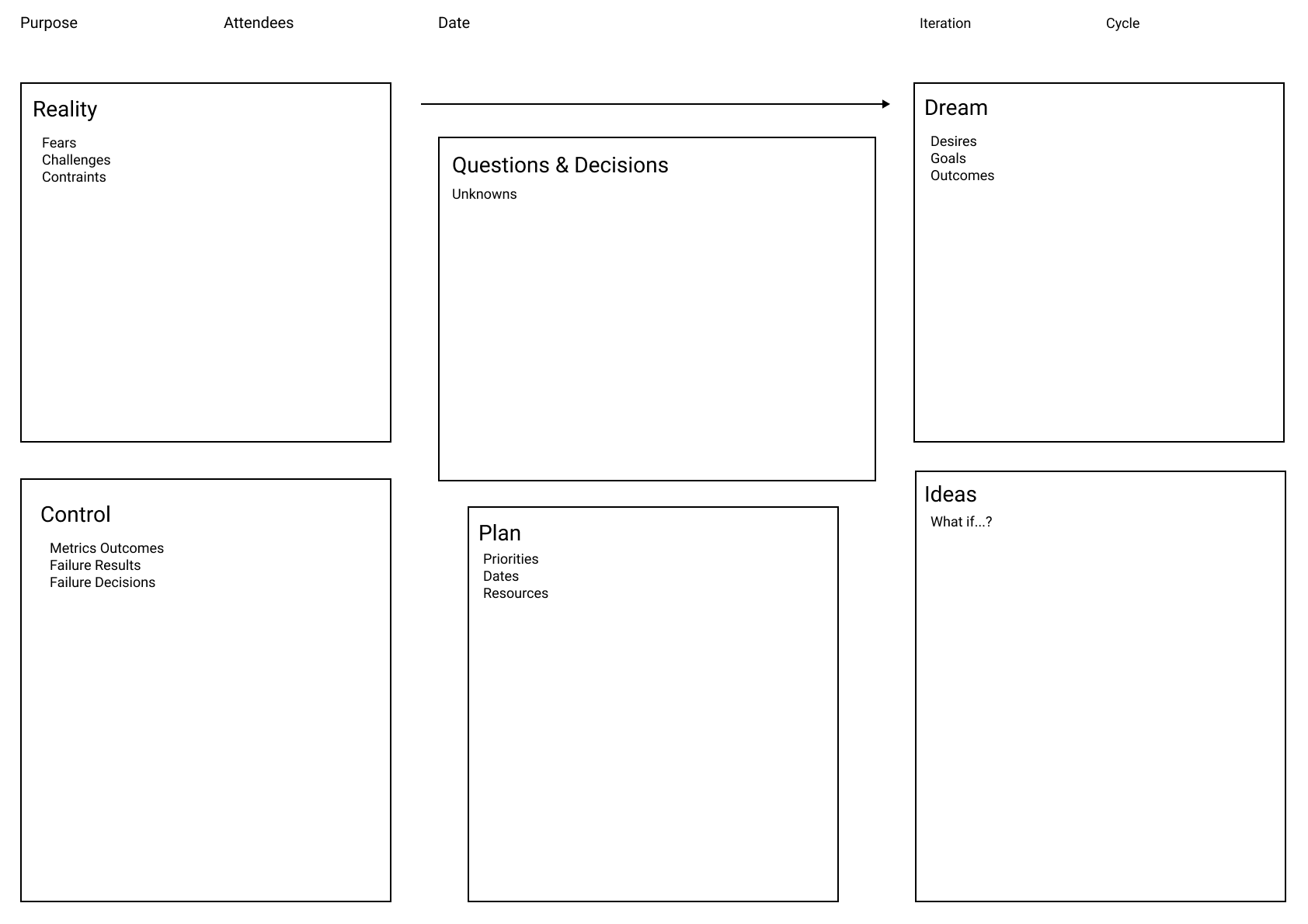
A meeting is a state transition. The six-box canvas — Reality, Dream, Questions, Plan, Control, Ideas — is the state being read and updated. Pick the right type and you change the right state.
Async Gate
Before requesting a meeting:
- Can I send a message to request the desired input or action instead?
- If not, add reasoning why synchronous time is worth the cost in the invite.
Async communication is the default. Meetings are the exception that must justify itself.
Five Types
Every meeting uses the same six-box canvas. The meeting type determines which boxes are primary, which archetype chairs, and what energy the room needs.
| Type | Chair | Energy | Purpose |
|---|---|---|---|
| Collision | Dreamer | Divergent | Creative spark, unplanned magic |
| Discovery | Philosopher | Receptive | Share information, find patterns |
| Debate | Realist | Convergent | Narrow criteria, test ideas |
| Decision | Engineer | Committed | Commit resources, place bets |
| Accountability | Coach | Reflective | Review progress, enter the danger |
Specialized protocols apply the five types to specific domains. AI Strategy specializes the Decision type for technology choices — the business owner chairs, not the tech person.
Protocol Flow
Universal standard for every meeting, regardless of type:
| Stage | Standard | Output |
|---|---|---|
| Before | Purpose, agenda, required attendees, prep docs | Shared context |
| During | Timebox, facilitation rules, live note-taking, clear decision call | Clear commitments |
| After | Minutes, owners, due dates, follow-up cadence | Execution continuity |
Best Practices
Meetings without an agenda or minutes are a party.
- Agenda: Send in advance with purpose, decisions required, and expected outcomes. Provide materials that minimize information transfer during the meeting.
- Attendance: Invite people who can make decisions or will be directly accountable. Before confirming: "What will I gain that I can't gather via notes or recording?"
- Preparation: Re-read the agenda (5 mins). Assign someone to record minutes. Agree delegated actions for the next meeting.
- Minutes: Capture decisions, commitments, open questions, and sparks. Recap next steps at the end. If it is not written down it did not happen.
Benchmarks
| Benchmark | Target |
|---|---|
| Agenda compliance | >90% of meetings start with explicit agenda |
| Decision clarity | >90% of decisions have owner + due date |
| Follow-through rate | Commitments completed by agreed date |
| Time efficiency | Duration within declared timebox |
| Rework avoidance | Fewer repeated alignment meetings on same topic |
Dig Deeper
- Collision — Divergent creative energy. When you need sparks, not structure.
- Discovery — Receptive learning. When the room needs shared understanding before anything else.
- Debate — Convergent evidence testing. When positions need stress-testing before commitment.
- Decision — Committed resource allocation. When the room must commit with owners and dates.
- Accountability — Reflective progress review. When outcomes need honest comparison to expectations.
- AI Strategy — Specialized Decision for non-technical owners making technology choices. The owner chairs.
Context
- Navigation — Value, belief, control — the three systems meetings should align
- Decision Making — What meetings should produce
- Decision Journal — Where meeting decisions get recorded
- Communication — Structure, Substance, Connection
- Productivity — The loop meetings serve
- Flow State — What bad meetings destroy
- Async Comms — The alternative to test first
- Make Meetings Matter — The six-box canvas
- Standards — Meetings freeze insight into state that lasts
- Archetypes — The five chairs, one per meeting type
- Protocols — Meetings are operational protocols; agent commerce and network standards are coordination protocols. Same pattern, different domain
Links
- Steve Jobs
- Meeting Decisions
- Cut meeting time
- Meetings at Amazon
- meetinghero.ai
- meetgeek.ai
- minutes.io
Questions
How many lifetimes are wasted every minute across the globe in pointless meetings?
- If meetings without minutes are parties, what percentage of your meetings last month had written outcomes?
- Which of the five meeting types — collision, discovery, debate, decision, accountability — do you default to, and which do you avoid?
- What would change if every meeting required a two-sentence justification for why it couldn't be async?
- When agents join meetings, which of the five types changes the most — and which stays exactly the same?