Navigation System
Every system — person, organization, economy — runs three interlocking loops. When all three harmonize, you experience flow. When one is off, you feel dis-ease — the signal to diagnose which loop needs attention.
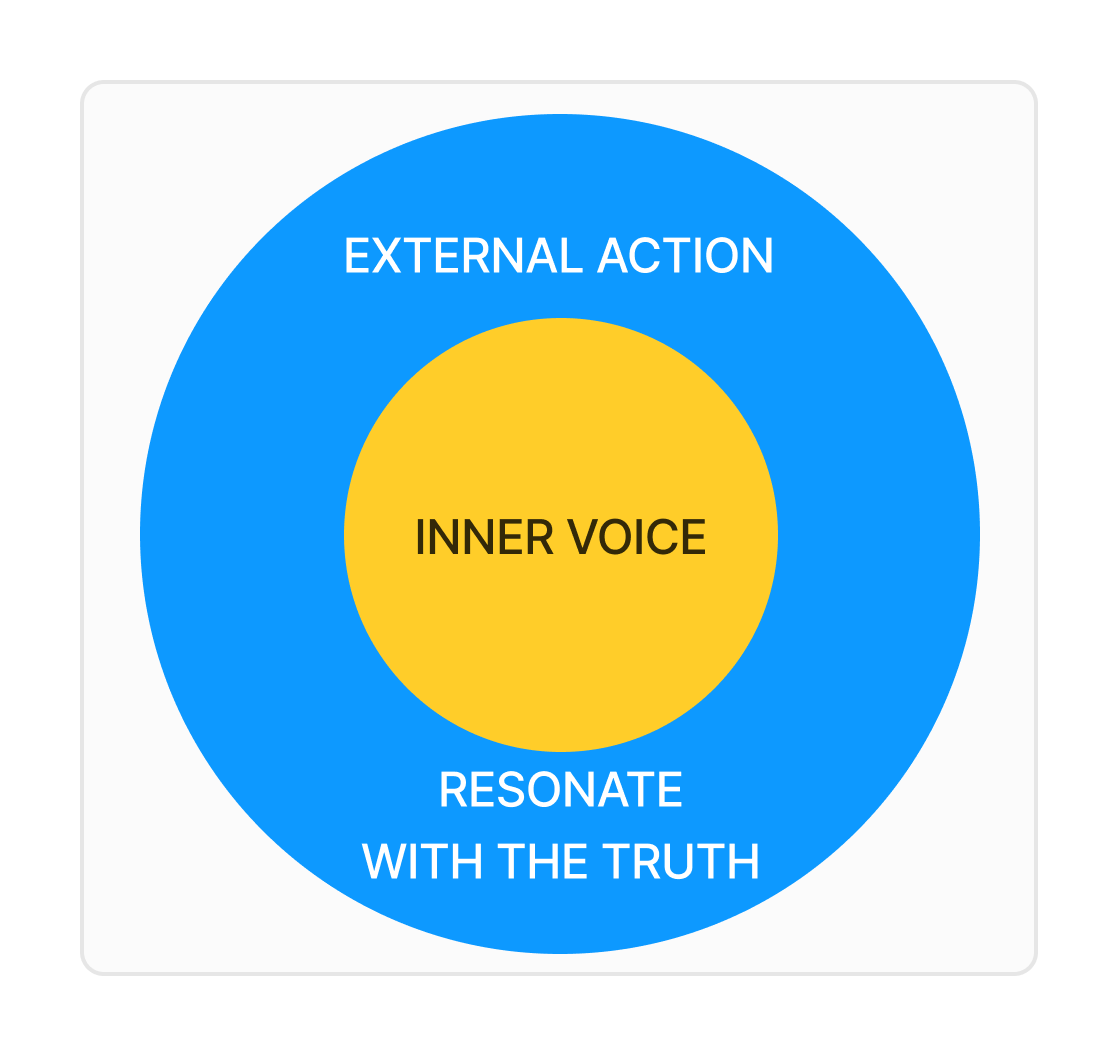
The sequence matters. Value comes first — always.
| Order | System | Question | Force | When Aligned | When Broken |
|---|---|---|---|---|---|
| 1st | Value | What is truly important? | Anchor | Clarity of purpose — grounded in real world worth | Chasing metrics that drift from meaning |
| 2nd | Belief | Where are you going? | Pull | Dreams attract capability | Delusion — confident movement toward the wrong thing |
| 3rd | Control | How do you navigate? | Push | Power without strain | Efficient movement in the wrong direction |
Belief without value is delusion — you head somewhere with conviction but no ground. Control without value is waste — you execute well toward the wrong outcome. The value system must be rock solid before the other two can function. Not rock solid as in rigid — rock solid as in known. You know what real world value looks like. You know what matters to real people. That knowing is the anchor everything else attaches to.
Principles
VALUE (anchor)          BELIEF (pull)         CONTROL (push)
What grounds you?       Where headed?         How to get there?
      ↓                      ↓                      ↓
  Principles              Predictions            Protocols
  Essentials              Intentions             Standards
  Belonging               Purpose                Platform
      └──────────────────────┼──────────────────────┘
                             ↓
                     NAVIGATION STATE
                    (flow or dis-ease)
Mantra
Continuously develop mantra to get a prompt in the right direction — mindset before method. Peak flow is the state where insight arrives without effort and action expresses goodwill without friction. The mantra is the prompt that opens the channel.
The Tight Five is the mechanism. Five questions, run in sequence, build the belief platform — not through willpower but through progressive clarity:
| Question | Builds | Belief Gained |
|---|---|---|
| Why does this matter? | Purpose | Clarity — I know what I'm for |
| What truths guide me? | Principles | Trust — I'm not guessing |
| What do I control? | Platform | Leverage — I have something to work with |
| What do I see others don't? | Perspective | Conviction — my edge is real |
| How do I know it's working? | Performance | Agency — I can find a way |
Confidence is not a personality trait. It is the output of having your Tight Five tight. When you can answer all five, you have the platform to act — because you know what you're for, what's true, what you control, where your edge is, and how to read the feedback. That's "find a way" as a system, not a hope.
The purpose of this inner discipline is bandwidth. Mantra and systems handle the known decision routes — the hard calls you've already thought through — so you arrive at the novel problem with full capacity. Point of difference only lives in the novel. You cannot access your edge while managing the routine.
These three systems are the Scoreboard loop at the individual level — Belief sets intended state (priorities), Control executes decisions to change state, Value determines which instruments you trust to read the gap.
| Scoreboard | Navigation System | Question |
|---|---|---|
| Priorities | Belief — intended state | Where are you going? |
| Decisions | Control — execution | How do you change state? |
| Instruments | Value — what you measure | What grounds the reading? |
The Landscape
Each system maps to site sections you build and industries that threaten sovereignty if someone else owns the data.
| System | What You Build | Industry Exposure | Data at Stake |
|---|---|---|---|
| Value | Principles, Foundations | Payments, Banking | What you value enough to pay for, what you own |
| Belief | Priorities, Scoreboard | AI Data, Advertising, Gaming | What you see, believe, and inhabit |
| Control | Platform, Protocols, Standards | Telecom, Mobility, Robotics | Where you go, what signals reach you, what acts on your behalf |
Navigation Scorecard
Every navigation system runs on data. The scorecard reveals which data flows carry the most power — and who controls them.
| # | System | Data Flow | Source Industry | Data (1-5) | AI (1-5) | Robot (1-5) | If Someone Else Owns It |
|---|---|---|---|---|---|---|---|
| VALUE | |||||||
| 1 | Value | Transaction records | Payments | 5 | 4 | 1 | They record what you value enough to pay for |
| 2 | Value | Financial records | Banking | 5 | 4 | 1 | They custody your stored value |
| 3 | Value | Property records | Real Estate | 4 | 3 | 1 | They certify what you own |
| BELIEF | |||||||
| 4 | Belief | Training data | AI Data | 5 | 5 | 1 | They train the brain making your predictions |
| 5 | Belief | Attention signals | Advertising | 4 | 5 | 1 | They shape what you see and believe |
| 6 | Belief | Behavioral patterns | Gaming | 3 | 4 | 1 | They design the systems you inhabit |
| 7 | Belief | Content engagement | Entertainment | 2 | 4 | 1 | They curate your information diet |
| CONTROL | |||||||
| 8 | Control | Connectivity | Telecom | 4 | 4 | 2 | They control the signals between you and the world |
| 9 | Control | Movement data | Mobility | 5 | 4 | 5 | They know where you go and when |
| 10 | Control | Sensor + actuator | Robotics | 5 | 5 | 5 | They command agents acting on your behalf |
| 11 | Control | Earth observation | Space | 5 | 4 | 4 | They observe the physical world from above |
How to read:
- Data — How valuable is this data for predicting and influencing behavior? (1 = generic, 5 = irreplaceable)
- AI — How much does AI amplify this data's power? (1 = marginal, 5 = existential)
- Robot — How much does physical automation extend this data's reach? (1 = minimal, 5 = dominant)
Three patterns:
- Belief is the most AI-exposed system. Training data (5), attention (5), behavior (4) — AI doesn't just use this data, it reshapes what you perceive. Lose belief sovereignty and your predictions are someone else's.
- Control is the most robot-exposed system. Mobility (5), robotics (5), space (4) — physical agents extend data collection into the real world. Lose control sovereignty and your movements, actions, and environments are instrumented by others.
- Value is the most regulated but least defended. Transaction and financial data are highly regulated (GDPR, PCI) but regulation assumes centralized custody. DePIN + tokenization shift the custody model entirely.
Inner Loop
The inner loop is how you navigate in practice:
QUESTIONS → PROBLEM SOLVING → DECISIONS → ACTION → FEEDBACK
| Stage | Core Question | Surface |
|---|---|---|
| Questions | What am I really trying to understand? | Questions |
| Problem Solving | What is the most important problem now? | Problem Solving |
| Decisions | Given constraints, what will I do next? | Decisions |
Five Priorities
Five questions keep the loop coherent across personal, venture, and system levels:
| Priority | Question | System |
|---|---|---|
| Purpose | Why does this matter? | Value |
| Principles | What truths guide this? | Value |
| Platform | What do I control? | Control |
| Perspective | What do I see others don't? | Belief |
| Performance | How do I know it's working? | Control + Belief |
When these five are explicit, the three systems align faster and dis-ease is easier to diagnose.
Data Sovereignty
The three systems depend on data you control. Industries that generate and own data are the convergence point — if someone else owns the data, they steer the system.
| System | Data Dependency | Industrial Threat |
|---|---|---|
| Value | Transaction + financial records | Payments, Banking |
| Belief | Training data + attention + behavior | AI Data, Advertising, Gaming |
| Control | Connectivity + movement + sensors | Telecom, Mobility, Robotics |
DePIN is the mechanism. Data sovereignty is the outcome. The navigation system is why it matters.
Context
- Scoreboard — The loop made measurable: priorities → decisions → instruments
- Industries — The scorecard shows what's at stake across every vertical
- Tight Five — Five bound elements, any domain
- Principles — Foundational truths powering the value system
- Platform — Tools and infrastructure powering the control system
- Flow — When all three systems align
- DePIN — The mechanism for data sovereignty
- Business — The five business layers that this navigation system makes coherent: Strategy → BD → Growth → Operations → Artifacts
Questions
If dis-ease is the signal that a system is misaligned — what dis-ease are you ignoring right now?
- Which of the three systems do you over-invest in at the expense of the others?
- What would change if you treated your strongest conviction as your biggest blind spot?
- Where in your life are you optimizing a solution that should be questioned instead?