Rugby
Spirit and intent meeting capability to execute. That is the highest form of agency.
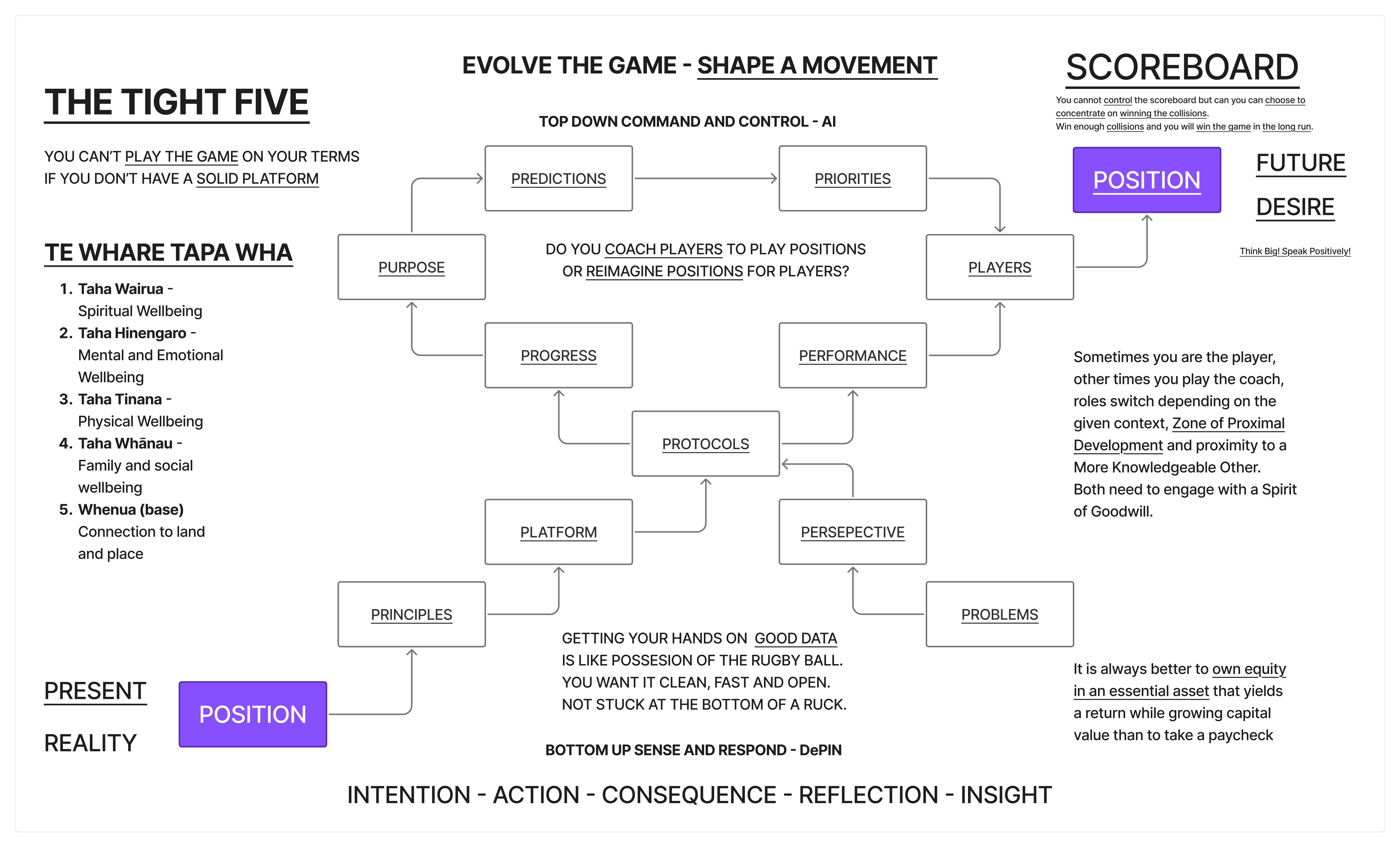
The best teams adapt the fastest to the referee and playing conditions. Given similar physical attributes, the team that can coordinate complimentary talents to execute the best decisions fastest will win the moments that matter.
Flowing rugby is that expression of will made visible. Fifteen agents reading the game as one organism. The ball finds space before the gap opens. This is the mastermind — collective flow beyond what any individual could produce alone.
Heads Up
Scan for opportunities. See the picture. Believe you can make a positive impact for the team.
Head down is the negative spiral. Caught in the inner loop — the missed tackle, the knocked-on ball, the story that says you can't affect what happens next. Head down sees the ground. No scan. No options. No agency. The narrative shrinks to survival and the team loses a player in plain sight.
Head up breaks the loop. You see the whole field — the space forming, the defender's weight shifting, the runner timing the line. The scan comes first. Then the belief that what you do next will make the team better. Not individual glory — a contribution that lifts the collective. Without the scan, you react. Without the belief, you hesitate. Both kill the opportunity.
Nothing worse than the dis-ease of indecision, except for knowing the right decision and lacking the agency to do anything about it. The first is head down — no scan, no picture, paralysed by noise. The second is head up but legs won't move — you see the gap but the story says you can't get there. Both are broken feedback loops. The fix is the same: next action, for the team, now.
The best players scan before they receive. They know what they'll do with the ball before it arrives because they've already seen where the team needs them. That's perspective in motion — processing the picture at pace, in service of the mastermind.
Embrace Chaos
Create systems and patterns to thrive in chaos by limiting downside risk while exploring upside potential.
- Practice coordinated decisions under pressure and exhaustion.
- Use deception to mislead intentions.
- Simplify options.
Off The Ball
Give your ball player multiple options when on attack and their ball player one on defence.
Shape the future for best possible outcomes through practiced patterns for attack and defence.
- See pictures from multiple perspectives to communicate and take better decisions.
- Hive mind: you can take decision unless everyone has worked hard off the ball to get themselves into the right shapes.
Great teams instinctively take better collective decisions
The leader is the one that knows what to do next.
Better Practice
Better systems, better practice, better decisions, better outcomes.
There are limited places avaliable to outright specialists. But if you evolve a rare combination of complimentary skills that together provide a competitive edge you can dominate a category of your own.
Better Practice creates greater belief
Rugby fitness also provides social fitness.
Winning Collisions
Every contest is a collision — tackle, ruck, breakdown, the moment a ball carrier meets the line. Everything before the collision is information. Everything after is consequence.
The team that wins the collision is the team that had the better prediction at the moment of contact. Attack loads false signal into the defence's read. Defence strips the noise to find the true intention. Same feedback loop, opposite seats.
Defence
Read the signs. React to the pattern early. Ignore the declared signal — watch the weight shift, the hips, the timing. The real intention leaks through the noise if your gauge is calibrated to the right variable.
Commitment, Attitude, Discipline.
You can't lose if you don't concede points
Take care of the downsides and the upsides will take care of themselves.
- Read body language before the ball moves — hips don't lie
- Communicate the picture to compress the attacker's options
- Give their ball player one option, not three
Attack
Fake your intentions. Make the opposition commit to the wrong picture. By the time reality arrives, they're out of position.
Fortune Favours the Brave
Platform: Attack needs a deep and broad platform. Deep gives momentum — forward power that fixes defenders and earns go-forward. Broad gives options — width that stretches the defensive line and creates space to distribute into. The scrum is the essential platform because it delivers both: eight-man shove for depth, channel options across the backline for breadth.
Without depth, distribution is lateral. Without breadth, momentum is blunt. You need both to attack the space where opportunity lies.
Distribution: The routing function that connects platform to space. The ball must move faster than the defensive read. Hold it too long and options collapse. Move it early and every off-the-ball runner becomes a threat. Distribution is key — it turns platform power into points.
Workrate: Make yourself available. Aim to make three touches
Unexpected Vectors:
- A prop that can side step or chip and chase
- The deep pass on a fake crash
- The inside pass line
- The bounced pass
Mislead Intentions: Lie with your eyes
- Fake disinterest/interest
- Look where you're not going
The Business Game
Same game, different field.
| Rugby | Business | The Pattern |
|---|---|---|
| Deep and broad platform (scrum) | Platform as crystallized capability | Depth = momentum. Breadth = options. Both compound. |
| Distribution (ball to space) | Distribution beats product | The routing function that connects capability to opportunity |
| Winning collisions (prediction) | Perspective — seeing what others miss | Better prediction at contact = competitive edge |
| Attack (fake intentions) | Positioning — occupy the space in their mind | Make the market commit to the wrong picture |
| Defence (read the signs) | Tight Five Loops — signal over noise | Calibrate your gauge to the right variable |
| Off the ball (create options) | Building capability before the moment arrives | The team that did the work before the collision wins it |
| Better practice → belief | VVFL — validated practice compounds | Repetition under pressure creates conviction |
The master loop runs the same in every domain. Question → Principle → Protocol → Standard → Platform → Better Question. On the rugby field you feel it. In business you measure it. The loop doesn't care.
Context
- Collective Agency — The mastermind state rugby exemplifies
- Flow — The mechanics of individual and collective flow
- Decisions
- Platform — Crystallized capability compounds like scrum dominance
- Distribution — Superior distribution beats a superior product
- Positioning — Occupy the space before the competitor arrives
- Perspective — The shift from player to coach
- Tight Five Loops — Same loop, every domain
- Culture
Links
Questions
What makes the difference between a team that coordinates and a team that flows?
- If great teams instinctively take better collective decisions, how do you train instinct?
- When does individual brilliance help the team and when does it break the flow?
- What is the rugby equivalent of a broken feedback loop — and how do you fix it mid-game?
- If the same feedback loop runs in rugby and business, what's the equivalent of the scrum — the deep platform that creates distribution options?