Aligned Priorities
How do you get a room of stakeholders to agree on what matters most?
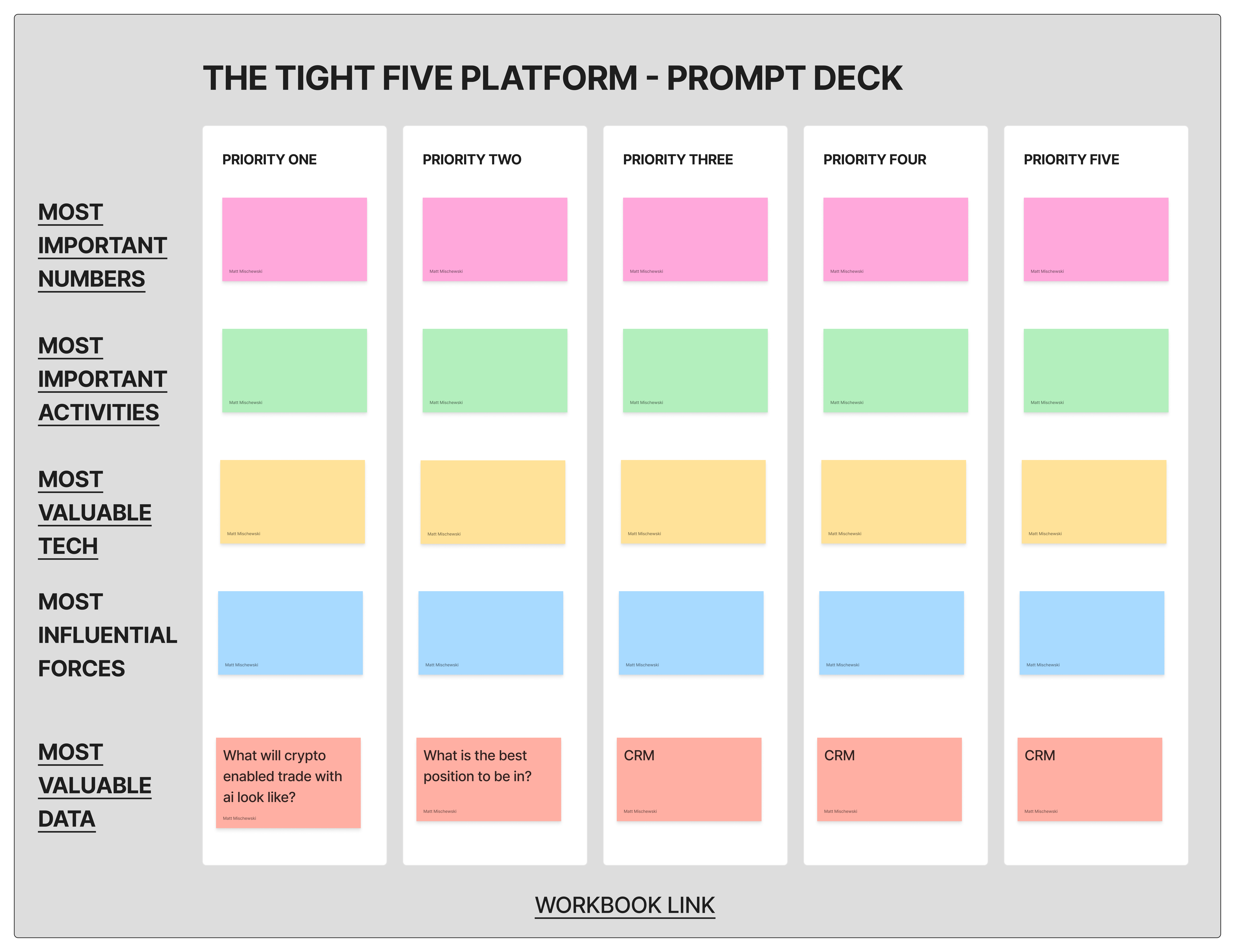
Give them cards. Make them sort. The argument about order IS the alignment.
The Exercise
Five cards on the table. Each card is a priority with a claim, a picture, and a table — a Prompt Deck slide. The facilitator doesn't present slides. The stakeholders sort them.
| Step | What Happens | What It Reveals |
|---|---|---|
| Deal | Place 5 cards face-up on the table | The priorities exist |
| Sort | Each person ranks cards left-to-right by importance | Individual mental models visible |
| Compare | Show all rankings side by side | Where alignment exists and where it doesn't |
| Argue | Discuss the disagreements — not the agreements | The hidden assumptions surface |
| Commit | Lock the order. Column 1 = build first. | Consensus has coordinates |
The sorting forces a decision that a slide deck never does. You can nod along to a presentation. You can't hide behind a card sort.
Why Cards
| Presentation | Card Sort |
|---|---|
| Passive — audience listens | Active — participants choose |
| Order is the presenter's | Order is the room's |
| Disagreement is invisible | Disagreement has coordinates |
| "Any questions?" | "Why did you put that first?" |
| Consensus assumed | Consensus earned |
This is presenting inverted. Instead of one idea per slide delivered to an audience, it's one idea per card sorted by the audience. The consulting psychology shifts from "I'll show you what's broken" to "you show me what matters."
The Grid
Once cards are sorted left-to-right (priorities), fill the grid top-to-bottom (dimensions):
| Row | Lens | What It Forces |
|---|---|---|
| Numbers | What must be true financially? | Revenue, margin, runway per priority |
| Activities | What work actually matters? | The vital few vs the trivial many |
| Tech | What technology creates leverage? | Build, buy, or agent |
| Forces | What external pressure shapes this? | Regulation, competition, timing |
| Data | What do you need to know? | The question that unlocks the decision |
Five priorities across. Five dimensions down. Twenty-five cells. One sentence per cell max — if it takes more, you don't understand it yet.
Read down columns — does each priority have numbers, activities, tech, forces, and data aligned? If not, it's a wish.
Read across rows — are your numbers consistent? Do your activities match your tech investments?
Find the empty cells — that's where the risk lives. Every blank is an unasked question.
Alignment Signals
| Signal | What It Means |
|---|---|
| Columns align | Priority has a coherent plan |
| Rows contradict | Priorities compete for the same resources |
| Cells are empty | You haven't done the thinking yet |
| Sort order unanimous | Real consensus — rare and valuable |
| Sort order split | The real conversation starts here |
From Exercise to Product
The card sort is the manual version of the Prompt Deck product. The product digitises the exercise:
| Manual (cards) | Digital (product) |
|---|---|
| Cards on a table | PromptDeck slides on screen |
| Sort by hand | Drag to reorder |
| Grid on whiteboard | Persistent 5x5 grid |
| Photograph the result | Snapshots track evolution |
| Repeat next quarter | Weekly return loop compounds |
Context
- Prompt Deck Component — The digital instrument: five slides, claims, tables, depth links
- Prompt Deck PRD — The product that makes this exercise persistent and compounding
- Presenting — The discipline this exercise inverts
- Consulting Playbook — The diagnostic the card sort delivers
- The Tight Five — The 5-position pattern behind the cards
- Matrix Thinking — Empty cells manufacture the space where insight lives
- Business Development — The plan this exercise informs
Questions
When stakeholders sort the same five cards into different orders, is the disagreement the problem — or the most valuable output?
- What happens when you run the exercise quarterly and the sort order hasn't changed — is that alignment or stagnation?
- If one sentence per cell is the rule, what thinking are you skipping when you need a paragraph?
- The empty cell is an unasked question. How many of your current priorities have empty cells you've never noticed?
- At what point does the facilitator's framing of the cards predetermine the sort — and how do you prevent it?