The Journey
What does the game look like from above?
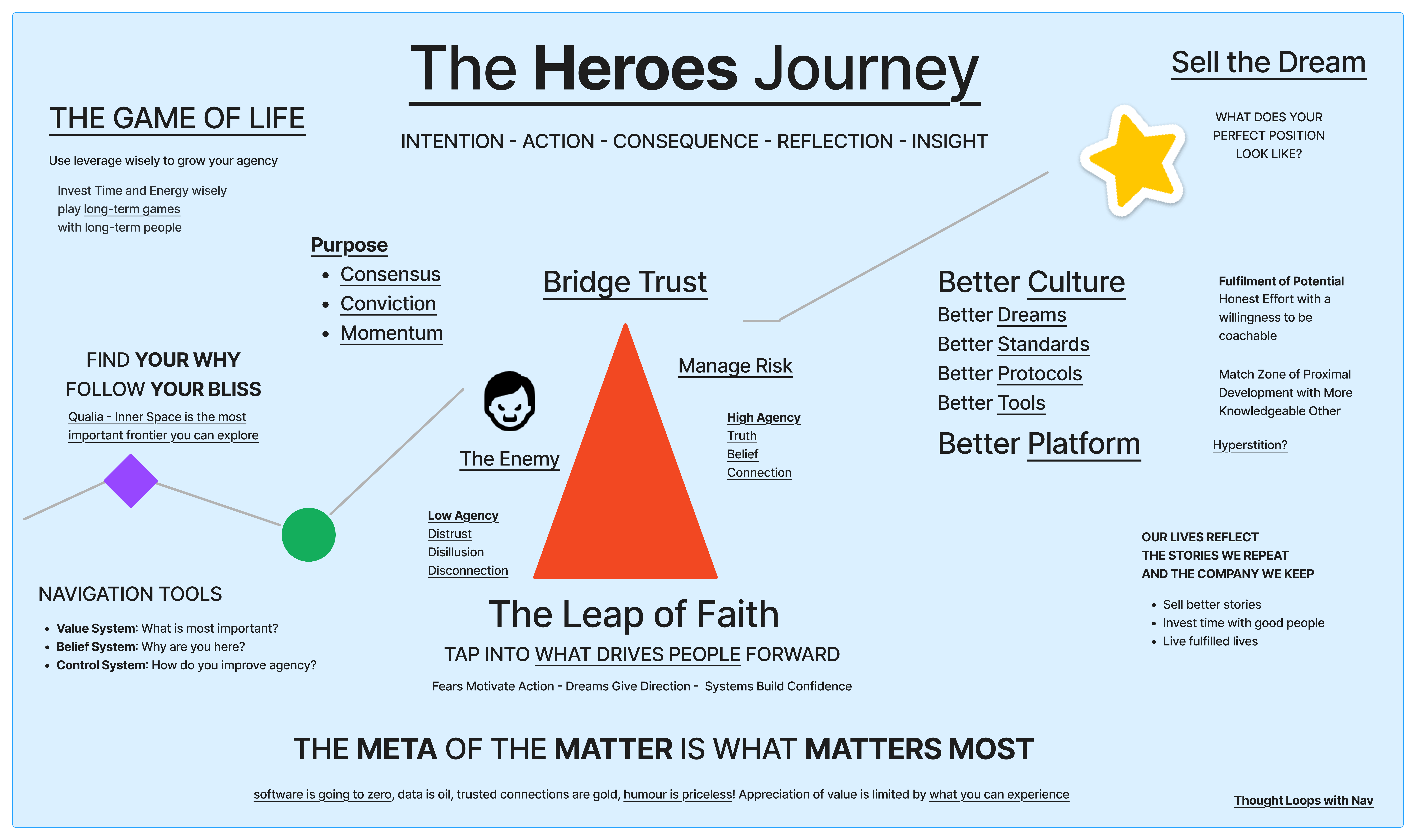
The Heroes Journey diagram is the master map. Every concept on the site finds its position here.
Reading the Map
| Zone | What It Shows | Where It Links |
|---|---|---|
| Left: The Game of Life | Where you start — find your why, follow your bliss | Play, Purpose |
| Centre: The Triangle | The Enemy within, the leap of faith, bridging trust | The Journey, Courage |
| Right: Sell the Dream | What emerges — better culture, standards, platform | Culture, Standards |
| Bottom: The Meta | The tagline — meta of the matter is what matters most | The Mycelium |
Navigation Tools
The bottom-left names the three systems that frame navigation across the entire site:
| System | Question | Maps To |
|---|---|---|
| Value System | What is most important? | Principles |
| Belief System | Why are you here? | Purpose, Predictions |
| Control System | How do you improve agency? | Standards, The Logo |
The Two States
The triangle at centre shows the crossing point. Two directions from the leap of faith:
| State | Characteristics | Direction |
|---|---|---|
| Low Agency | Distrust, Disillusion, Disconnection | Downward spiral |
| High Agency | Truth, Belief, Connection | Upward spiral |
The leap of faith: tap into what drives people forward. Fears motivate action. Dreams give direction. Systems build confidence.
The Ship
Every hero needs a vessel. The venture is the ship — the thing you build to cross the gap between fear and hope. Without a ship, the map is just a picture on a wall.
Every voyage needs five things: direction, maps, a good ship, good mates, and a compass. The ship is the platform — what holds the crew and cargo together. But a ship without maps is blind, without a compass is lost, without mates is empty. All five or nothing.
The Crew
You don't sail alone. The hero's journey is plural — the crew is what makes the ship move and the journey worth the effort.
Mateship isn't networking. It's investing in people whose values align with yours and whose capabilities complement yours. Good mates make you better under pressure, not just comfortable in calm.
| What Good Mates Do | What Bad Company Does |
|---|---|
| Challenge your pictures honestly | Agree with everything |
| Bring capabilities you lack | Duplicate what you already have |
| Stay when the crossing is hard | Leave when the wind drops |
| Share the cargo and the credit | Take the cargo and the glory |
How do you find them? Build something worth crewing. The venture attracts the mates. The mates strengthen the venture. The loop compounds.
The Destination
Right side of the map. What the ship sails toward:
Better Dreams + Better Standards + Better Protocols + Better Tools = Better Platform
Better Platform = Better Culture
Explore This
Copy this prompt into any LLM to explore the framework yourself.
Map the Heroes Journey as a systems diagram with these zones:

LEFT — "The Game of Life"
- Use leverage wisely to grow your agency
- Invest time and energy wisely, play long-term games with long-term people
- Find your why, follow your bliss
- Navigation Tools: Value System (What is most important?), Belief System (Why are you here?), Control System (How do you improve agency?)

CENTRE — "The Leap of Faith"
- Purpose emerges from: Consensus, Conviction, Momentum
- The Enemy sits at the base — representing Low Agency (Distrust, Disillusion, Disconnection)
- Bridge Trust leads to High Agency (Truth, Belief, Connection)
- The crossing point: Fears motivate action. Dreams give direction. Systems build confidence.

RIGHT — "Sell the Dream"
- What emerges when the crossing succeeds: Better Culture, Better Dreams, Better Standards, Better Protocols, Better Tools, Better Platform
- Fulfilment of potential requires honest effort and willingness to be coachable
- Our lives reflect the stories we repeat and the company we keep

The loop: INTENTION → ACTION → CONSEQUENCE → REFLECTION → INSIGHT

The foundation: "The meta of the matter is what matters most" — software is going to zero, data is oil, trusted connections are gold, humour is priceless. Appreciation of value is limited by what you can experience.

Now explore:
1. How does someone move from Low Agency to High Agency through this map?
2. What role do the three navigation systems (Value, Belief, Control) play at each stage?
3. Where do fears become fuel rather than paralysis?
4. How does "sell the dream" connect back to "the game of life" as a loop?
5. What would YOUR version of this map look like — which zones are strong, which are gaps?
Context
- The Logo — The control loop compressed into a brand mark
- The Journey — Life stages, fears, and mastery dimensions
- Culture — The ship this journey describes
- AI Problems — The fear that makes the crossing urgent
- Ventures — Ships in the water, not on the drawing board
- Situational Wisdom — Mateship that compounds
- Flow State — When the journey flows
- Matrix Thinking — The method for reading maps like this
Questions
Who is in your crew — and did you choose them, or did you just end up together?
- If the ship is the venture and the crew is the mates, what happens when you have a great crew but no ship?
- Which part of the ship is weakest — hull, sail, compass, cargo, or rudder — and what does that predict about where you'll fail?
- When the crossing gets hard, does your crew challenge you or comfort you — and which do you actually need?
- If fears motivate action and dreams give direction, what happens when you have one without the other?