The Meeting
What happens in the gap between where you are and where you want to be?
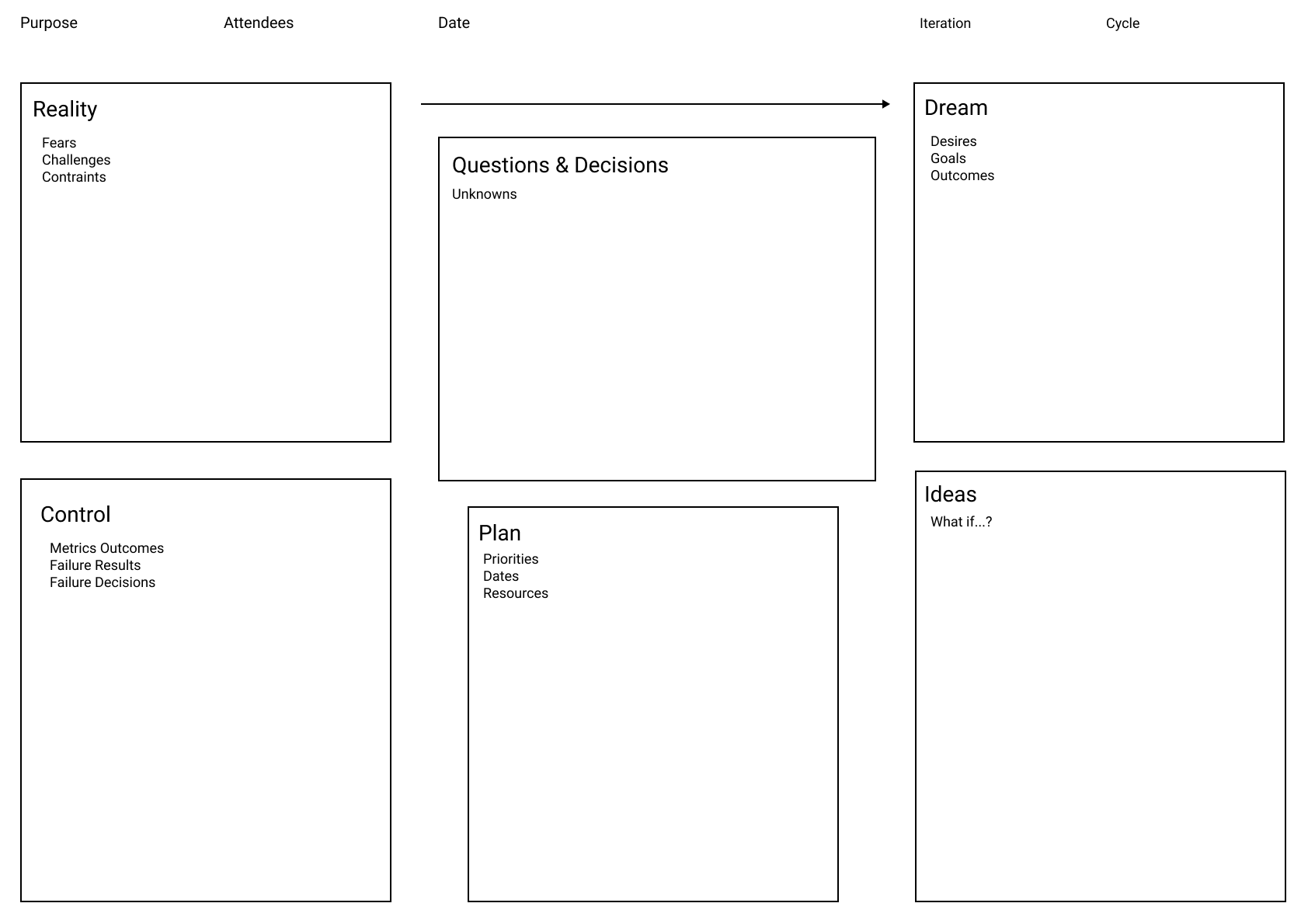
Six boxes on a page. One arrow pointing from Reality to Dream. Everything else exists to close that gap — or to discover it was the wrong gap.
The Arrow
One arrow. Reality to Dream. Left to right. That is the intention of every meeting: we are here, we want to be there. The arrow does not point back. It does not branch. Intention has one direction.
But the page has six boxes because intention alone changes nothing.
Six Boxes
| Box | Position | What Lives Here |
|---|---|---|
| Reality | Top-left | Fears, challenges, constraints. What is true right now — not what you wish were true. |
| Dream | Top-right | Desires, goals, outcomes. What "good" looks like if you could draw it on a napkin. |
| Questions & Decisions | Centre-top | Unknowns. The gap between Reality and Dream made explicit. What must be decided before anything moves. |
| Plan | Centre-bottom | Priorities, dates, resources. The engineering that bridges the gap. |
| Control | Bottom-left | Metrics, failure results, failure decisions. What happened last time — honestly. |
| Ideas | Bottom-right | What if...? Sparks that do not fit the plan yet. Protected divergence. |
The outer four boxes form a loop. Reality feeds Dream (the arrow). Dream feeds Plan (what must be built). Plan feeds Control (did it work?). Control feeds Reality (the updated truth). One cycle of the feedback loop.
The centre two boxes are the instrument — Questions & Decisions above, Plan below. The outer four are the agent's perception of where they are, where they want to be, what happened, and what might be possible.
The Header
Five fields across the top: Purpose, Attendees, Date, Iteration, Cycle.
Iteration and Cycle are the ones that matter. They make this a loop, not a one-shot. Meeting #1 fills the boxes. Meeting #2 updates them. By meeting #5, the Reality box holds truths that did not exist at meeting #1 — truths earned by running the loop.
Same structure, deeper answers. Recursion, not repetition.
The Archetypes
Each box has a natural chair:
| Box | Archetype | Why |
|---|---|---|
| Reality | Realist | Faces what is. "What does the evidence show?" |
| Dream | Dreamer | Sees the unseen. "What would make this remarkable?" |
| Questions | Philosopher | Seeks truth. "Is this the right game?" |
| Plan | Engineer | Builds the path. "What is the critical path?" |
| Control | Coach | Asks, does not tell. "What is holding you back?" |
| Ideas | Dreamer | Protects sparks. "What if...?" |
The chair changes with the box, not the meeting. A single meeting can move through all six. The skill is knowing which archetype to activate when.
The Simple Version
Three sentences. Tape them to the wall.
- Name what is true (Reality) and what you want (Dream).
- Decide what you do not know (Questions) and how you will close the gap (Plan).
- Check what happened (Control) and protect what might be possible (Ideas).
If you cannot fill the six boxes on one page, the meeting is not ready.
Explore This
Use this meeting template to run any meeting as a feedback loop:

SIX BOXES:
- Reality (top-left): Fears, challenges, constraints. What is true now.
- Dream (top-right): Desires, goals, outcomes. What good looks like.
- Questions & Decisions (centre-top): Unknowns. What must be decided.
- Plan (centre-bottom): Priorities, dates, resources. How to cross.
- Control (bottom-left): Metrics, failures, decisions. What happened.
- Ideas (bottom-right): What if...? Sparks worth protecting.

HEADER: Purpose | Attendees | Date | Iteration | Cycle

THE LOOP:
Reality → Dream (intention)
Dream → Plan (engineering)
Plan → Control (measurement)
Control → Reality (updated truth)
Ideas float freely — they feed the next cycle.

Now run your meeting:
1. Fill Reality first. Name the fears before the hopes.
2. Fill Dream. One sentence: what does done look like?
3. Centre boxes: what do you not know? What is the plan?
4. Control: what happened since last time? Honestly.
5. Ideas: what sparks emerged? Protect them. Do not evaluate yet.
6. Close: read back decisions. Who does what by when?
Context
- The Logo — The control loop compressed into four P&ID shapes
- The Tight Five — The scrum metaphor expanded across three zones
- Meetings — The protocol: before, during, after
- Archetypes — The five chairs
- Control System — Feedback architecture behind the loop