The Tight Five
Do you coach players to play positions, or reimagine positions for players?
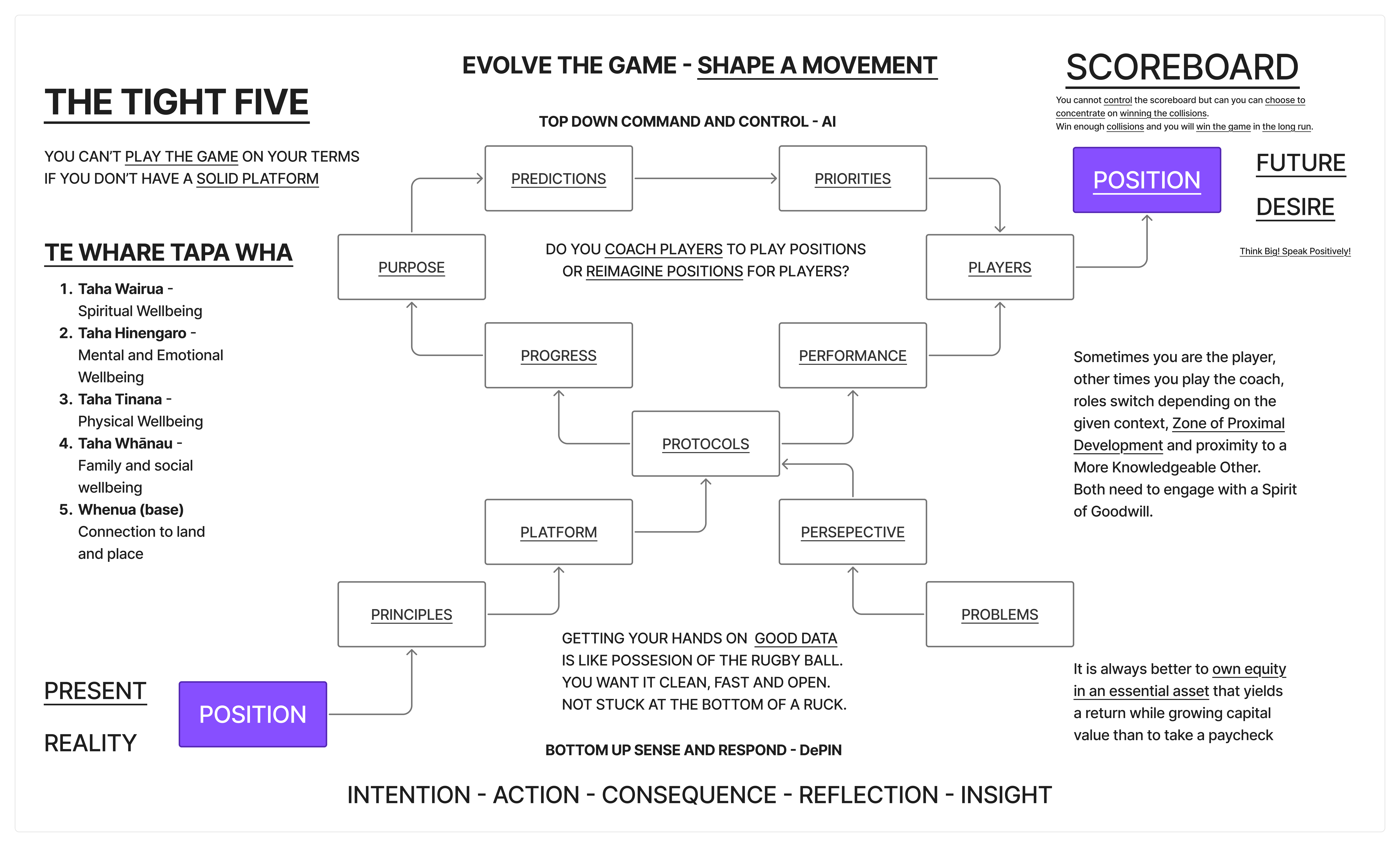
That question sits at the centre of the diagram because it is the only strategic question. Every other decision falls out of how you answer it.
The Scrum
In rugby, the tight five are two props, a hooker, and two locks. They do not score tries. They do not make highlight reels. They create the platform that lets the backs play the game they intend to play. Without the scrum, possession is contested and the game becomes reactive.
You cannot play the game on your terms if you do not have a solid platform.
This diagram maps that truth across three domains at once.
Three Zones
| Zone | What It Shows | The Question |
|---|---|---|
| Left: Te Whare Tapa Wha | Where you stand — present reality, grounded position | What is true right now? |
| Centre: The Loop | How the game moves — ten linked elements cycling through PROTOCOLS | What are you running? |
| Right: Scoreboard | Where you want to be — future desire, chosen position | What does winning look like? |
POSITION appears twice in purple. Once on the left: present, reality. Once on the right: future, desire. The gap between the two IS the game. Everything in the centre exists to close it.
Left: The Ground
Te Whare Tapa Wha — the Maori wellbeing model — is a Tight Five for being human:
| Wall | Dimension | Without It |
|---|---|---|
| Taha Wairua | Spiritual | Action without meaning |
| Taha Hinengaro | Mental | Knowledge without direction |
| Taha Tinana | Physical | Ambition without capacity |
| Taha Whanau | Social | Achievement without belonging |
| Whenua | Foundation | Everything without ground |
Same architecture, different domain. Remove one wall and the house falls. This is why agency requires all five dimensions — the same binding principle that holds a scrum together holds a life together.
Centre: The Loop
Ten elements. One cycle. Protocols at the centre holding it all in tension.
PREDICTIONS → PRIORITIES → PLAYERS → PERFORMANCE
                                          ↓
    PURPOSE ← PROGRESS ← PERSPECTIVE ← PLATFORM
                                          ↓
                     PRINCIPLES ──→ PROTOCOLS
Two forces shape the cycle. Top-down: AI — command and control, pattern recognition, prediction at scale. Bottom-up: DePIN — sense and respond, ground truth from physical infrastructure, coordination without centralisation. The tension between them is productive. Neither alone is sufficient.
The data metaphor at the base says it plainly: getting your hands on good data is like possession of the rugby ball. You want it clean, fast, and open. Not stuck at the bottom of a ruck.
Right: The Scoreboard
You cannot control the scoreboard. You can choose to concentrate on winning the collisions. Win enough collisions and you win the game in the long run.
This is the control system insight applied to outcomes. The scoreboard reads POSITION against FUTURE and DESIRE — not what happened, but what gap remains. Problems live here too. They are not obstacles. They are the collisions worth winning.
The note on player-coach duality matters: sometimes you are the player, sometimes the coach. Roles switch depending on context. Zone of Proximal Development — proximity to a more knowledgeable other, engaged with goodwill. This is how culture compounds.
The Feedback Spine
Underneath everything:
INTENTION → ACTION → CONSEQUENCE → REFLECTION → INSIGHT
This is the consciousness loop. It runs inside every cycle of the ten-element system. It runs inside every scrum engagement. It runs inside every conversation about position.
The diagram does not show a hierarchy. It shows a feedback loop — the same architecture as the logo, expanded to show what the game looks like when all positions are filled.
The Simple Version
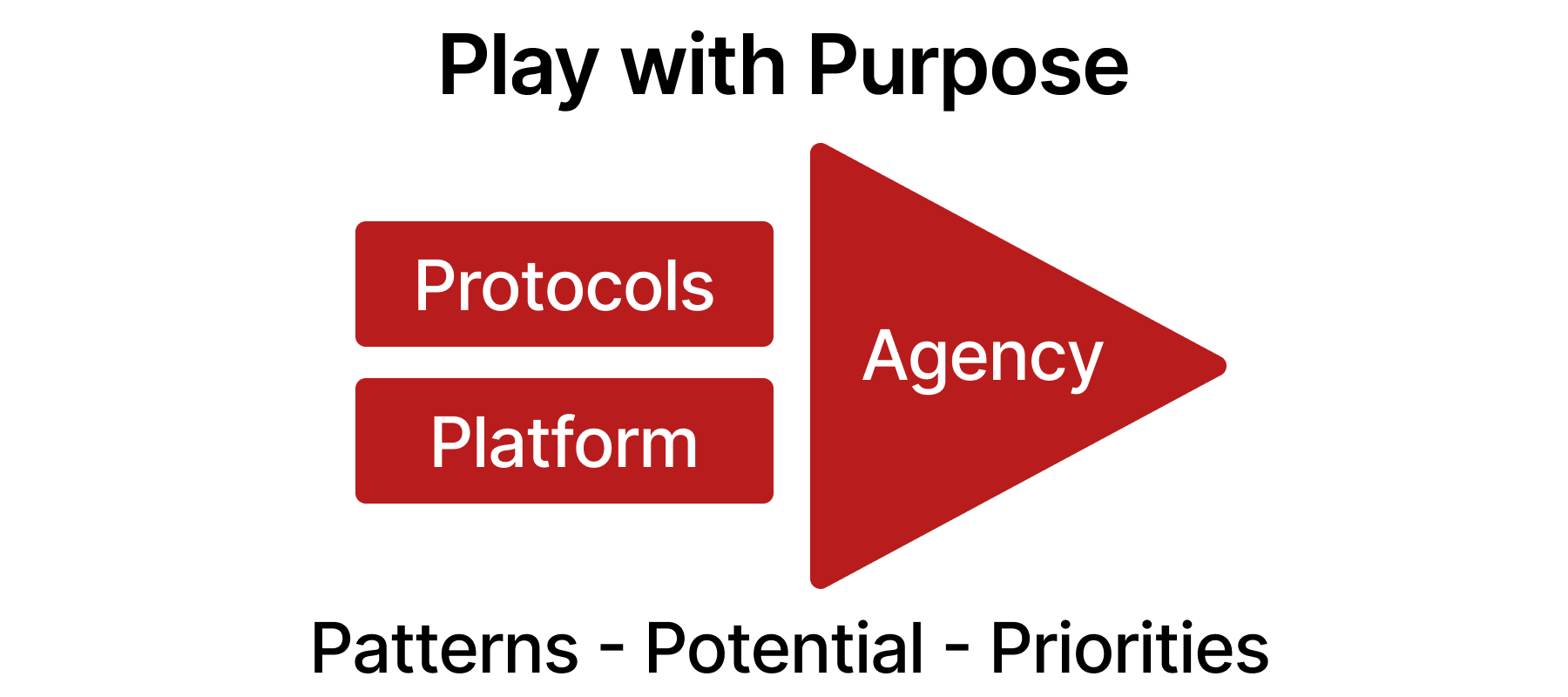
Strip everything back. Protocols plus Platform feed Agency. Patterns reveal potential. Potential sharpens priorities. The red arrow points forward.
This is the Tight Five at its most compressed: know your patterns, build your platform, play with purpose.
Explore This
Copy this prompt into any LLM to explore the framework yourself.
Map a business operating system using a rugby scrum as the structural metaphor:

THE TIGHT FIVE — five bound positions that create the platform:
- Principles (first truths), Performance (measurement), Platform (assets),
  Protocols (coordination), Players (ecosystem)

THREE ZONES:
Left — PRESENT REALITY. Te Whare Tapa Wha (Maori wellbeing model):
  Wairua (spiritual), Hinengaro (mental), Tinana (physical),
  Whanau (social), Whenua (foundation). Where you stand now.

Centre — THE LOOP. Ten elements cycling through Protocols:
  Predictions, Priorities, Players, Performance, Perspective,
  Platform, Principles, Purpose, Progress, back to Predictions.
  Top-down force: AI (command and control).
  Bottom-up force: DePIN (sense and respond).
  Central question: Do you coach players to play positions
  or reimagine positions for players?

Right — SCOREBOARD. Future desired position.
  You cannot control the scoreboard but you can win the collisions.
  Problems are the collisions worth winning.

Feedback spine: INTENTION → ACTION → CONSEQUENCE → REFLECTION → INSIGHT

Now explore:
1. Pick a domain (business, health, education, sport). What are YOUR tight five?
2. Where is the gap between your present position and desired position?
3. Which collisions are you avoiding? Which should you stop fighting?
4. Is your data clean, fast, and open — or stuck at the bottom of a ruck?
5. Are you coaching players to positions, or reimagining positions for players?
Context
- The Logo — The control loop compressed into four P&ID shapes
- The VVFL — The logo expanded into a full operating system
- Tight Five Framework — The cognitive technology: any domain, five bound elements
- Te Whare Tapa Wha — The wellbeing instance of the pattern
- Control System — Feedback architecture behind the loop
- The Tight Five (article) — The meta article that sells the framework