The VVFL
What kind of loop are you running?
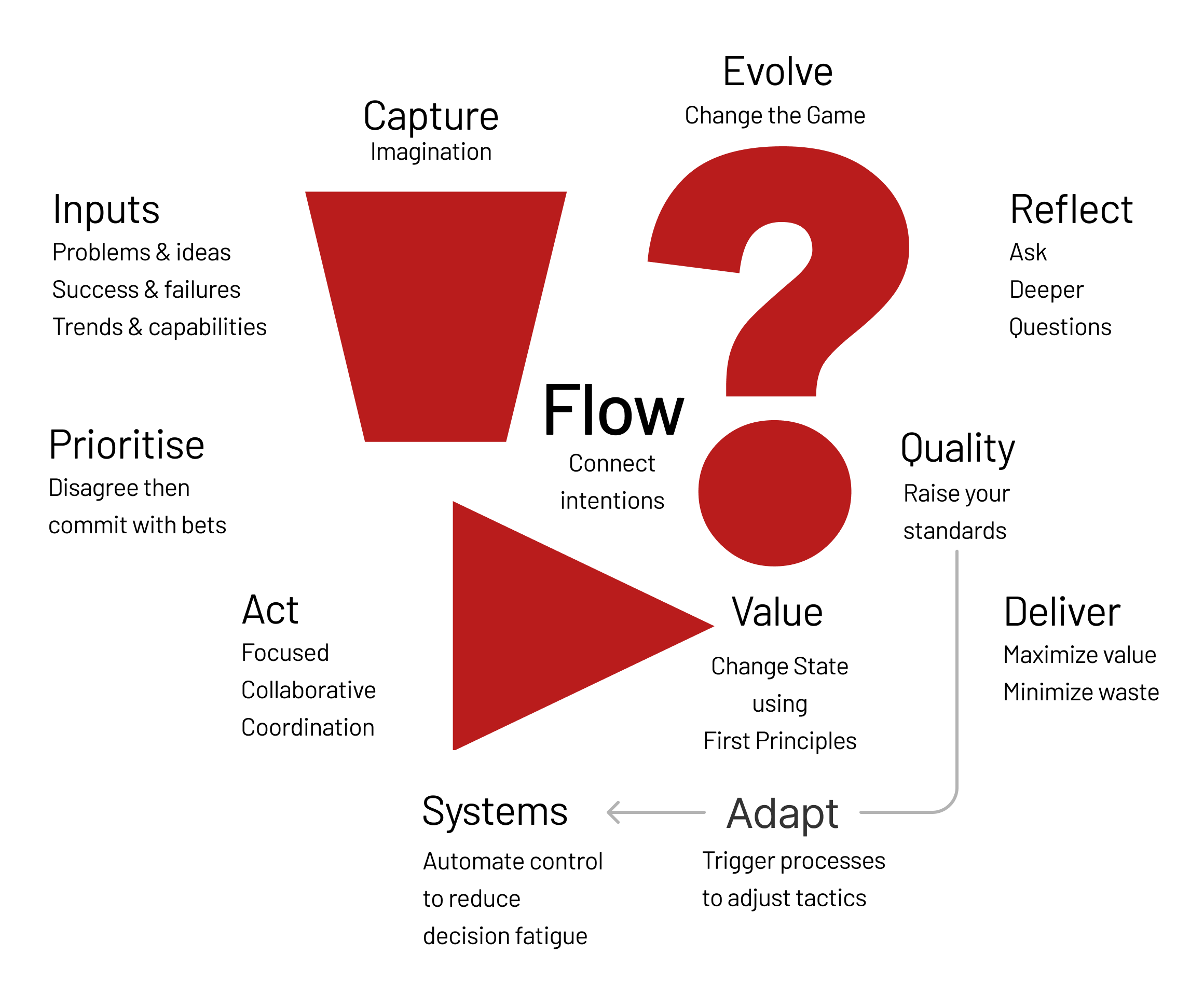
This is not a brand graphic. It is the logo expanded — every P&ID element opened to show what lives inside it. The question mark becomes a complete operating system for making better decisions faster.
Three Loops
Most people confuse these. The confusion costs them agency.
| Loop | Setpoint | Measurement | What Happens |
|---|---|---|---|
| Positive (reinforcing) | None | None | Runaway — doom scrolling, panic selling, addiction |
| Negative (corrective) | Defined | Yes | Control — but toward what? |
| VVFL | Values-aligned AND reality-tested | Validated against outcomes | Progress that compounds AND serves |
"Positive feedback" sounds like praise. In engineering it means amplification without correction — a microphone pointed at a speaker. No setpoint, no gauge, no control. Without a clear picture of what good looks like, you're a passenger.
The VVFL is the third kind. Not just corrective — validated (tested against reality, not just believed) and virtuous (the setpoint serves beyond self).
The Stations
Reading the diagram clockwise from top-left:
Capture
The hopper — where raw material enters. Inspiration, problems, ideas, signals from success and failure. Trends and capabilities flowing in.
Without capture, you run on old inputs. The system starves.
Priorities
The filter between capture and action. Disagree with integrity. Record decision logic. Commit your capital. Not everything that enters the hopper deserves the pump.
Attention
The pump — what drives flow through the system. Focused. Collaborative. Coordinated. This is where agency meets action. The pump doesn't care about quality — that's the filter's job. The pump cares about movement.
Value
Where first principles transform state. Raw attention becomes directed effort. The pump creates motion; value gives it direction.
Systems
The feedback mechanism at the base. Automate to reduce decision fatigue. Trigger processes to adjust tactics. Adapt and adjust — this is where the loop becomes self-correcting rather than one-shot.
Standards
The gauge — raise the platform. Without measurement, you can't know if the loop is working. Standards are what make improvement systematic rather than accidental. The gauge reads reality.
Distribute
Maximize benefit, minimize waste. Goodwill compounds here — what you distribute returns. This is what makes the loop virtuous rather than merely corrective. Extraction breaks loops. Distribution strengthens them.
Reflect
The controller — practice asking deeper questions. The controller reads the gauge, compares measurement to setpoint, and asks: is this where we should be? Perspective is the controller's output.
Evolve
Change the game. Not just improve within the current frame — question whether the frame itself is right. This is where the loop compounds rather than merely repeats.
The Center
Flow. Make connections.
When all stations are running clean — capture feeding priorities, attention driving value, systems enabling standards, reflection driving evolution — the center holds. That's flow state. Not luck. Architecture.
Why Not Politics?
Nobody in power wants to make decisions. They want enough votes to stay relevant. Consultancies exist because "no one ever got fired for hiring McKinsey" — outsourced accountability dressed as expertise. This is not a control system. It's a reinforcing loop of self-preservation.
Politics is what happens when systems fail.
When feedback loops break — when the gauge is ignored, the filter is corrupt, the controller is absent — you get committees, votes, and lobbying instead of measurement, correction, and progress. The idea that governments will decide how to control AI is a fantasy. The people making those decisions have spent careers distancing themselves from decisions.
| Political Loop | VVFL |
|---|---|
| Optimize for staying in power | Optimize for goodwill |
| Outsource accountability | Own the measurement |
| Enough votes to remain relevant | Enough trust to remain useful |
| Top-down control | Bottom-up coordination |
The answer is not waiting for someone to save you. The answer is talking to your neighbours. Using tokenomics and tokenisation to share ownership in important assets and distribute the value that comes from them fairly. Futarchy — backing decisions with bets rather than votes — replaces opinion with skin in the game. Building culture at the community level where feedback loops are short enough to actually work.
Intelligence is no longer a competitive advantage. AI leveled that field. Culture is. And the strongest cultures are judged by how they look after their weakest. See Governance for what happens when we try to build systems that don't fail.
The Bottom Line
Make better decisions faster.
Each cycle through the loop:
- Sharpens the questions (better inputs)
- Strengthens the filter (clearer principles)
- Focuses the pump (more directed action)
- Raises the gauge (higher standards)
- Deepens the controller (wiser reflection)
The loop doesn't guarantee good outcomes. It guarantees that each failure makes the next attempt better. That's what separates the VVFL from hope.
Context
- The Logo — The compressed version: four P&ID shapes forming a question mark
- Control System — The three types of loop: positive, negative, VVFL
- VVFL Loop — Standards as the leverage point
- Agency — The capacity the loop builds
- Flow State — What happens when all stations run clean