Critical Path
What is the shortest route to viable value?
When you find a way, make it easier for the next person to follow
Perceive: What Is the Critical Path?
The critical path is the sequence of dependent steps that determines the minimum time to reach your goal. Every project has one. Every business has one. Miss it, and everything slows down.
When you reach a critical mass of reliable systems and capable people, you can navigate and enjoy any journey.
The Idea Maze
Imagine how you will navigate through the idea maze to reaching critical mass.
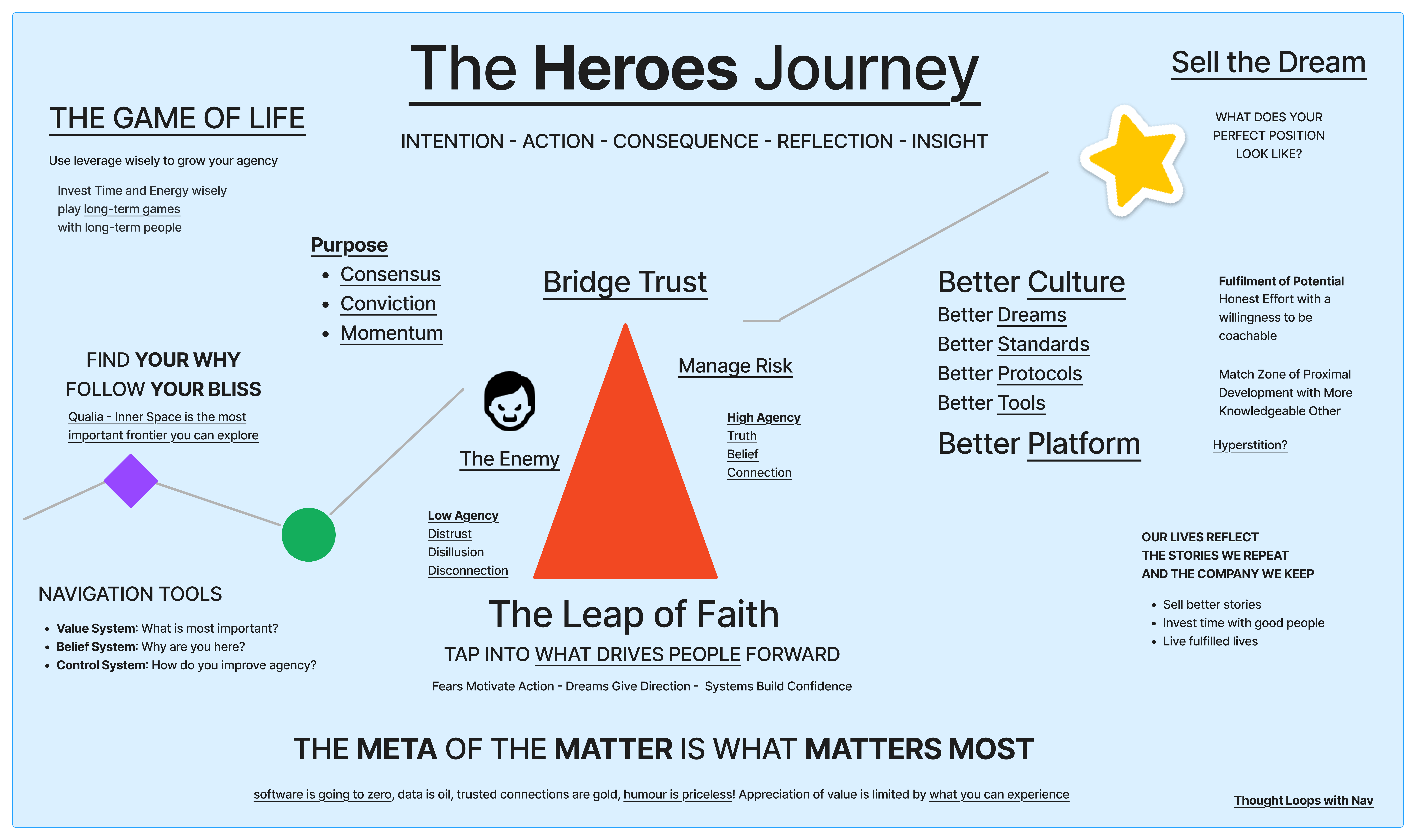
Every organisation must perpetually navigate the hero's journey facing similar challenges, doubts, triumphs and redemptions.
The epiphanies along the way are important to capture and retell to create emotional connection when selling others on the idea that there is a path to fulfilment they too can follow.
Question: Why Does Critical Path Matter?
Most paths lead nowhere. The critical path leads forward.
The Cost of Wrong Paths
- Resources spent on non-critical activities
- Delays that compound through dependencies
- Team energy dissipated on low-leverage work
- Competitors who found the path faster
The Value of Clarity
When everyone understands the critical path:
- Priorities become obvious
- Trade-offs become clear
- Focus replaces chaos
- Progress accelerates
People need to believe they are going to be OK doing what they are doing
Act: How to Find and Follow the Critical Path
1. Preparation
Clarify goals fit with Vision and Mission with outcomes aligned to Values.
Make a cashflow forecast to contrast the value of different decision options. Supplementary value analysis:
- Lessons from the bet/experiment
- Enhance relationships in the team, with suppliers and the customer
- Document insights on how to improve operations
- Minimise waste
2. Map Dependencies
Identify:
- What must happen before other things can start?
- What can run in parallel?
- What is the longest chain of dependent steps?
The longest chain is your critical path. Everything else is optional optimization.
3. Focus Resources
The critical path gets priority:
- Best people on critical tasks
- Buffer time for critical dependencies
- Clear blockers immediately
- Let non-critical work wait
4. Standardization
Schedule routine and process checks. Standardisation reduces variance on critical activities.
5. Risk Management
Ask for forgiveness, not permission.
Planning is thinking about activities required to achieve a desired goal. But plans are worthless—planning is invaluable.
Forecasting
Predictability comes from character of people, culture of teamwork, and discipline to follow best practices.
Probability assessment requires understanding:
- History
- Current state
- Future events
- Trends
Timing
Maintaining peak performance is not linear. Pick the right frequency to push into growth and then consolidate gains.
- Ebb and flow
- Ambition and consolidation
There is a time for everything, and a season for every activity under the heavens - Ecclesiastes
Checklist
- Have you mapped all dependencies?
- What is the longest chain of dependent tasks?
- Are your best resources on critical tasks?
- What blockers exist on the critical path?
- Do all stakeholders understand the path?