Tight Five Prompts
A teacher can teach a subject. A coach knows how to make you care. Your Tight Five prompts are the coach's voice — right message, right time, right reason.
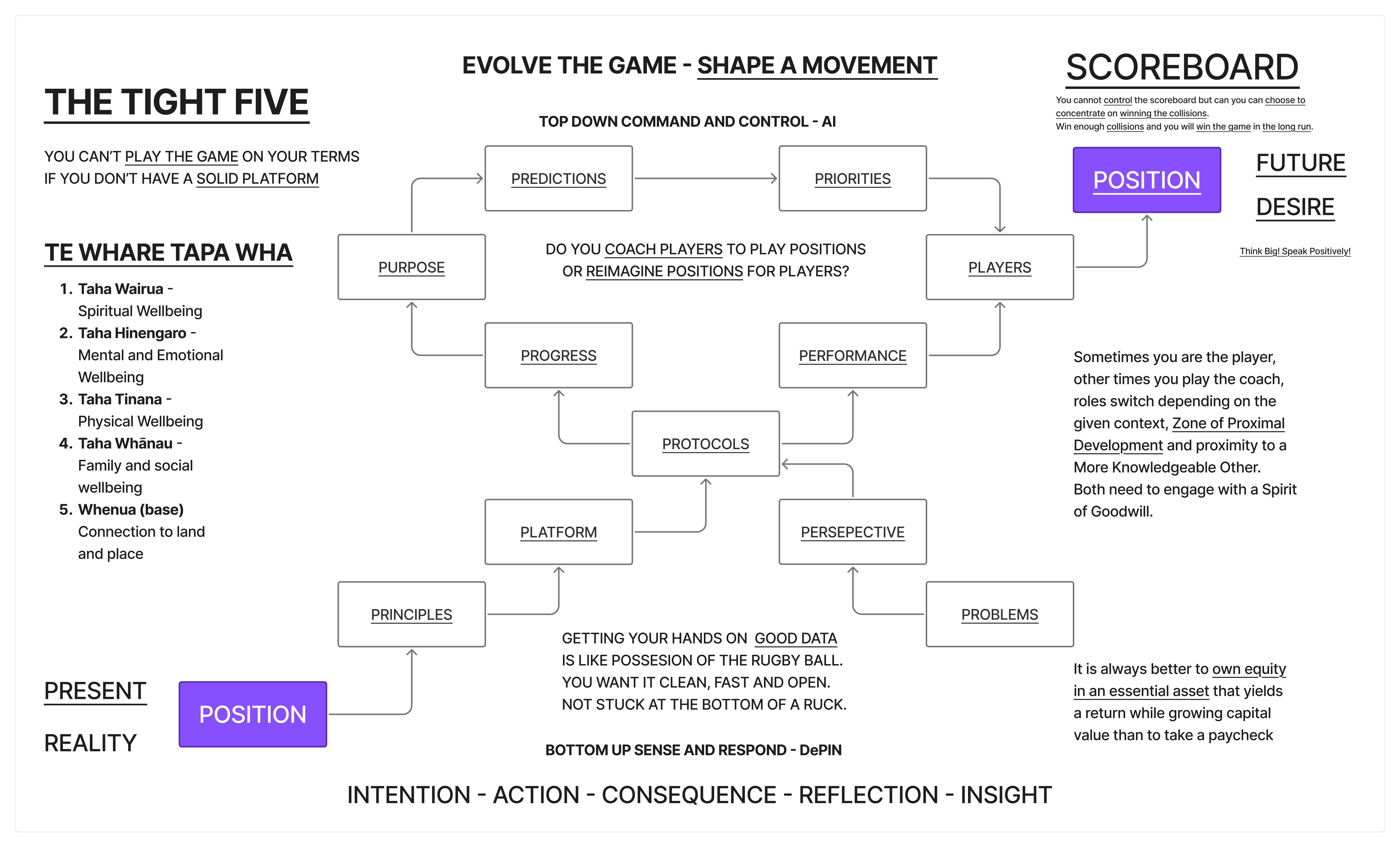
Incompressible simplicity is powerful. Same five, two modes — prepare yourself to act, then help others see why it matters. Each prompt is a fast path back to the truth with just enough context to stay in flow without info overload.
"Simplicity is the ultimate sophistication." - Leonardo da Vinci
Working Memory
What's the maximum number of things you can hold in mind and still act?
Miller's Number says seven, plus or minus two. But holding isn't acting. Five is the sweet spot — enough to capture a complete system, few enough to stay in working memory while you decide what to do next.
The Tight Five is a cognitive technology: any domain worth mastering can be compressed into five tightly-bound elements. The skill is knowing which five matter for the context you're in.
Each headline is a key, not the full lock. The five sit in working memory as surface labels. Behind each one is depth — knowledge, practice, hard-won experience. You don't hold the depth in mind. You hold the key. When the situation calls for it, you turn the key and the depth is there — because you did the work to build it.
This is why mantras compound with practice and why shallow slogans don't. A mantra that points to no depth is just noise. A mantra that is a key to real practice produces insight every time you use it under pressure.
The Tight Five prompts are your navigation instrument. You use them with the navigation system to stay on course — Value (what truly matters), Belief (where you're headed), Control (how you navigate). When you feel drift or dis-ease, the five questions locate which system is misaligned. The keys point you back.
| When you feel... | Turn this key | It opens to... |
|---|---|---|
| Lost in activity | Why does this matter? | Value — real world worth |
| Uncertain about direction | What truths guide me? | Belief — grounded intention |
| Overwhelmed | What do I control? | Control — leverage and levers |
| Undifferentiated | What do I see others don't? | Perspective — your edge |
| Busy but not progressing | How do I know it's working? | Performance — real instruments |
Meta and Matter
The Tight Five is meta — the schema that organises schemas. Different domains produce different fives. The pattern is always the same: five, tight, bound.
| Domain | The Five | What Binds Them |
|---|---|---|
| Business | Principles, Performance, Platform, Protocols, Players | Value creation |
| Wellbeing | Wairua, Hinengaro, Tinana, Whanau, Whenua | Holistic health |
| Rugby | 2 props, hooker, 2 locks | The scrum |
| Music | 4 Beatles + George Martin | The sound |
| Questions | Why? What's true? What do I control? Who's with me? Is it working? | The loop |
| Agency | Capabilities, Character, Drive, Foundations, Money | Agency |
| Rhetoric | Ethos, Logos, Pathos, Kairos, Topos | Persuasion |
| Optimism | Breaking Cycle, ABC Reframe, Luck Engineering, Stoic Balance, Daily Protocol | Training the muscle |
| Archetypes | Dreamer, Realist, Engineer, Coach, Philosopher | The swarm |
| Prompt Deck | Capture, Inquire, Design, Platform, People | The instrument |
| Forces | AI, Blockchain, Crypto, Devices, Energy | Transforming the OS |
Each instance is five. Each five is different. What makes them "tight" is the binding — remove one and the system collapses. What makes them "five" is cognitive science — beyond five, humans lose grip.
Why Tight
Three meanings. One word.
| Meaning | Origin | What It Means |
|---|---|---|
| Bound | Rugby | The tight five are bound together under pressure — remove one prop and the scrum collapses |
| Polished | Comedy | A comedian's tight five is their best five minutes — refined until every word lands, every pause earns its place |
| Incompressible | Both | Nothing can be removed without the system falling apart |
In rugby, the tight five do the unglamorous work that makes the flashy stuff possible. Without props, hooker, and locks providing the platform, the backs can't play the game they intend to play. You're reacting, not creating.
In comedy, a tight five is not a short set. It's an incompressible set. Comedians perform hundreds of times, cutting everything that doesn't land, until what remains is pure signal. That's why the best pitches sound effortless — they've been compressed until nothing remains that doesn't serve the audience.
A house with four walls and no whenua (land) falls. Four Beatles without George Martin pull apart. A business with Principles and Platform but no Players is a machine with nobody to serve.
The count isn't the point. The binding is.
Meta Defines Matter
Schemas influence ability to pay attention and learn quickly. The schema isn't describing reality — it's selecting which reality you can perceive.
| Meta | Matter |
|---|---|
| Schema | Knowledge |
| Pattern | Instance |
| Intention | Attention |
| Dream | Engineering |
| Invisible | Visible |
| The five you choose | The world you see |
The quality of your meta determines the quality of your matter. Whoever defines the organising pattern controls what becomes real.
This is why the meta of the matter, matters the most.
Instance: Business
When the domain is business, the Tight Five becomes the 5Ps:
| P | What It Is | Question | Weak Signal |
|---|---|---|---|
| Principles | Understand the truth. First truths, immutable values. | What truths guide you? | Decisions feel random |
| Performance | Good vs bad. Impact vs noise. Clarity of focus. | How do you know it's working? | Activity without outcomes |
| Platform | Assets, resources, tools, technology you can muster. | What do you control? | Dependent on others |
| Protocols | Best practice standards with available platform. | How do you coordinate? | Success doesn't compound |
| Players | Consumers, contributors, community. The ecosystem. | Who creates harmony? | Isolated agency |
This instance organises every industry analysis on the site, every meta article playbook, and the /docs/ structure itself:
| Docs Section | P |
|---|---|
| Principles | Principles |
| Performance | Performance |
| Platform | Platform |
| Protocols + Standards | Protocols |
| Players | Players |
Applied fractally: Marketing gets five subfolders. Space gets five subfolders. Countries get scored on five dimensions. Same meta, different matter.
The Sequence
The order isn't alphabetical. It's a commissioning sequence.
In process engineering, commissioning verifies a built system actually works — component by component, loop by loop. Each valve progresses through discrete states: idea → spec → drawing → procurement → installed → wired → controls proven → operating. Readiness is the weighted blend of all components at different points on that progression.
The Five P's work the same way. Commission understanding of any domain in this order:
| P | Why This Position |
|---|---|
| Principles | What's true? Without this, every downstream decision is guesswork |
| Performance | What does good and bad look like? Without this, you're building blind |
| Platform | What creates leverage? Only meaningful once you know what you're measuring |
| Protocols | How do you coordinate? Only valuable when built around performance targets |
| Players | Who does what? Only assessable against the system they operate in |
Performance second gives clarity — define what good cheese looks like before designing the pipework.
The data footprint is the commissioning instrument. Every industry is a data model. Every business function is a data model. Understanding the data model is understanding the domain. The instrument tells you which subsystems are wired, which are installed but unproven, which are still drawings.
95% of business operations are commodity — marketing, finance, HR run the same ~40 jobs dressed in different names. The mycelium shares that 95%. Your point of difference — the 5% — goes on top.
Platform for Growth
Platform is not technology. It's the stack of enabling conditions — capacity, clarity, feedback, and supporting structures — that lets agency operate. Same pattern at three scales.
| Scale | Enabling Conditions | Without It |
|---|---|---|
| Individual | Self-authorship, reflective awareness, skill base, perceived control, optionality, coherent goals | Reacting, not choosing |
| Business | Property rights, quality institutions, innovation engine, capital formation, human capital, competitive markets, trust frameworks | Planning without predictability |
| Community | Shared norms, bonding + bridging trust, dense networks, inclusive voice, social infrastructure, conflict capacity | Coordination without cohesion |
Increasing agency means increasing the set of states you can reliably move between with intention. That's the litmus test at every scale.
| Individual feeds... | Business creates... | Community reduces... |
|---|---|---|
| Innovation and entrepreneurship that drive business dynamism | Jobs, skills, and resources that expand individual options and strengthen communities | Friction and risk, making both personal agency and economic investment more effective |
The unifying principle: increase real options and feedback loops at each layer, while maintaining trust and predictability in the interfaces between them.
The data footprint is the commissioning instrument for the business layer. Te Whare Tapa Wha is the commissioning instrument for the individual layer. What's the commissioning instrument for the community layer? That's the mycelium thesis — shared substrate, no central brain, nutrients flow to where growth happens.
Instance: Platform (Investment)
When the domain is platform analysis for business investment, the Platform P itself decomposes into five:
| Element | What It Is | Invest If... | Weak Without It |
|---|---|---|---|
| Machines | Physical infrastructure that does work — servers, rigs, devices, sensors, factories, vehicles | Footprint creates local moats, economies of scale, harder to fork | Dependent on others' hardware |
| Tools | Human-usable interfaces on top of machines — UIs, CLIs, SDKs, dashboards, playbooks | Strong lock-in via workflows, high activation rate, time-to-value | Capability without adoption |
| Software | Coordinating logic — applications, agents, orchestration, smart contracts, data models | High-margin, scalable coordination layer that can become the default | Commoditized by open-source |
| Property Rights | Scarce bases of production — land, spectrum, energy, data, IP, permits, exclusive deals | Long-duration compounding leverage, ability to price access | No defensible position |
| Laws | Formal and protocol rules — jurisdiction, licenses, compliance, token treatment, governance | First-mover in clear regimes, shapes standards, higher trust bar | Regulatory risk destroys value |
Five fingers. Anyone can hold them. Anyone can sell the proposition.
| Element | Core Metric | Main Risk |
|---|---|---|
| Machines | Utilization, uptime, unit economics | Capex intensity, obsolescence |
| Tools | DAUs, retention, time-to-value | Poor UX, low adoption |
| Software | Reliability, gross margin, automation % | Technical debt, commoditization |
| Property Rights | Share of resource controlled, yield, duration | Expropriation, adverse contracts |
| Laws | Regulatory clarity, compliance cost as % revenue | Adverse regulation, enforcement |
The test: if one of these five failed badly, would you still invest? If yes, the platform thesis isn't tight enough.
Every business model and every business function of every industry demands a platform. The five elements hold whether the platform is purely physical (factory floor), purely digital (SaaS), or phygital — robots and DePIN devices bridging atoms and bits. As autonomy increases, Machines become agents and Property Rights become on-chain assets, but the five never change. The spectrum:
| Platform Type | Machines | Property Rights | Binding Force |
|---|---|---|---|
| Physical | Factories, vehicles, land | Deeds, permits, leases | Location and capital |
| Digital | Servers, cloud, compute | Data, IP, API access | Network effects |
| Phygital | Robots, sensors, DePIN devices | Tokens, on-chain assets, spectrum | Smart contracts |
This instance nests inside the Business 5Ps — Platform is the third P. The other four Ps wrap around it: Principles define what "good" looks like across all five elements. Performance measures each. Protocols coordinate between them. Players operate them.
Instance: Forces (ABCDE)
When the domain is transformative technology, the Tight Five becomes five forces reshaping the operating system of the world.
| Force | One Line | Constraint Removed |
|---|---|---|
| A — AI | Intelligence as infrastructure | Cognitive scarcity |
| B — Blockchain | Validate the truth | Trust without intermediaries |
| C — Crypto | Engineer the incentive | Coordination without gatekeepers |
| D — Devices | Bridge physical and digital | Human monopoly on physical action |
| E — Energy | Power and direction | Scarcity of power and purpose |
B and C are not the same. B is the infrastructure that enforces integrity — public ledger, immutable stored procedures, user pays. C is incentive engineering — tokenomics designed to influence behaviour. Blockchain validates the truth. Crypto motivates the action.
E binds the other four. Without energy, nothing runs. Without thought energy, nothing has direction. The contrast between biological and phygital forms: machines out-think us at ABCD, but we out-receive them at E.
Every industry is a matrix of these five forces against its frictions. The empty cell is the opportunity.
Instance: Wellbeing
When the domain is hauora (wellbeing), the Tight Five becomes Te Whare Tapa Wha:
| Element | Dimension | The Wall |
|---|---|---|
| Taha Wairua | Spiritual | Purpose, meaning, connection to something larger |
| Taha Hinengaro | Mental | Thoughts, feelings, cognitive health |
| Taha Tinana | Physical | Body, movement, material presence |
| Taha Whanau | Social | Family, belonging, relationships |
| Whenua | Foundation | Land, place, what grounds everything |
Same principle. Different five. Remove one wall and the house falls.
Instance: Questions
When the domain is self-examination, the Tight Five becomes five questions that never stop mattering:
| # | Question | Builds | Belief Gained |
|---|---|---|---|
| 1 | Why does this matter? | Clarity | I know what I'm for |
| 2 | What truths guide you? | Trust | I'm not guessing |
| 3 | What do you control? | Leverage | I have something to work with |
| 4 | What do you see others don't? | Conviction | My edge is real |
| 5 | How do you know it's working? | Agency | I can find a way |
Clarity → Trust → Leverage → Conviction → Agency. This is the inner confidence pathway — not motivation, but architecture. Each answer builds the platform for the next. When all five are tight you have the belief foundation to act without needing permission or certainty.
This inner sequence maps directly to the outer 5Cs needed for a venture to compound:
| Inner (you) | Outer (venture) | What transfers |
|---|---|---|
| Clarity — why this matters | Consensus — others see it too | Shared purpose |
| Trust — grounded in truth | Conviction — the bet is real | Belief in the thesis |
| Leverage — what you control | Commitment — deploying assets | Skin in the game |
| Conviction — your edge | Credibility — visible to others | Earned trust |
| Agency — you can find a way | Capital — resources flow toward predictable systems | Prediction earns investment |
The inner loop prepares the outer. You can't build consensus without clarity. You can't attract capital without agency. Capital is the last column because it's earned by the preceding four: a system that demonstrates consensus, conviction, commitment, and credibility can predict its own performance — and prediction is what capital buys. Better standards reduce variance. Reduced variance tightens prediction bounds. Tight predictions lower risk. Lower risk attracts capital. Each pass produces deeper answers. Recursion, not repetition. The meta article explores each in depth.
The Prompt
Five best mantras in a row. Each one shifts the mindset for the next. The sequence IS the transformation.
| Form | Audience | What Lands |
|---|---|---|
| Mantra | Self | The phrase that resets you under pressure |
| Meme | Culture | The sticky truth that spreads without explanation |
| Prompt Deck | Inner circle | The living grid where gaps become strategy |
| Pitch | Decision-maker | The incompressible case that earns the next meeting |
Situational wisdom is knowing which form, which five, which moment. The coach knows — ask, don't tell. The right question at the right time does more than the right answer at the wrong time. A prompt deck is coaching in product form — it keeps a wise head on your shoulders in times of pressure and decision fatigue.
The Instrument
The Tight Five is also a product — a prompt deck that helps people find their own five. The Time + Mind instrument closes the gap between what you intended and what actually happened. Together: the Prompt Deck aligns WHAT matters, Time+Mind closes the gap between WHAT and DID. The pattern recurses through three levels:
| Level | The Five | Output |
|---|---|---|
| Discovery | Capture, Inquire, Design, Platform, People | Ideas to explore |
| Strategic | Principles, Performance, Platform, Protocols, Players | Clarity on what and why |
| Tactical | 5 Facts → 5 Questions → 5 Answers → 5 Ideas → 1 Decision | Execution loop |
Two modes: Pep Talk (inner loop — sell yourself first) and Pitch (outer loop — align others to your vision). The first and most important sale is always to yourself. Both run on the same mechanism: listen, reflect, prompt — never tell. The instrument that turns the meta-pattern into action.
Reference implementation: the Agriculture Industry prompt deck — five slides, five questions, depth links per slide. That's what a completed prompt deck looks like.
Context
- Tight Five Loops — Every operational feedback loop on the site, collected
- Standards — Where protocols compound into predictability
- Data Footprint — The commissioning instrument
- Knowledge Schema — The data model IS the schema
- Matrix Thinking — How do you see the meta in the matter?
- The Tight Five — The article that sells the framework
- Selling — The dream side of dream engineering
- Prompt Deck PRD — The product: 5x5 alignment instrument
- Time + Mind PRD — The complement: intention vs attention
- Players — Who uses the instrument — every player wears different hats
- Mantra — The simplest prompt: one phrase that resets you
- Situational Wisdom — Right prompt, right time, right context
- Coach — Ask, don't tell — the mode that unlocks the five
- Listening — Reception before transmission
- Peter Kaufman — Mirrored reciprocation: the mechanism that makes collisions compound
- Memes — When a tight five becomes culturally sticky
Links
- ScienceDirect — Personal Agency — Capacity, clarity, feedback, supporting structures
- Stanford Encyclopedia — Agency — Self-authorship as the core of intentional action
- PMC — Personal Agency and Wellbeing — Reflective awareness and perceived control
- NZ Treasury — Drivers of Growth — Property rights, institutions, capital formation
- OECD — Business Growth Dynamics — Quality institutions and competitive markets
- Community Commons — Social Capital — Shared norms, trust, dense networks
- What Works Wellbeing — Social Capital — Bonding and bridging trust, conflict capacity
Questions
What five would you choose if you could only hold five — and would they work for both preparation and persuasion?
- When the same five serves as mantra (inner) and pitch (outer), what does that reveal about the quality of the compression?
- If the count isn't the point but the binding is, how do you test whether your five are truly tight?
- What changes when you stop telling people your five and start listening for which five they need?
- Which of the three platform layers — individual, business, community — is your weakest enabling condition, and what does that predict about where growth stalls?